Showing posts with label Chicago. Show all posts

Balistrieri, Frank P. (1918-1993)

b. Milwaukee, May 27, 1918.
d. Milwaukee, Feb. 7, 1993.

Frank Peter Balistrieri was the best known of Milwaukee's Mafia bosses and the most targeted by law enforcement.

Balistrieri was also the first local Mafia boss who was born in the United States. He was born in Milwaukee in 1918, the son of immigrant Mafiosi Joseph Balistrieri of the Town of Aspra near Santa Flavia, Sicily. He grew up in the city's Third Ward "Little Sicily" neighborhood around the intersection of Jefferson and Detroit Streets. (Detroit Street was later renamed St. Paul Avenue.)

FBI heard conflicting reports about Balistrieri's selection as boss. Some said that Alioto had trained him for the post through years and handed him the reins in December 1961 or January 1962. Others said that Alioto went into retirement at that time opposed to the idea of Balistrieri becoming boss, preferring someone older and more experienced. (FBI heard that Alioto was angered by a Balistrieri romantic relationship outside of his marriage to Alioto's daughter.)

As Balistrieri advanced in the local Mafia, he opened night clubs and gambling spots and attempted to monopolize jukeboxes and coin-operated vending machines. The success of one of his gambling ventures brought him into conflict with boss Sam Ferrara in 1952. Ferrara wanted a piece of the Balistrieri-run Ogden Social Club gambling hall. When Balistrieri resisted, Ferrara ousted him from the crime family.

Balistrieri's father-in-law John Alioto, a capodecina in the Milwaukee organization, brought a protest to the leaders of the Chicago Outfit. Since the establishment of the Mafia's Commission system in the early 1930s, Chicago had been responsible for overseeing Milwaukee. Outfit bosses ruled that Ferrara exceeded his authority and ordered him to step down. The Outfit then installed Alioto as the new boss.

Alioto reportedly groomed Balistrieri as his successor but seems to have had second thoughts as he retired in 1961-62. Alioto was upset by a Balistrieri romantic relationship outside of his marriage to Alioto's daughter. The break between the two men became so severe that Alioto did not attend the funeral of Balistrieri's father in 1971.

As boss, Balistrieri sought to increase the crime family's wealth and influence by assessing a street tax on gambling racketeers and a number of legitimate businesses. He brought in Joseph Gurera and Buster Balestrere from Kansas City (the Balistrieris of Milwaukee and the Balestreres of Kansas City are related) to enforce that protection racket.

He angered segments of his organization by elevating the newcomer Gurera to capodecina rank, as well as by doing away with the "sagia," a leadership panel used by Alioto for dispute resolution, and by acting in an autocratic manner. Balistrieri was protected against rebellion through his close relationship with Chicago Outfit leaders, particularly Felix "Milwaukee Phil" Alderisio.

He could not protect himself against the U.S. government, however. In the late 1960s, he was sentenced to two years in federal prison for tax evasion. In the 1980s, his participation in extortion and Las Vegas casino skimming rackets were exposed. In 1984, he was sentenced to thirteen more years in federal prison. (His sons, Joseph P. and John J. Balistrieri, were also convicted of extortion and served time in federal prison.) During this imprisonment, Balistrieri's brother Peter stood in for him as acting boss.

Frank Balistrieri was released from federal prison at Butner, North Carolina, in 1991. He died of a heart attack in 1993.

Sources:
  • "Balistrieri given 13 years," Oshkosh WI Northwestern, May 30, 1984, p. 3.
  • "Balistrieri goes to grave denying being mob boss," Fond du Lac Commonwealth Reporter, Feb. 8, 1993, p. 2.
  • "Feds clean up union," Oshkosh WI Northwestern, Aug. 25, 1996, p. 15.
  • "Genealogy search," Archdiocese of Milwaukee Catholic Cemeteries, cemeteries.org.
  • Joseph Balistrieri Naturalization Petition, U.S. District Court for Eastern District of Wisconsin, Vol. 111, No. 15152, certificate no. 5199880, filed May 20, 1941, approved July 17, 1941.
  • Le Grand, Alexander P., "La Cosa Nostra," FBI report, file no. 92-6054-640, NARA no. 124-10287-10189, May 28, 1964.
  • Reed, Carlyle N., "La Cosa Nostra," FBI report, file no. 92-6054-2105, NARA no. 124-10293-10341, Sept. 11, 1967.
  • Schmitt, Gavin, Milwaukee Mafia: Images of America, Charleston: Arcadia Publishing, 2012.
  • Schmitt, Gavin, The Milwaukee Mafia, Fort Lee NJ: Barricade Books, 2014
  • Social Security Death Index, 388-18-0128, died Feb. 7, 1993.
  • United States Census of 1920, Wisconsin, County of Milwaukee, City of Milwaukee, Enumeration District 42.

See also:

Alioto, John (1888-1972)

b. Porticello, Santa Flavia, Sicily, Aug. 25, 1888.
d. Milwaukee, Aug. 27, 1972.

Alioto was the only boss of the Milwaukee Mafia to be installed by forces outside of the crime family. His reign marked the return to power of a faction originating in Santa Flavia, Sicily, after a quarter-century of diminished status.

After reaching Milwaukee in the 1900s, Alioto advanced through the local Outfit and formed alliances within the Santa Flavia faction. He served time in prison in the 1930s, following convictions for forgery and larceny. He and his wife Catherine raised a large family on Van Buren Street.

Two younger Mafiosi married into the Alioto family: Joseph Caminiti (a former Aiello Mafia member in Chicago who fled to Milwaukee following the unsuccessful war with Capone) married his daughter Mary; Frank Peter Balistrieri married his daughter Antonina "Nina."

A pivotal moment for Alioto and the Milwaukee Mafia occurred in 1952, when then-boss Sam Ferrara quarreled with Alioto son-in-law Frank Balistrieri. The cause of the quarrel reportedly was a Ferrara effort to acquire an ownership share in Balistrieri's Ogden Social Club gambling hall. Irritated by Balistrieri's resistance, Ferrara expelled Balistrieri from the Milwaukee Mafia. This briefly fractured the Milwaukee underworld and caused the involvement of Chicago Outfit leaders, responsible for overseeing Milwaukee under the Commission system established in the early 1930s.

A panel of Chicago gangsters - the FBI reported Anthony Accardo, Rocco Fischetti and Sam Giancana took part - ruled that Ferrara had abused his authority. The Chicagoans demoted Ferrara and installed John Alioto as new boss. The decision of Chicago Outfit leaders restored the power of the Milwaukee Mafia's founding Santa Flavia faction.

The Alioto administration included underboss Joe Gumina and lieutenants Mike Mineo, Pasquale Migliaccio, John DiTrapani and Frank Peter Balistrieri (restored to Mafia membership following the removal of Sam Ferrara as boss). During his reign, disputes within the family were resolved by a leadership panel, called "sagia."

Shortly after becoming boss, Alioto was faced with an insurrection. John DiTrapani, relative and godson of ex-boss Sam Ferrara, plotted with Frank LoGalbo and Jack Enea to take control of the crime family. The rebellion was put down with the murders of John DiTrapani and Jack Enea in 1954. Frank LoGalbo avoided a similar fate by quickly transfering out of the Milwaukee crime family and into a Chicago Outfit regime in Chicago Heights. He continued to reside in Milwaukee under Chicago protection.

It appears that Joseph Caminiti became an Alioto lieutenant following the murder of DiTrapani.

Alioto entered retirement around December 1961 or January 1962. Frank Balistrieri succeded him as boss. Alioto died of natural causes in 1972 at the age of 83. Following a funeral Mass at St. Rita's Church, he was buried at Holy Cross Cemetery.

Sources:
  • "Balistrieri goes to grave denying being mob boss," Fond du Lac Commonwealth Reporter, Feb. 8, 1993, p. 2.
  • "Death notices," Milwaukee Sentinel, Aug. 28, 1972, p. 14.
  • "Executive clemency denied 74 Badger state prisoners," Green Bay WI Press-Gazette, June 30, 1936, p. 19.
  • Le Grand, Alexander P., "La Cosa Nostra," FBI report, file no. 92-6054-640, NARA no. 124-10287-10189, May 28, 1964.
  • Reed, Carlyle N., "La Cosa Nostra," FBI report, file no. 92-6054-2105, NARA no. 124-10293-10341, Sept. 11, 1967.
  • Social Security Death Index, 387-40-5134, Aug. 1972.
  • United States Census of 1920, Wisconsin, Milwaukee County, City of Milwaukee, Ward 3, Enumeration District 40.
  • United States Census of 1930, Wisconsin, Milwaukee County, City of Milwaukee, Ward 3, Enumeration District 26.
See also:

Tropea, Orazio (1880-1926)


Born Catania, Sicily, April 29, 1880.
Killed Chicago, IL, Feb. 15, 1926.

Once a feared enforcer and collector for the Chicago Mafia led by the Genna brothers, Tropea became a key figure in an anti-Genna rebellion. He paid the ultimate price for his betrayal.

Born in 1880, Tropea left a wife and children behind in Catania, Sicily, when he traveled to the U.S. in 1909. After some time with relatives in New York City, he moved on to Buffalo, New York. He became romantically involved with Buffalo resident Helen Brown around 1916. A son Lawrence was born to the couple in 1917.

In June 1919, Tropea was among a number of U.S. Mafiosi who sent floral offerings to Buffalo boss Giuseppe DiCarlo following the death of DiCarlo's wife. Also sending flowers were Joseph Aiello of Utica, New York (later of Chicago), John Vitale and Gaspare Milazzo of Detroit and others from across the country.

Tropea became husband to two wives when he married Brown in 1920. A short time after that, he relocated to Chicago and joined the Mafia organization commanded by the "Terrible Gennas." Helen and Lawrence accompanied him to Chicago but later returned to stay with Helen's family in Buffalo.

An application for travel papers was filed by Tropea in summer 1924. At that time, he made a number of false and questionable claims. The application stated he arrived in the U.S. in April 1920 aboard the S.S. Conte Russo. That date was years later than his actual arrival and involved a ship that did not sail its maiden voyage until 1922. He stated that his address was 1022 Taylor Street in Chicago. Such an address was unlikely, as 1022 Taylor was the location of the Italian-American Educational Club that served as Genna headquarters. It also appears that, despite his two wives, Tropea indicated on the application that he was single.

Two wives were not yet enough for Tropea. Around 1923-1924, he began a relationship with a Chicago teenager, Beatrice Gould. He reportedly wished to marry Beatrice, but her parents would not permit it.

There was considerable turmoil following the death of Chicago's highly regarded gangland statesman Michele Merlo in November 1924. The Genna leadership was devastated in the violence that followed. In just two months of 1925, three of the Genna brothers were killed. Angelo Genna was shot to death while at the wheel of his roadster on May 26. Mike met his end on June 13 following a chaotic shootout with other gangsters and police. Tony was fatally shot July 8 at Grand Avenue and Curtis Street, while shaking the hand of a mysterious gangland figure known as "Cavallero."

Cavallero, later identified as Antonio Spano, was a disgruntled former Genna gunman, who joined Samuzzo "Samoots" Amatuna in an anti-Genna rebellion.

As a result of the gunfight in which Mike Genna was killed, Genna gunmen John Scalisi and Albert Anselmi were charged with the murder of a police officer. (There was widespread suspicion that Scalisi and Anselmi were in the process of betraying their Genna bosses to side with the Chicago Heights-based forces of "Cavallero" and intended to kill Mike Genna themselves on the day a police bullet caused his death.) Orazio Tropea was assigned the task of raising money for the Scalisi-Anselmi defense fund.

He went about the job by terrorizing local Italian merchants into making large cash donations. As the case involved several trials and a couple of appeals, Tropea conducted multiple rounds of strong-arm collections for the defense fund. The oppression was so great that Sicilians in Chicago referred to Tropea as "The Scourge."

Being squeezed more than once by Tropea did not sit well with a Genna in-law, Henry Spingola. While Spingola was generous in the opening round of collections, accounts say he made a far smaller contribution later. Spingola was murdered in January 1926 after playing cards with Tropea at Amato's Restaurant on Halsted Street. It quickly became apparent that Tropea had signaled the gunmen who killed the popular and well-connected Spingola.

Making matters worse for Tropea were rumors that he was keeping a good percentage of the defense fund donations for himself (preparing to fight a U.S. government effort to have him deported) and that he was secretly in league with "Cavallero."

Tropea was living comfortably under the assumed identity of "O. Trayers" at the Congress Hotel, apparently paying his bill from Scalisi-Anselmi defense moneys. He had been entertaining his girlfriend Beatrice Gould at that hotel. Press accounts said her last visit there was on February 13, 1926 - two days before Tropea's murder.

At the end, Tropea was left with few friends and numerous enemies. The people who may have wanted him dead included the Gennas and Spingolas, the family of Buffalo's Helen Brown, the family of Chicago's Beatrice Gould, his in-laws in Sicily, Chicago businessmen who had been repeatedly terrorized into providing money for what looked to be Tropea's personal slush fund and, possibly, Cavallero and other allies of Scalisi and Anselmi.

On the evening of February 15, 1926, Tropea stepped off an eastbound streetcar at South Halsted and West Taylor Streets. As he crossed Halsted, an automobile came up and stopped abruptly just before striking him. Tropea shouted at the driver. There was no spoken response. The car pulled alongside Tropea. A man with a double-barreled shotgun emerged from the vehicle, put the end of the weapon to Tropea's head and fired.

Chicago's gangland skipped the usual spectacular funeral in Tropea's case. News of his death was received with relief throughout Chicago's Sicilian communities.


Address book

The murder exposed connections among Mafiosi across the U.S.

In Tropea's possession at the time of his death, police found $975 in cash, a large diamond ring and a book containing addresses and telephone numbers. The Chicago Tribune published the contents of that book. A number of the entries are discussed below:
  • Caterina Amara (reported as "Catherina Anara" in the newspaper) was the wife of Joe Aiello. They married in Buffalo in 1917. After spending some years in Utica, New York, Aiello moved into Chicago and eventually became boss of the local Mafia there.
  • Tony Lombardo was a local businessman and president of the Mafia-linked Unione Siciliana organization. Lombardo was angry to be connected in the press with Tropea. He said Tropea had his address and phone number merely because Lombardo had once sold a restaurant to him.
  • Sam Lovullo was a member of the Mafia of Buffalo, living on Efner (the newspaper reported it as "Epnor") Street in that city.
  • Amato Mongelluzzo ran the restaurant on South Halsted Street where Henry Spingola played his last game of cards.
  • James Palese of Detroit may have been the same Palese who corresponded with his cousin Nino Sacco during Sacco's 1910s imprisonment for interstate transportation of women for immoral purposes.
  • Sam Pollaccia of Brooklyn, the only New York City resident to appear in the book, was a trusted aide and close friend of Mafia boss of bosses Salvatore D'Aquila before giving his support to D'Aquila's rival Giuseppe "Joe the Boss" Masseria. Pollaccia was the traveling companion of Brooklyn gang leader Frankie Yale during a 1924 visit to Chicago. Both men were suspected of involvement in the murder of Chicago's Dean O'Banion.
  • Giuseppe Siragusa (the newspaper interpreted the scribbled letters of his surname as "Louognino") served as boss of the Mafia in western Pennsylvania.


After death

Helen and Lawrence
The Brown family of Buffalo tried to have Tropea's remains transported to Buffalo, so he could be buried in the community where his (U.S.) wife and child resided. Helen Brown and her nine-year-old son Lawrence visited Chicago and tried in vain to persuade funeral director Michael Iarussi to have Tropea buried in Buffalo. The Browns did not have money to finance the transport and burial.

Chicago Police Captain John Stege spoke with Brown. While she and Tropea were living in separate cities, she told the police captain that Tropea visited her four times in recent months and regularly sent her money.

Stege also interviewed Beatrice Gould. He learned that Tropea and Gould recently had been living together as man and wife, that Tropea's legal wife in Sicily had died several years before (it appears that Stege was unable to confirm this) and that the gangster had a twenty-one-year-old son and an eighteen-year-old daughter in Sicily.

Orazio Tropea was buried February 20 in Chicago without ceremony or flowers. His casket was paid for with $300 of public funds. His only mourners were Beatrice Gould and her brother Donald. Beatrice wore a black veil and a mink coat Tropea gave her.

The Chicago Tribune noted, "What following Orazio had died with him. To have shown either sympathy or loyalty would have marked them for death also, was the word that went around."

Related:

Sources:
  • "Deportation or death seen as gangster fate," Chicago Tribune, Feb. 17, 1926, p. 2.
  • "Feudist's death may renew war," Decatur IL Herald, May 27, 1925, p. 1.
  • "Feudists slay Sicilian ally of Genna gang," Chicago Tribune, Feb. 16, 1926, p. 1.
  • "Fight to free city of thugs given impetus," Belvidere Daily Republican, Feb. 16, 1926, p. 1.
  • "One dead in gang fight," DeKalb IL Daily Chronicle, Feb. 16, 1926, p. 1.
  • "Orazio the 'Scourge' buried without friends or clergy," Chicago Tribune, Feb. 21, 1926, p. 4.
  • "Rival loves weep for Orazio but his real widow is sought," Chicago Daily Tribune, Feb. 18, 1926, p. 3.
  • "Say man killed in Chicago son-in-law of Buffalo woman," Buffalo Daily Courier, Feb. 17, 1926, p. 16.
  • "Sicilian gang kills again," Chicago Tribune, Feb. 22, 1926, p. 1.
  • "Son-in-law is killed by gang in Chicago row," Buffalo Morning Express, Feb. 17, 1926.
  • "Trace Sicilian killers in fight for deportation," Chicago Tribune, Feb. 18, 1926, p. 3.
  • Herrick, Genevieve Forbes, "New rich rum chief slain by gunmen in car," Chicago Tribune, May 27, 1925, p. 2.
  • Hunt, Thomas, and Michael A. Tona, DiCarlo: Buffalo's First Family of Crime, Vol. I - to 1937, 2013.
  • Manifest of the S.S. La Gascogne arrived New York City Feb. 1, 1909.

Calabrese, Frank (1937-2012)

b. Chicago, IL, March 17, 1937.
d. Butner, NC, Dec. 25, 2012.

An administrator, loan shark and hit man for the Chicago Outfit for many years, Frank J. "Frankie Breeze" Calabrese was put permanently behind bars following the "Family Secrets" case of 2007.

Calabrese was born on Chicago's West Side to James and Sophia Calabrese on March 17, 1937. His early childhood was spent on Chicago's West Erie Street.

Beginning his criminal career as a teenager, Calabrese was convicted and imprisoned for possession of stolen cars in 1954. Calabrese was back in the streets and running a lucrative loan sharking enterprise by the early 1960s. In that period, he became a protege of the Chicago Outfit's South Side boss Angelo "the Hook" LaPietra. His loan sharking operation continued into the 1990s, as Calabrese grew in importance within the Outfit.

On July 28, 1995, Calabrese and eight members of his underworld crew - including several relatives - were indicted for racketeering, conspiracy, extortion, mail fraud, witness tampering and impeding the IRS. Federal prosecutors said the group operated an extensive loan sharking racket in the Chicago area, using threats and violence in the course of business. Calabrese pleaded guilty and was sentenced to a long term in federal prison.

Calabrese's son, Frank Jr. also pleaded guilty and went to prison in the loan sharking case. During their time in prison, Frank Jr. began cooperating with federal authorities and helped assemble evidence that was used against Calabrese and other Outfit leaders in the Family Secrets trial of 2007. Frank Jr. wore a "wire" during some prison conversations with his father.

Calabrese was convicted of racketeering and racketeering murders in the 2007 trial. Witnesses against him included his son Frank Jr. and his brother Nick. Calabrese took the stand in his own defense, admitting to loan sharking but denying membership in the Outfit and participation in killings.

The jury found him guilty of involvement in seven killings. His victims were racketeer Michael Albergo (disappeared in 1970), trucking executive Michael P. Cagnoni (car bomb 1981), informant ex-mobster William E. Dauber and his wife Charlotte Dauber (shotgunned 1980), racketeer and former union business agent John Fecarotta (shot 1986), bar owner Richard Ortiz and his friend Arthur Morawski (shotgunned 1983). The jury could not reach a decision on six other killings Calabrese was accused of taking part in.

Two other Outfit leaders, James Marcello and Joseph Lombardo, along with codefendants Paul Schiro and Anthony Doyle also were convicted of racketeering conspiracy in the case. Marcello and Lombardo were convicted of racketeering murders.

Calabrese was sentenced January 30, 2009, to life in prison.

In early April, Calabrese and three others convicted in the "Family Secrets" case were ordered to pay more than $24 million in fines and restitution to the families of their victims. Part of Calabrese's debt was paid in March of the following year, when FBI agents executed a search warrant at the former Calabrese home in Oak Brook and discovered a secret compartment in the wall behind a framed collection of family photographs. Envelopes in the compartment were found to contain $728,000 in cash. The compartment also held one thousand pieces of jewelry (many still in store display boxes or with price tags still attached), seven firearms, twelve audio microcassettes and a collection of handwritten notes and ledgers.

Frank Calabrese, Sr. died December 25, 2012, at the Federal Medical Center of Butner Federal Correctional Complex in North Carolina. He was seventy-five.

Prison officials said he had been in poor health, with heart disease and other afflictions. Calabrese, himself, outlined an assortment of medical problems, including an enlarged heart, during his 2009 sentencing hearing.

There were reports that Calabrese had been seriously ill for more than a year. His attorney told the Chicago Tribune that Calabrese had been taking seventeen different medications for a variety of health problems.

The attorney, Joseph Lopez, recalled Calabrese as "quick-witted, smart and street-savvy." He said his client was "difficult at times because he was used to getting his way."

Lopez said Calabrese's Christmas Day death felt "odd" because that day was Calabrese's favorite holiday: "He always talked about how much he loved spending Christmas with his family."

Sources:
  • Coen, Jeff, Liam Ford and Michael Higgins, "10 murders laid at feet of 3 in mob," Chicago Tribune, Sept. 28, 2007.
  • Donato, Marla, "Cicero revisits '83 double slaying," Chicago Tribune, April 12, 2000.
  • Koziol, Ronald, and John O'Brien, "A deadly trick for mob figure," Chicago Tribune, Sept. 16, 1986, p. 19.
  • O'Brien, John, and Lynn Emmerman, "Mob violence: Bullets riddle hit man, wife," Chicago Tribune, July 3, 1980, p. 1.
  • Unger, Rudolph, and Philip Wattley, "Radio-control bomb kills suburbanite," Chicago Tribune, June 25, 1981, p. 1.
  • United States Census of 1940, Illinois, Cook County, Chicago, Ward 28, Enumeration District 103-1767.
  • Weber, Bruce, "Frank Calabrese, 75, hit man for the mob in Chicago," New York Times, Dec. 27, 2012, p. 22.
  • "A look at 18 murders detailed in mob case," Rock Island Dispatch-Argus, Sept. 11, 2007.
  • "Chicago Crime Commission calls FBI raid on Calabrese home major blow to organized crime," Prnewswire.com, March 28, 2010.
  • "Frank Calabrese, notorious Chicago mob hit man, dies in prison, authorities, say," CBS News, Dec. 27, 2012.
  • "Members of 'street crew' indicted Norther District of Illinois," United States Attorneys' Bulletin, September 1995, p. 304.
  • "Mob hitman Frank Calabrese Sr. dies in prison," Chicago Tribune, Dec. 26, 2012.

Alex, Gus (1916-1998)

Born Chicago, IL, April 1, 1916.
Died Lexington, KY, July 24, 1998.

Gus Alex, the son of Greek immigrants, became a key figure in the Italian-dominated Chicago Outfit. He was a longtime gambling rackets boss for the Outfit and became a part of a 1970s Outfit leadership panel that included Anthony Accardo and Joseph Aiuppa.

In his youth, Alex became familiar with Chicago crime figures. His father's restaurant at 26th Street and Wentworth Avenue was reportedly popular with bosses Al Capone and Frank Nitti. Early in Alex's underworld career, he is believed to have served as an Outfit hit man. He became a trusted aide to Accardo during the 1940s.

He was once arrested in connection with the murder of a gambler shotgunned to death in 1947. Though the victim's deathbed statement indicated Alex was his killer, Alex was no convicted of the murder.

Alex worked closely with underworld financial wizard Jake Guzik and political "fixer" Murray Humphries. In the 1950s, he rose to command rackets within Chicago's Loop. He became the Outfit's top "fixer" after Humphreys' death in 1965, commanding the "connection guys," who established and maintained underworld connections to legislators and judges.

He reluctantly joined the mob's leadership group for several years in the 1970s, before retreating back to less visible roles.

He was charged in December 1991 with sanctioning violent extortion schemes against legitimate business enterprises. With the assistance of turncoat racketeer Lenny Patrick, an Alex underling and supervisor of a North Side street crew, federal prosecutors won a conviction against Alex in October 1992. He was sentenced in February 1993 to fifteen years and eight months in prison and $823,000 in fines and restitution.

Alex died July 24, 1998, while held in federal prison medical center at Lexington, Kentucky.

Sources:
O'Connor, Matt, "Old 'pals' face off in mob case," Chicago Tribune, Sept. 8, 1992, chicagotribune.com.
O'Connor, Matt, "Gus Alex faces prison, big fines for extortion," Chicago Tribune, Feb. 20, 1993, p. 5.
O'Connor, Matt, "Patrick back in hot water," Chicago Tribune, April 15, 1993, Sec. 2, p. 4.
O'Brien, John, "Gus Alex, 82, syndicate boss for nearly 50 years," Chicago Tribune, July 30, 1998, Sec. 2, p. 9, chicagotribune.com.
"Deaths last week," Chicago Tribune, Aug. 2, 1998, Sec. 4, p. 8.

Campagna, Louis (1900-1955)

b. Brooklyn, NY, June 27, 1900.
d. Miami, FL, May 30, 1955.

A close associate of Al Capone, Louis "Little New York" Campagna is believed to have briefly served as boss of the Chicago Outfit in the post-Capone era.

Like Capone, Campagna was born in Brooklyn, New York, and relocated to Chicago. He became a trusted aide and bodyguard to Capone.

Following Capone's imprisonment for tax evasion, Campagna became the top lieutenant for Frank Nitti. Nitti, Campagna and several other leaders of the Chicago Outfit were indicted in 1943 by a federal grand jury in New York for using their control of a screen and stage employees union to extort a million dollars from movie company executives. Just hours after the indictment, Nitti committed suicide. Campagna appears to have served as the Outfit's top man until the extortion case resulted in his conviction.

Anthony Accardo and Paul Ricca later emerged as the leading figures in the Outfit.

Campagna connections were credited with arranging for a more convenient prison term for Outfit leaders, having them moved from distant Atlanta Federal Prison, to more accessible Leavenworth, Kansas, and arranging for a quick parole in 1947.

Campagna maintained a home in Berwyn, Illinois, just west of Cicero, and also had a palatial estate in Benton Harbor, Michigan.

In spring of 1955, Campagna and his wife vacationed in the Bahamas. The returned to the U.S. by plane on May 16, landing in Miami. Two weeks later, Campagna went on a fishing trip in the waters off Miami. He reportedly suffered a heart attack on the fishing boat. He was pronounced dead at Miami.

Campagna's Benton Harbor estate was purchased several months later by the Seventh Day Adventist Church for use as a sanatorium.

See also:

Sources:

  •   Cook County Illinois Birth Certificates Index.
  •   Florida Death Index.
  •   New York City Birth Records
  •   Passenger manifest of aircraft N1080M, Chalk's Airline, departed Bimini, Bahamas, arrived Miami, Fl., 5:25 p.m., May 16, 1955.
  •   Roberts, S.A. John W. Jr., "La Cosa Nostra, Chicago Division," FBI report, file no. 92-6054-677, NARA no. 124-10287-10243, July 16, 1964, p. 5.
  •   United States Census of 1930, Illinois, Cook County, City of Berwyn, Enumeration District 16-1988.
  •   United States Census of 1940, Illinois, Cook County, City of Berwyn, Ward 3, Enumeration District 16-15.
  •   Yost, Newton E., "La Cosa Nostra," FBI report, file no. 92-6054-683, NARA no. 124-10208-10406, July 22, 1964, p. 18.
  •   "Capone 'enforcer' shot by detective," New York Times, Dec. 20, 1932, p. 8.
  •   "Gang leader Nitti kills himself in Chicago after indictment here," New York Times, March 20, 1943, p. 30.
  •   "Louis Campagna, notorious Capone gangster, dies," St. Louis Post-Dispatch, May 31, 1955, p. 2.
  •   "Adventists buy estate of gangster," Dixon IL Evening Telegraph, Aug. 26, 1955, p. 6.

Battaglia, Salvatore (1908-1973)

b. Illinois, Nov. 4, 1908.
d. Chicago, IL, Sept. 7, 1973.

Known as "Sam" or "Teets," Battaglia was an important figure in the post-Capone Chicago Outfit and appears to have served as a short-term acting boss of the organization.

Battaglia first earned notice in October 1930, when he was involved in holding up the wife of Chicago Mayor William Hale Thompson. Mrs. Thompson was driven home by a police officer. As she reached her apartment building and stepped from the automobile, gunmen relieved her of an estimated $15,500 in jewelry.

In the late 1950s, Battaglia was again in the news for refusing to answer questions put to him by the U.S. Senate's McClellan Committee. In August, 1958, he was one of thirteen men cited by a unanimous Senate for contempt of Congress.

Battaglia was a top lieutenant in the regime of Sam Giancana in the early 1960s. When Giancana was imprisoned for contempt of court in 1965 and departed the U.S. for Mexico the following year, Battaglia served as acting boss of the Chicago Outfit.

By 1966, Battaglia faced his own problems with law enforcement. He was convicted in spring 1967 of extorting money from a construction company. "Teets" claimed he was framed. He was sentenced to 15 years.

In prison, he was diagnosed with terminal cancer. He was paroled in late August 1973 from the medical center for federal prisoners at Springfield, Missouri. Eleven days later, he died.

See also:

Yale, Frank (1893-1928)

[This bio is an excerpt from a larger article, "What do we know about Frankie Yale?"]

Born Longobucco, Italy, Jan. 22, 1893.

Killed Brooklyn, NY, July 1, 1928.

Frankie Yale
Frankie Yale was a Brooklyn gangster and businessman with ties to Giuseppe "Joe the Boss" Masseria and Al Capone. His 1928 assassination coincided with dramatic changes in the Brooklyn underworld and the Mafia of the United States.

Yale was born Jan. 22, 1893, in Longobucco, a town in the southern mainland Italian region of Calabria. His father, Domenick Ioele, was born about 1860. His mother, Isabella DeSimone Ioele, was born between 1863 and 1865. Frank had two brothers, John and Angelo, and a sister, Assunta. Domenick Ioele crossed the Atlantic to America in 1898. John and Frank joined him in New York in the early 1900s. Isabella, Assunta and Angelo followed on Sept. 4, 1907. Domenick worked as a wholesale produce merchant. John was employed as a postcard printer. Frank "Yale" found early work as a railroad guard.

Yale's first arrest occurred in October 1912. He was convicted of disorderly conduct and fined $10. In July 1913, he was arrested with Michael Petro and Andrew Bombara for first-degree robbery and second-degree assault. In court, the victim refused to identify the defendants. Yale become involved in some gang conflicts, including a brawl that drew police officers to a Bath Beach, Brooklyn, coffeehouse on Feb. 1, 1917. Yale, then 23, and two other men were arrested for carrying revolvers. On May 21, Yale was convicted on a weapons charge and was given a stay in the penitentiary on Blackwell's Island.

In the same year, Yale married Mary DeLapere. In June 1918, daughter Isabella was born to the couple. Another daughter, Rose, was born in October 1919. In January, 1920, the young Yale family lived with Mary's parents in a multi-family home at 6605 14th Avenue in Brooklyn. At that time, Yale reported that he was employed as an undertaker.

Yale was noted in Chicago at the time of "Big Jim" Colosimo's May 1920 murder and was briefly considered a suspect in the killing.

Yale was wounded in the chest during a two-day gang fight at Manhattan's Park Row in February 1921. Another brawling gangster, Michael Demosci, was killed in a shootout. In June, Yale was arrested in connection with the decapitation murder of Ernesto Melchiorre at Coney Island. He was quickly released for lack of evidence. A short time later, on July 15, Yale's car was riddled with heavy-caliber bullets fired from a passing vehicle. Robert (Rocco) Lawrence of 72nd Street and Yale's brother Angelo were wounded in the attack. Frank Yale and companions Anthony "Little Augie Pisano" Carfano and "Babe" Cannalle were unharmed. Silvio Melchiorre, brother of the recently murdered Ernesto, was killed eight days later. Yale was suspected of involvement but there was no evidence to hold him.

In the early 1920s, Giuseppe "Joe the Boss" Masseria eliminated a bothersome rival and assembled a strong Mafia organization in Manhattan. He quickly welcomed Yale and Carfano into his growing underworld empire.

As a businessman, Yale was involved in a funeral home, in a restaurant, some laundries, a taxi company and a cigar manufacturing plant. "Frankie Yale" cigars included with the crime boss's image on the box. Yale provided generously to charities in Brooklyn and was a donor to St. Rosalia's Roman Catholic Church.

In the early morning of July 9, 1923, another attempt was made to murder him. Gunmen shot and killed the only occupant of the Yale automobile, driver Frank Forte. Police and press concluded that Forte was killed by accident.

Yale made another trip west to Chicago in November 1924, following the death of highly regarded Chicago Mafia leader Michele Merlo. Yale traveled along with Brooklyn Mafioso Saverio "Sam" Pollaccia. The visit of the Brooklyn mobsters coincided with the Nov. 10 murder of Chicago's North Side Gang boss, Dean O'Banion.

Chicago Police recalled that Yale had been in town when Colosimo was killed and suspected him of involvement in the O'Banion murder. Yale and Pollaccia were held, as police checked into their alibis. When their stories checked out, they were released.

Yale's father, Domenico, died at his Brooklyn home on March 3, 1926. His March 6 funeral was said to be among the largest recalled in Brooklyn.

That summer, Yale and his wife separated. Yale began spending time with a woman in Manhattan, though he continued to support Mary and their daughters. He quietly sought a divorce. That summer, Yale married again. He and his wife Lucita were joined in a civil ceremony in Brooklyn. Some said that Lucita had formerly been married to a murdered Mott Street restaurateur.

When friction began between Capone and Sicilian Mafia bosses in Chicago, Masseria stepped in to make Capone his personal vassal, a capodecina in the Masseria organization. At about the same time, Masseria became quite close to Yale lieutenant Carfano. Yale, targeted by rivals for many years, was growing less important to his primary underworld protector, Masseria.

Capone and Yale reportedly partnered in a rum-running operation. Rumors got back to Capone that Yale was cheating him. Capone responded by having a spy named James DeAmato inserted into Yale's organization. In July 1927, DeAmato was found dead on a Brooklyn street.

On May 2, 1928, a daughter was born to Frank and Lucita Yale. Later in the year, Mary Yale was granted an interlocutory divorce decree including alimony of $35 a week.

At about 4 p.m. on July 1, 1928, Yale was driving his Lincoln automobile along 44th Street in Brooklyn, when he was overtaken by a black sedan. Shots were fired into the Lincoln's rear window, and Yale accelerated in an effort to escape. The two cars came abreast between 9th and 10th Avenues, and a volley was fired by pistols and a sawed-off shotgun into Yale's car. Yale's skull was crushed by the slugs, and his car veered off the road, crashing into the stone steps in front of 923 44th Street. He died immediately.

Yale was given an elaborate gangland sendoff, arranged by the Graziano & Janone Funeral Home and his lieutenant Anthony Carfano. A funeral Mass was celebrated at St. Rosalia's Church. An estimated 15,000 people turned out to catch a glimpse of Yale's reported silver coffin, believed to be worth $15,000. The funeral cortege included 200 automobiles of mourners and a "mountain of floral tributes, gaudy enough to have satisfied even the show-loving gang leader."

The police investigation of Yale's killing eventually pointed to Capone. Three of Capone's associates reportedly had left him in Miami Beach and headed north on a train that reached New York City hours before the murder. Investigators learned that Capone had threatened Yale following the slaying of James DeAmato. Later, ballistic evidence linked the weapons used in the Yale killing with those used in the St. Valentine's Day Massacre in Chicago. Police arrested various individuals in connection with the Yale murder but were unable to assemble a convincing case against any of them.

Though the loss of his powerful Brooklyn group leader should have negatively impacted Giuseppe Masseria, Masseria appears to have suffered no ill effect. By the end of the 1928, Masseria was proclaimed boss of bosses of the Mafia in the United States. Two other men appear to have benefited greatly from the elimination of Yale. Anthony Carfano took charge of many of Yale's lucrative rackets. And Giuseppe Profaci, who quietly led a small Mafia organization comprised of relatives and fellow immigrants from Villabate, Sicily, assumed control of Yale men and territory in southern Brooklyn. The added strength and prestige instantly made Profaci a significant player in the national Mafia network.

Sources:

  •  "1,000 suspects seized by Chicago police," New York Times, Nov. 17, 1924.
  •  "10,000 guarded in Frank Yale's $50,000 burial," New York Evening Post, July 5, 1928, p. 18.
  •  "2 men wounded when gangsters attack in motor," Brooklyn Daily Eagle, July 15, 1921, p. 18.
  •  "Auto gunmen wound two in car and flee," New York Tribune, July 16, 1921, p. 13.
  •  "Capone subpoenaed in murder of Yale," New York Times, July 8, 1928, p. 3.
  •  "Decision reserved in case of justices' pistol permits," New York Tribune, Feb. 25, 1922, p. 7.
  •  "Frank Yale saved again in gang feud; friend shot dead," Brooklyn Daily Eagle, July 9, 1923, p. 18.
  •  "Gangster shot dead in daylight attack," New York Times, July 2, 1928, p. 1. 
  •  "Give up monument at Uale son's request," Brooklyn Standard Union, March 12, 1926, p. 6.
  •  "Gun that slew Yale traced to Chicago and Capone arsenal," New York Times, Jan. 18, 1930, p. 1.
  •  "Gunmen kill man in crowded street; old feud suspected," New York Tribune, July 24, 1921, p. 7.
  •  "Gunmen kill one, wound 2, in Park Row," New York Tribune, Feb. 7, 1921, p. 3.
  •  "Hold merchant for perjury," Brooklyn Daily Eagle, July 9, 1913, p. 2.
  •  "Hunt Yale's slayer at showy funeral," New York Times, July 6, 1928.
  •  "In the real estate market: Parochial school to cost $175,000," Brooklyn Daily Eagle, May 24, 1928.
  •  "Permits by justices to carry guns valid," New York Evening World, March 2, 1922, p. 2.
  •  "Police reports clash on fatal Yale bullet," New York Times, Jan. 29, 1930. 
  •  "Prison, then exile for daring robber," Brooklyn Daily Eagle, May 21, 1917, p. 3. 
  •  "Question gangster in Marlow murder," New York Times, July 19, 1929, p. 16. 
  •  "Ruby Goldstein stops Cecolli in first round," Brooklyn Standard Union, May 3, 1927, p. 11.
  •  "Say three carried guns," Brooklyn Daily Eagle, Feb. 2, 1917, p. 20.
  •  "Shot dead for another," New York Times, July 9, 1923.
  •  "Uale breaking ground for parochial school," Brooklyn Daily Eagle, July 2, 1928, p. 3.
  •  "Uale, gangster, left estate of $3,000 only," New York Times, Oct. 15, 1930.
  •  "Warren rebuffs plea to fight gangs," New York Times, July 12, 1928, p. 1.
  •  "Yale killed by Chicago gun," New York Sun, Jan. 18, 1930, p. 2.
  •  Critchley, David, The Origin of Organized Crime in America: The New York City Mafia, 1891-1931, New York: Routledge, 2009.
  •  Domenico Ioele Death Certificate, No. 5158, Kings County, NY, March 3, 1926.
  •  Frank Uale Death Certificate, Borough of Brooklyn, City of New York, No. 14764, July 1, 1928, filed July 3, 1928.
  •  Gentile, Nick, Vita di Capomafia, Rome: Editori Riuniti, 1963.
  •  Pasley, Fred D., Al Capone: The Biography of a Self-Made Man, Garden City NY: Garden City Publishing Company, 1930.
  •  Passenger manifest of S.S. Nord America, departed Naples on Aug. 22, 1907, arrived New York City on Sept. 4, 1907.
  •  Thompson, Craig, and Allen Raymond, Gang Rule in New York: The Story of a Lawless Era, New York: Dial Press, 1940.
  •  U.S. Census of 1910, Brooklyn borough, New York, Supervisor's District 2, Enumeration District 1073, Ward 30. 
  •  U.S. Census of 1920, Brooklyn borough, New York, Supervisor's District 3, Enumeration District 955, Ward AD-16.
  •  U.S. Census of 1930, Brooklyn borough, New York, Supervisor's District 32, Enumeration District 23-1389, Ward AD-16.
  •  World War I draft registration card of Frank Uale, June 1917.
  •  World War I draft registration card of Angelo Ioele.


Lombardo, Antonino (1891-1928)

Born Galati, Sicily, Nov. 23, 1891.

Killed Chicago, IL, Sept. 7, 1928.

Antonino Lombardo

Lombardo, a trusted Capone adviser and perhaps his organization's consigliere, was one of the tools used by Capone in his effort to penetrate Chicago's Unione Siciliana.

In the chaos following Unione leader Mike Merlo's death in November 1924, Samuel Amatuna briefly held the presidency of the Sicilian underworld network in the Chicago area. Amatuna got in the way of some bullets five days after the first anniversary of Merlo's death, and the Unione leadership was once again vacant.

According to legend, Capone, who had taken over Johnny Torrio's operations in January of that year, used his influence to shove Lombardo into the president's chair. Reportedly many objected to the move but were too fearful of Capone's wrath to oppose it. The legend is probably inaccurate. Capone's authority within Chicago's Sicilian-Italian underworld was limited in 1925. However, it could be the case that Lombardo - a respected figure in the immigrant Sicilian community - took Capone under his wing.

Antonio Lombardo was born to Salvatore and Rosaria Lombardo on Nov. 23, 1891. Little is known for certain of his early life. It appears he entered the United States early in 1909. By the Prohibition Era, he was living in Cicero, Illinois, and running a successful wholesale grocery in Chicago.

Legend says that, by 1926, Lombardo was preparing the way for a direct takeover of the Chicago-area Unione Siciliana fraternal organization by Capone. Lombardo supposedly opened the membership of the group to non-Sicilian Italians, allowing the Neapolitan Capone to become a member. As a sign of the policy change, the organization changed its name to the Italo-American National Union. While the name change portion of this legend is accurate, the Unione fraternal organization had actually been open to non-Sicilian Italians for some time but remained closed to any who had criminal records. So, either the legend of Capone's takeover is incorrect or the name Unione Siciliana was applied at the time to more than the fraternal organization. If Unione Siciliana was a term used to refer to an underworld network in the Chicago area, it would explain Capone's long struggle to earn its recognition.

By 1927, Capone's meddling in the Unione and his aggressiveness in the Chicago rackets had forced the Aiello Brothers into an alliance with the North Side Gang against Capone. In January 1928, there were demands that Lombardo surrender the local Unione presidency to Joe Aiello. That did not happen.

The Sicilian underworld in Chicago took aim at Lombardo and blew him away in early September. He was shot in the head in front of 61 East Madison Street on Sept. 7, 1928. Lombardo's funeral was elaborate, in the gangland tradition. Mourners lined the streets, and floral decorations filled his home and spilled out onto the lawn. An enormous floral heart containing the words, "My Pal," was provided by Capone. Lombardo was buried in Mount Carmel Cemetery on Sept. 11.

After Lombardo, there followed a succession of short-lived presidents of the Chicago Unione, and the Unione itself began to diminish in importance as the Chicago Sicilian-Italian criminal societies consolidated.

Lombardo death certificate


Lolordo, Pasqualino (1885-1929)

Born Ribera, Sicily, June 28, 1887.

Died Chicago, IL, Jan. 8, 1929.


Lolordo was one of the unfortunate leaders of the Chicago Unione Siciliana of the late Prohibition Era. He stepped to the Unione presidency upon the death of Antonio Lombardo in September of 1928.

Lolordo's place of birth appears to have been Ribera, Sicily. The date of his birth was June 28, though the year is recorded differently in public records. A 1917 World War I draft registration shows his birth year as 1887. Lolordo's Cook County, Illinois, death certificate states that he was born in 1885. The later year seems the more reliable of the two. Lolordo entered the U.S. about 1907 and initially settled in New York City. He married Lena Mule. After serving time in a New York prison before Prohibition, he migrated westward to Chicago, where he became a successful merchant.

Police initially suspected Pasqualino's brother Joseph Lolordo - a Lombardo bodyguard - of performing the 1928 assassination of Lombardo. Newspapers noted that Joseph Lolordo and Al Capone had the same attorney at that time.

Pasqualino Lolordo's dreams of becoming a second Mike Merlo - and, in fact, his dreams of anything at all - stopped abruptly on Jan. 8, 1929. On that day, he was assassinated by visitors to his home. It is believed that the killing was ordered by the Aiello Mafia clan.

After Pasqualino's death, his wife Lena returned to New York City and lived with in-laws there.

Joseph "Hop Toad" Giunta, who had begun a Sicilian revolt within the Capone organization, bravely took over the Unione presidency. But he wouldn't survive to see the summer.


Guinta, Giuseppe (1887-1929)

Born 1887

Killed Cicero, IL, May 7, 1929.


"Hoptoad" Guinta briefly led the Chicago Unione Siciliana in 1929 and tried unsuccessfully to organize a revolt among Sicilians affiliated with Al Capone's Chicago gang.

Joe Guinta, resident of 1756 North Lockwood Avenue (he also used the home address of 1715 Adams Street), moved upward within the Unione Siciliana of Chicago as Unione bosses died or fell victim to assassination. Late in 1927, Guinta was arrested along with Unione boss Antonio Lombardo and Michael Butero. The men were all found to be carrying concealed weapons. Early the next year, the three were discharged, as Judge Joseph L. McCarthy determined that police were not justified in searching the men for weapons.

Lombardo took a conciliatory posture toward non-Sicilian gang boss Capone, and that likely cost him his life. He was shot to death in September 1928. Patsy Lolordo, brother of Lombardo's ineffective bodyguard, was Unione president briefly. Guinta took over the Unione presidency upon the murder of Pasqualino Lolordo, apparently by anti-Capone crime figures, in January 1929.

Unlike his predecessors, Guinta resisted Capone's attempts to dominate the Unione. Guinta drew John Scalisi and Albert Anselmi, believed at the time to be Capone enforcers, into a plot to eliminate their boss.

Capone learned of the conspiracy against him. According to legend, he invited the unsuspecting Guinta, Scalisi and Anselmi to a May 7, 1929, celebration at the Hawthorne Inn in Cicero. At the dinner, he had the three men suddenly bound and proceeded to beat them to death with a baseball bat. A few bullets were thrown in for good measure.

The three victims were discovered at Douglas Park in Hammond, Indiana. Scalisi's body had been tossed into a ditch. Guinta's and Anselmi's bodies were found in the rear of an abandoned automobile.

So ended Guinta's career and the Chicago rebellion. Guinta was buried in a $10,000 glass-covered bronze casket. The remains of Anselmi and Scalisi were shipped back to Sicily for burial.

The beating deaths of the three Mafiosi caused a great deal of concern among Capone's New York-area colleagues (many of whom were proudly Sicilian and strongly objected to Neapolitan Capone's abuses of their countrymen). Capone was called to a mid-May peace conference in Atlantic City, New Jersey.

Guinta was replaced as Unione boss by Capone's greatest Sicilian rival Joe Aiello.

Giancana, Sam (1908-1975)

Born Chicago, IL, June 15, 1908.

Killed Oak Park, IL, June 19, 1975.


Known as "Momo" and "Mooney," Sam Giancana became boss of the Chicago Mafia organization in 1956. After a rollercoaster career, he was assassinated in 1975.

Giancana was born to parents Antonino and Antonina DeSimone Giancana, immigrants from Castelvetrano, Sicily. (They and their daughter Antonina entered the U.S. through New York City on Dec. 22, 1906, aboard the S.S. Sicilian Prince. At that time, they were heading to Chicago to stay with a brother-in-law, Nicola Sciarcota, 567 Harrison Street. Antonino became a produce peddler.) There are conflicting birthdates for Sam Giancana in various records. One birth certificate obtained by the FBI showed a birthdate of May 24, 1908, and a certificate filing date of June 30, 1908. Church Baptismal records indicate a birthdate of June 15, 1908, and a Baptism date of Dec. 15, 1908. A document filed by Giancana as an adult showed his birthdate as June 15.

Giancana grew up in the 42 Gang on Chicago's west side. He was arrested often in the late 1920s (22 times in 1928 alone). Some of those arrests were on serious criminal charges, but none of the cases made it to trial.

He did serve time in prison 1930-31 for burglary and was behind bars once again in 1939-42 after a federal alcohol tax violation. Those sentences helped earn him notice among the big-time Chicago Mafiosi.

In 1933, he became a bodyguard for Outfit bigshot Tony Accardo. In September of that year, Giancana was married to Angelina DeTolve in Chicago.

In 1948, with Accardo then the big boss, he graduated to the position of the family's primary enforcer. By 1950, he was specializing in gambling and associating with Hollywood stars. When authorities began focusing their attention on Accardo, he turned the day-to-day operations over to Giancana.

In 1959, Giancana earned the notice of the local press by throwing an extravagant wedding for his daughter Antoinette and Carmen Manno. The reception, estimated to cost $15,000, was held on the 19th floor of the LaSalle Hotel. Among the 700 invitees were Accardo, Marshall Caifano, Joey Glimco, Sam Battaglia and Phil Alderisio.

Giancana is believed to have had connections with the Kennedy family of Massachusetts and to have assisted in John F. Kennedy's Presidential election in 1960. Some sources have claimed that Giancana and Kennedy had  mistresses in common - Judith Campbell Exner was said to have dated both men - and passed information to each other through their women friends.

Following John Kennedy's election to the White House, Attorney General Robert Kennedy put enormous legal pressure on the Chicago crime lord. Giancana responded by suing to end FBI surveillance. After serving a sentence for contempt of court, Giancana eventually fled the United States for Mexico in 1966 (he had traveled to Mexico repeatedly in the 1950s and early 1960s).

U.S. authorities convinced Mexico to shove Giancana back across the border in 1974. A Senate panel hoped in summer 1975 to have him testify on his reported connections to a CIA plot to assassinate Fidel Castro.

Before his appearance could be scheduled, an unknown gunman ended Sam Giancana's life. An elderly caretaker at Giancana's home discovered his dead body on the floor of a basement kitchen at 11 p.m. on June 19, 1975. Police seven small-caliber bullet wounds to Giancana's head and neck. The murder initially was attributed to a power struggle within the Chicago Outfit. Johnny Roselli, a well-traveled Chicago mobster who also was connected to the CIA's anti-Castro plot, was found murdered a year later. This caused some to speculate that both killings had something to do with the work done with the CIA.

Related Links:

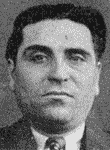
Genna, Angelo (1898-1925)

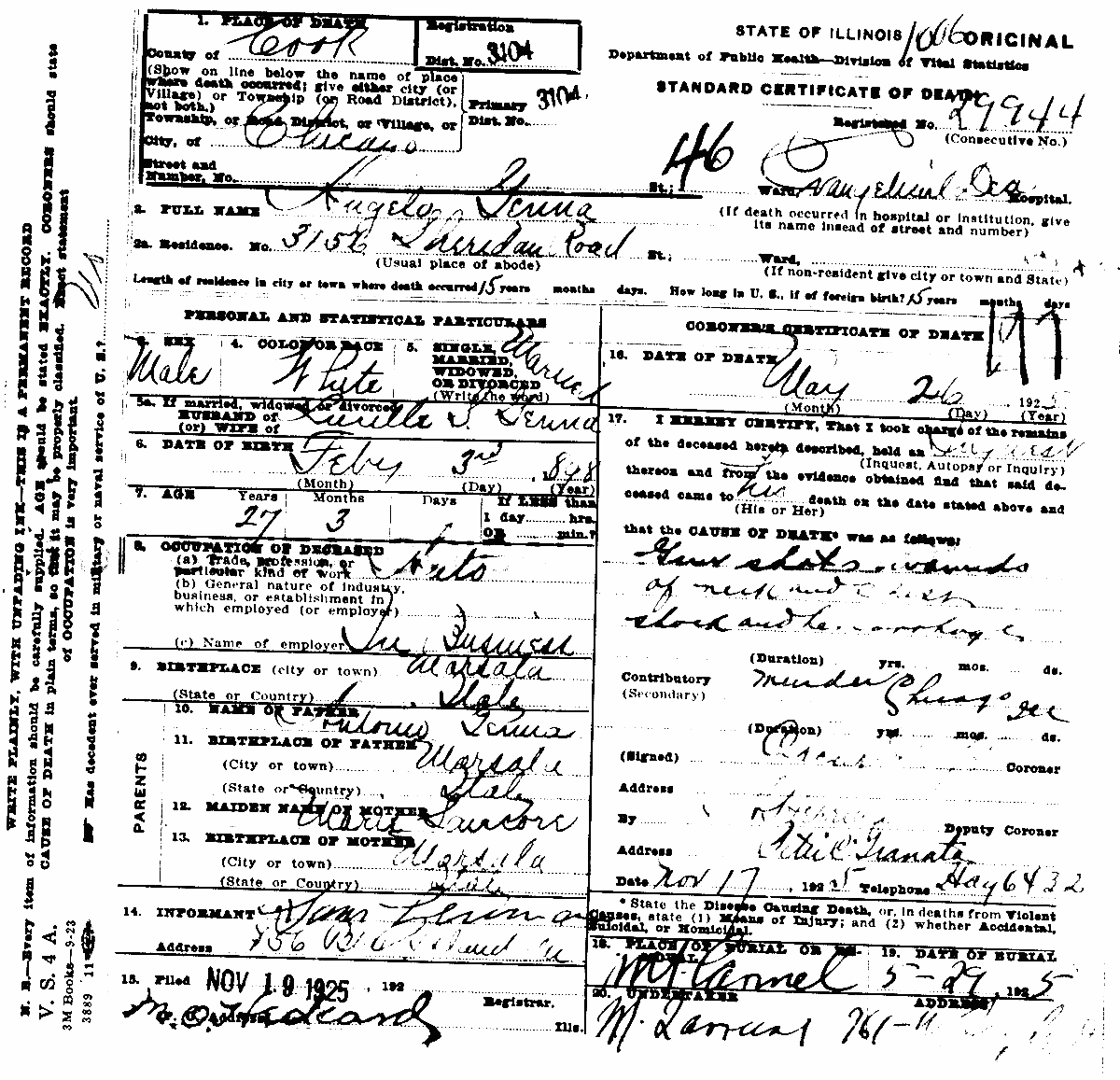
Born Marsala, Sicily, Feb. 3, 1898.

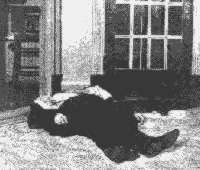
Killed Chicago, IL, May 26, 1925.


Angelo Genna was born Feb. 3, 1898, in Marsala, Sicily, to Antonino and Mary Sancore Genna. He and his brothers entered the U.S. through New York around 1910. Angelo arrived in New York harbor on Aug. 5, 1914, aboard the S.S. Venezia. He was on his way to meet his brother Pietro, of 870 Blue Island Avenue in Chicago.

The Gennas became a close knit Marsala-based Mafia and bootlegging gang. They were closely allied with the more Americanized Spingola family of Chicago. Their gang feuded with the budding underworld organization of Alphonse Capone through the early 1920s.

The conflict was a bloody one. Angelo Genna was tried and acquitted for one murder, accused but not prosecuted in another murder. Beginning in November of 1923, he served a sentence of one year and one day in Leavenworth Prison for intimidating a witness.

Genna married Lucille Spingola, sister of his ally and business partner Peter Spingola on Jan. 10, 1925. The wedding was lavish, with three thousand guests and a two-thousand-pound wedding cake.

On May 26, 1925, Genna was shot numerous times as he drove his automobile. With serious wounds to his head and neck, he crashed the car into a lamp post at Hudson and Ogden Avenues. He was conscious as he arrived at the Evangelical Deaconess Hospital. Police urged him to tell who shot him. Genna merely shrugged. He died shortly afterward, as his brother Sam, wife and brother-in-law arrived at his bedside.

Genna was buried May 29, 1925, in Mount Carmel Cemetery in Chicago.

More of the Gennas lost their lives in the days ahead, and the remaining brothers fled Chicago. Their departure allowed the Aiello clan - originally from Bagheria, Sicily - to dominate the Sicilian underworld of the region.

Related links:

D'Andrea, Philip (1889-1952)

Born NY, Sept. 7, 1889

Died California, Sept. 18, 1952.


Phil D'Andrea served as a bodyguard and trusted adviser to Chicago mob boss Al Capone. During Capone's tax evasion trial in 1931, D'Andrea sat directly behind the prominent defendant by special permission of the court.

D'Andrea later was found to be attending the court proceedings while armed with a handgun. He was arrested as he left the courtroom on Oct. 10. At that time, the press referred to D'Andrea as "Capone's constant companion."

After Capone's imprisonment for tax evasion, D'Andrea became the president of the declining Unione Siciliana organization in Chicago.

D'Andrea was sought for questioning in connection with the April 1941 murder of Italian-language newspaper editor John F. Arena. D'Andrea was known to be part owner of a competing newspaper.

In 1943, D'Andrea and other Outfit leaders Paul Ricca, Louis Campagna and Charles Gioe were convicted of using extortion to build an empire in the Hollywood entertainment industry. They were sentenced to ten years in prison but served just three. They all were paroled on Aug. 14, 1947. The paroles did not escape notice. Federal legislators demanded all documentation on the early releases. The matter was again investigated in November 1952, after D'Andrea's death.

D'Andrea was one of the many underworld figures called before the Kefauver Committee in 1950.

He retired from the Chicago underworld and moved west to California.

D'Andrea, Anthony (1872-1921)

Born Valledolmo, Sicily, June 7, 1872.

Killed Chicago, IL, May 12, 1921.


Upon his arrival in the U.S. in the 1890s, D'Andrea became an ordained priest. In 1899, he was appointed to serve the parish of St. Anthony in Chicago. Almost immediately, he left the priesthood to marry sixteen-year-old Lena Wagner.

He took work as a translator but supplemented his income by participating in a coin-counterfeiting racket. He and his wife were arrested for counterfeiting in 1902.

In an apparent effort to free his wife of the charge, D'Andrea pleaded guilty at arraignment. The U.S. Secret Service hoped that he would provide information against other members of the counterfeiting network apprehended in western New York, where some of D'Andrea's relatives resided, but D'Andrea said he could not identify them.

(Authorities initially suspected that the New York City "Barrel Murder" victim was D'Andrea, killed because he assisted the counterfeiting investigation. The victim was later identified as Benedetto Madonia of Buffalo.)

On April 24, 1903, D'Andrea was sentenced to a prison term of 13 months and a fine of one dollar. He reached the Illinois State Prison at Joliet on April 25, becoming Inmate no. 8292. He was discharged upon the expiration of his sentence (with good time allowance) on March 4, 1904. D'Andrea subsequently received a presidential pardon from Theodore Roosevelt, allowing him to participate in politics.

The 19th Ward on Chicago's West Side came to be dominated by D'Andrea, who also became an organizer of local Mafiosi and of union labor. Mike Merlo served as his understudy. Politics in that time and place was a violent business. Blood was spilled through bombings and assassinations.

D'Andrea brought together the various Sicilian Mafia organizations of the Chicago area under his own brutal leadership. He was widely regarded as a merciless disciplinarian.

D'Andrea was shot and mortally wounded as he returned home in the early morning hours of May 11, 1921. The gunman fired at him with a shotgun from an apartment window looking out on the front stairs of D'Andrea's building. During hospital treatment, D'Andrea refused to reveal who shot him. He succumbed to his wounds on the afternoon of May 12.

Following D'Andrea's death, Mike Merlo stepped up to the leadership of the Chicago-area Mafia.

Related Links:

Colosimo, Vincenzo "Jim" (1878-1920)

Born Colosimi, Calabria, Italy, Feb. 16, 1878.

Killed Chicago, IL, May 11, 1920.


"Big Jim" Colosimo was a vice racketeer and political power broker in Chicago just after the turn of the 20th Century. His primary illicit business enterprises appear to have been gambling rackets and the management of a string of social clubs and brothels.

Colosimo was repeatedly victimized by Black Hand extortion and, for reasons largely unknown, sent to New York for aid. He called for Johnny Torrio, who partnered in a Brooklyn-Manhattan gang leadership with Frankie Yale, to move west. Torrio settled in Chicago around 1909 and immediately put an end to Colosimo's Black Hand troubles.

In 1919, Five Points Gang enforcer Al Capone, who was wanted on murder charges in New York, decided to follow in Torrio's footsteps and joined Colosimo's Chicago organization.

With the arrival of Prohibition, Torrio and Capone wished to expand their illicit enterprises into bootlegging. Colosimo, perhaps fearing to compete with established underworld gangs in the import of alcohol, reportedly refused.

Colosimo was assassinated May 11, 1920. It is widely believed the hit was performed by Yale at the request of Torrio and/or Capone.

The Colosimo-Torrio-Capone group was not a Mafia organization, and, in fact, was presenting growing problems for the true Mafiosi in town - the Gennas and later the Aiellos. The Gennas might have been partly responsible for Colosimo's death. Colosimo also went through an ugly divorce just before his death, and his former brother-in-law was apparently suspected by police.

Whoever the responsible parties were, Torrio and Capone were the main beneficiaries. They took over Colosimo's businesses and formed a full-fledged gang.

Related Links:

Civella, Nick (1912-1983)

Born Kansas City, MO, March 19, 1912.

Died Kansas City, MO, March 12, 1983.

During Nick Civella's reign, from the late 1950s to the early 1980s, the KC mob moved aggressively into Las Vegas casinos and reportedly had large interests in the Stardust (opened in 1955), the Fremont (opened in 1956) and later the Landmark Hotel (opened in 1969). The move west was done in concert with Mafia families from Cleveland and Chicago.

Kansas City-born Civella was closely tied to the Teamsters Union during Jimmy Hoffa's presidency and the later presidency of Roy Williams (1915-1988) and appears to have had access to the Teamster pension fund. (After the mob boss's death, Roy Williams told authorities that he was intimidated into doing Civella's bidding.)

Civella is believed to have been an attendee at the 1957 Apalachin, NY, crime convention, though he was able to escape Joseph Barbara's estate without being noticed by authorities. Police found Civella and KC Mafia big shot Joseph Filardo in a taxi at the train station in nearby Binghamton, New York. Civella probably was not yet official boss of the KC crime family at the time, but his underworld faction - including relatives Carl and Anthony Civella and Carl "Tuffy" DeLuna - had become the most powerful in the local mob.

Thanks to his skimming from the Stardust, Civella earned an early place on the Nevada Gaming Commission's Exclusion List. He, his brother Carl and nine others were the first to be named on the list in 1960. In the 1970s, FBI wiretaps revealed the extent of the organized crime conspiracy to skim from the casinos.

Civella spent the later years of his life in prisons. He was released in failing health in 1980 and passed away in March 1983.


Related Links:

Capone, Alphonse (1899-1947)

Born Brooklyn, NY, Jan. 17, 1899.

Died Palm Island, FL, Jan. 25, 1947.


Capone was a brutal Neapolitan mobster who became a powerful force in the American Mafia. Though he served as one of the architects of the nationwide criminal Syndicate, Capone never earned full acceptance by his Sicilian associates. Control of the underworld of his adopted Chicago eluded him until very near the end of his racket career.

Capone grew up in the Five Points Gang. He was a fearsome enforcer for Five Points leader Johnny Torrio. When Torrio later established himself in Jim Colosimo's Chicago vice rackets, Torrio and Frank Yale of Brooklyn arranged for Capone to make the move west in 1919.

Capone quickly rose to the top of the Colosimo-Torrio crime empire, which thanks to Torrio and Capone, included bootleg liquor among its enterprises. Torrio narrowly escaped death on Jan. 24, 1925, and retired, leaving the gang to Capone.

Al Capone's desire to control all of Chicago, including the local branch of the exclusively Sicilian Unione Siciliane, and his utter brutality ensured that the city's underworld was in a near constant state of warfare from 1925 to 1930. His tinkering with the Unione offended old-line Sicilian Mafiosi. Old friends Capone and Yale - both vassals of Mafia boss of bosses Giuseppe "Joe the Boss" Masseria - had a falling out. Legend says it was over the hijacking of liquor shipments.

When Yale was murdered in 1928, Capone initially was not suspected. But weapons used at the scene reportedly were linked to Chicago gangland murders, including the infamous St. Valentine's Day Massacre.


Capone is generally believed to have been responsible for the that Massacre of non-Italian North Side gangsters in February 1929 and a horrific triple-murder in May of that year which put an end to a rebellious Sicilian conspiracy within his organization.

The bloodletting drew the attention of East Coast Mafiosi. A mid-May conference of Chicago gang leaders was held in Atlantic City to iron out differences. Beyond Capone and his right-hand man Frankie Rio, attendees at the convention are unknown. It appears likely that the bosses of East Coast criminal organizations were present.

Following the Atlantic City meeting, Capone was arrested in Philadelphia on a weapons charge. Some believe he orchestrated the arrest. He remained in prison for most of a year.

When he emerged from prison, Capone found the nation's Mafia groups preparing for war and he backed his old boss Masseria. As his part in the Castellammarese War, Capone sent regular financial contributions to Masseria and eliminated Castellammarese ally Joe Aiello in September of 1930.

Capone saw his New York ally destroyed by Charlie Luciano's treachery in April of 1931. But the Chicago gang leader hosted the crowning of opposing Mafia general Salvatore Maranzano as the new boss of bosses in order to heal the old wounds.

Luciano then disposed of Maranzano in September 1931. Capone quickly arranged another underworld convention. Luciano refused the boss of bosses title. A new Commission of powerful Mafia leaders was installed to mediate differences between crime families.

Capone had only about a month to enjoy the new underworld order. His trial for tax evasion began in October. On Nov. 24, 1931, he was sentenced to 11 years in prison, in addition to more than a quarter million dollars in taxes, interest and fines. In jail, an existing case of syphilis reportedly began to eat away at his mind and body. He served about seven and a half years of his sentence.

He emerged from prison on Nov. 16, 1939, virtually incapacitated and was never again involved in underworld affairs. He retired to Palm Island, Florida, and died on Jan. 25, 1947. The causes of death were listed as stroke and pneumonia.

Related Links:

Ness, Eliott (1903-1957) - U.S. Treasury Dept.

Born Chicago, IL, April 19, 1903.

Died Coudersport, PA, May 16, 1957.


While Eliot Ness was not quite the one-man show depicted on television and radio and in the movies, he was a key player in the government's assault on Al Capone's Chicago crime empire.
Ness led a band of eight young men, titled the "Special Prohibition Unit" but remembered as "The Untouchables" for their refusal of enormous bribe offers. The group conducted a frontal assault against Capone's bootleg brewery operations while other government agencies picked away the crime lord's underbosses and allies and assembled the tax evasion case that would jail Capone in 1931.

Ness later led a municipal police force as Cleveland's Director of Public Safety in the late 1930s. In the job, he thoroughly modernized the city's police department while cracking down on corruption, violent labor activity, gambling and contraband alcohol. News headlines largely ignored his successes, however, and focused on the decapitation murder cases in the Kingsbury Run area that stymied Ness and on his anti-labor image. Ness saw additional bad press as the result of a drunk driving accident in 1942 and was forced to resign his post.

In 1947, former safety director Ness ran as a Republican for mayor of Cleveland. He lost the Nov. 4 election in a landslide to Democrat Thomas A. Burke, having sacrificed much of his personal wealth in the campaign.

Ness eventually left public service and became president of the Guaranty Paper Company and the North Bridge Industrial Corp. in Pennsylvania. He died at his home in Coudersport, PA, on May 16, 1957 (his remains reportedly were cremated), just before his autobiographical "The Untouchables" was published. The book, which exaggerated Ness's importance in the Capone fight and glossed over his failings, became enormously popular and spawned the myth of Eliot Ness.

Read:
The Untouchables by Eliot Ness with Oscar Fraley.

Anselmi, Albert (1883-1929)

Born Marsala, Sicily, July 15, 1883.

Killed Cicero, IL, May 7, 1929.


Anselmi was a bootlegger and enforcer in the Genna Brothers Mafia Family in Chicago who later became an important figure in the Al Capone Outfit. He was widely suspected of involvement in the 1924 murder of North Side gang boss Dean O'Banion.

In the mid-1920s, Anselmi and his perpetual companion John Scalisi appeared to pull away from the Genna Mafia and join an independent Sicilian underworld organization led by Samuzzo Amatuna and Orazio Tropea. Mike Genna was killed in a shootout with police June 13, 1925, while in the company of Anselmi and Scalisi. The two men subsequently became allies of Al Capone.

Between 1925 and 1927, Anselmi and Scalisi battled cop-killing charges arising from the shooting deaths of two Chicago detectives. After three trials, in which the defendants argued that they used deadly force against the police officers only in self-defense, the two men were freed.

Some believe that Capone used Anselmi, Scalisi and others to execute the St. Valentine's Day massacre of Bugs Moran's men. Scalisi was indicted for participating in the massacre, but he was never tried.

Just three months after that bloody event, Anselmi, Scalisi and Joseph Guinta were found dead in Indiana. The accepted legend is that Capone discovered the the three Sicilian men, all known as Capone supporters, were plotting against him. Capone reportedly held a lavish dinner in their honor at Hawthorne Inn in Cicero, IL, and personally beat them to death with a baseball bat.

The bodies of the three men - badly beaten and shot - were found within an automobile on May 8, 1929.

See also: