Showing posts with label Camorra. Show all posts

Lauritano, Leopoldo (1889-1958)

Born Naples, Italy, Dec. 30, 1889.
Died New York City, April 5, 1958.

Lauritano was a Brooklyn-based Camorra leader who ran a coffeehouse/saloon at 113 Navy Street and also conducted a lucrative murder-for-hire business.

Born in the Naples area near the end of 1889, Lauritano reached the United States in 1906 and was naturalized an American citizen in January 1915. He lived and worked in the area of the Brooklyn Navy Yard and participated in the operation of the infamous Navy Street Gang. His brother Anthony appears to have been acquainted with if not involved with the gang.

In the 1910s, as the Sicilian Mafia and Neapolitan Camorra in the New York area cooperated to monopolize rackets, Lauritano became a sort of sergeant-at-arms for the budding syndicate. He commanded what may have been the first Brooklyn-based murder-for-hire organization.

It was to Lauritano that Bronx Mafia boss Ciro Terranova allegedly ran to contract a hit on Joe DeMarco in 1916.

Camorra bosses took offense at Morello-Terranova actions and decided to dissolve the partnership and eliminate as much of the Sicilian Mafia leadership in New York as possible. Lauritano gunmen were employed later in 1916 to perform the executions, which resulted in the deaths of Terranova's brother Nicholas and aide Charles Ubriaco.

According to testimony from hitman Johnny "Lefty" Esposito, Lauritano paid his gunmen a steady salary to keep them on retainer. (Esposito complained that Lauritano lowered his pay as a result of the accidental killing of Lauritano friend Charles Lombardi during the DeMarco hit.)

In 1918, Lauritano was arrested for his involvement in the 1916 murder of Giuseppe Verrazano at the Italian Gardens in Manhattan. While held for that crime, he was tried and convicted of manslaughter in connection with another killing. He was sentenced to serve 20 years in state prison. The 1920 Census found him at Clinton State Prison in Dannemora.

On Jan. 12, 1926, Lauritano was released from prison on parole. He had served just seven and a half years of his original 20-year sentence. He was immediately rearrested on a 1918 indictment in the Verrazano murder case. On Jan. 14, Brooklyn Supreme Court Justice Selah B. Strong released Lauritano on a habeas corpus writ. Strong noted that he had dismissed the murder indictment against Lauritano two and a half years earlier.

Lauritano's discharge resulted in an bitter public feud between Justice Strong and Kings County District Attorney Charles J. Dodd. Strong insisted that Dodd had approved the dismissal of the murder charge in the summer of 1923. Dodd denied having any part in the dismissal.

In March of 1927, Lauritano was taken into custody as a material witness against accused Camorra assassin Anthony "Shoemaker" Paretti. He was held on $100,000 bail at the Raymond Street Jail in Brooklyn. Paretti went to trial that June. Camorra leaders Lauritano, Allessandro Vollero and Pellegrino Morano were all called to testify. All denied knowing Paretti. Lauritano further denied knowing his fellow witnesses and any members of the Navy Street Gang.
Paretti was convicted and sentenced to die in the electric chair at Sing Sing Prison. Lauritano's testimony caused him to be tried for perjury.

The perjury trial began on Feb. 10, 1927. On the following day, Assistant District Attorney James I. Cuff confronted Lauritano with a photograph showing him at a gathering of the Navy Street Gang. Lauritano changed his plea to guilty and admitted that he lied about his associations with gang members.

On March 1, Justice James C. Cropsey of Brooklyn Supreme Court sentenced Lauritano to serve five years in Sing Sing Prison. According to reports, Lauritano narrowly avoided a more serious sentence because his perjury occurred two days before the effective date of the strict Baumes laws.

After his release, Lauritano went to live with his brother Anthony on Adelphi Street in Brooklyn. The two worked together on Navy Street. Documentation on Lauritano after the start of World War II is lacking. He died within New York City in the spring of 1958 and was buried at Holy Cross Cemetery in Brooklyn.


Sources:
  •  "10 held when gunman exposes 23 murders," New York Tribune, Nov. 28, 1917, p. 16.
  •  "Armored car owner queried on Marlow," New York Times, July 11, 1929, p. 1.
  •  "Assassin, hired at $15 a week, admits part in 6 murders," New York Tribune, June 7, 1918, p. 16.
  •  "Convicts at trial refuse to testify," New York Times, July 1, 1926.
  •  "Dodd charges plot to Justice Strong," New York Times, Jan. 28, 1926.
  •  "'Judge, I lied,' he says," New York Times, Feb. 12, 1927.
  •  "Justice accuses Dodd of blunder," New York Times, Jan. 29, 1926.
  •  "Lauritano held in $100,000," New York Times, March 27, 1926.
  •  "Paretti witness gets five years," New York Times, March 2, 1927.
  •  "'Shoemaker,' fugitive for 10 years, surrenders on indictment for murder by Navy St. Gang," New York Times, March 17, 1926.
  • Email from Deirdre Sautter, June 3, 2019. 
  •  Leopoldo Lauretano, Find A Grave, findagrave.com, memorial ID 173448467, Dec. 3, 2016.
  •  Leopoldo Lauritano Naturalization Petition No. 12129 dated Jan. 28, 1915.
  •  Leopoldo Lauritano World War II draft registration, 1942. 
  •  New York, New York, Death Index, 1949-1965, Ancestry.com.
  •  U.S. Census of 1920, Clinton Prison at Dannemora, Jan. 7, 1920.

Genovese, Vito (1897-1969)

Born Risigliano, Italy, Nov. 21, 1897.

Died Springfield, MO, Feb. 14, 1969.


"Don Vitone" Genovese was born near Naples, Italy. Official documents show his birthdate as Nov. 21, 1897. However, some other sources - the New York Times obituary, for example - place his birth on Nov. 27. He entered the U.S. through New York City at the age of 15 on May 23, 1913.

As a teenager, he became involved in the Neapolitan gangs in lower Manhattan and nearby New Jersey, as well as Lower East Side multi-ethnic gangs that also produced Charlie "Lucky" Luciano and Meyer Lansky. In 1917, during the height of Mafia-Camorra friction in the city, Genovese was arrested for possession of a handgun. He was convicted and sentenced April 15, 1917, to serve 60 days at the workhouse.

In the 1920s, Genovese became a Luciano partner as Charlie Lucky gradually took over the Manhattan operations of Giuseppe "Joe the Boss" Masseria. It is widely believed that Genovese was among the gunmen who assassinated Masseria in 1931, ending the Castellammarese War. Luciano named Genovese his underboss in 1931. This likely was a recognition of Genovese's strength among the non-Sicilians in the criminal organization rather than a sign of affection for Genovese.

Genovese grew in strength while Luciano battled compulsory prostitution charges, and could have taken over the Family after Luciano's 1936 conviction. However, Genovese had legal problems of his own. Law enforcement officials were attempting to connect Genovese with the 1934 murder of Ferdinand "the Shadow" Boccia. In November 1936, Genovese obtained his U.S. citizenship. The following month, he obtained a passport and subsequently sailed for Italy, where the Fascist government was in need of his financial support.

In Italy, Genovese appears to have had a good relationship with Italian dictator Benito Mussolini, generally the enemy of Sicilian Mafiosi.

At the conclusion of World War II in 1945, U.S. occupying forces in Italy discovered Genovese. He assisted the Army, but was found to be engaged in the black market. Officials learned that Genovese was at that time wanted in New York as a suspect in the Boccia murder. While he was in Italy, prosecutors had tracked down a number of witnesses tying Genovese to the killing.

The Army brought Genovese back to the U.S. aboard the S.S. James Lyke, which reached New York harbor on June 1, 1946. However, due to the death in prison of corroborating witness Peter LaTempa, Genovese beat the old murder rap. Released from custody, he moved into a comfortable home at 68 West Highland Avenue, Atlantic Highlands, NJ, and began taking control of Luciano's old family from then-boss Frank Costello.

Family problems brought Genovese to the attention of the authorities in 1953. His estranged second wife Anna was seeking a divorce. She apparently communicated to members of the press that Genovese had begun a relationship with the wife of a Mafia underling, Thomas Calandriello. The same Calandriello had apparently taken care of paperwork associated with the purchase of the Atlantic Highlands home.

The relationship between Costello and Genovese degenerated into a long feud. An assassination attempt on Costello in 1957 was traced to Genovese gunman Vincent Gigante. Costello anounced his retirement after that, allowing Genovese to control the organization. Genovese and Carlo Gambino likely worked together to eliminate strong Costello-ally Albert Anastasia later that year.

A new boss eager to establish himself as a big shot on the national scene, Genovese seems to have encouraged the calling of the ill-fated Mafia convention in Apalachin, N.Y., on Nov. 14, 1957. Police discovered that convention, detaining everyone in sight, and establishing for certain the existence of the nationwide criminal network.

Genovese was convicted on narcotics trafficking charges in 1959 and earned a 15-year sentence. He continued to run Family matters from behind bars (through acting bosses like Tommy Eboli) until his 1969 heart attack death while in custody.

On January 30, 1969, he was moved from Leavenworth, KS, prison to the Medical Center for Federal Prisoners at Springfield, MO. He died there two weeks later.

Genovese's funeral began at the family hometown, Red Bank, New Jersey. Genovese's bronze coffin was transported from the William S. Anderson Funeral Home in Red Bank to his church. A sparsely attended funeral Mass was celebrated Feb. 17 at St. Agnes Roman Catholic Church in Atlantic Highlands, NJ, location of Genovese's more recent home. Genovese was buried at St. John's Cemetery in Middle Village, Queens, NY. The burial was attended only by family and close friends.

Related Links:

Gallucci, Giosue (1864-1915)

Born Naples, Italy, Dec. 10, 1864.

Killed New York, NY, May 21, 1915.


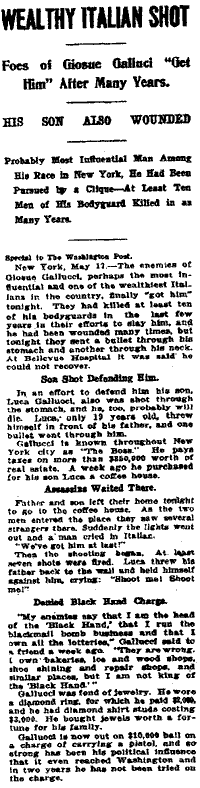
Gallucci reigned as the king of the Italian Harlem rackets from the turn of the Twentieth Century to his assassination in 1915.

Gallucci arrived in the United States about 1891. By 1898, American authorities already were complaining about his criminal activity and seeking to have him deported. They noted that he and his brothers, Genaro, Vincenzo and Francesco, had criminal records in Italy before they crossed the Atlantic. Giosue Gallucci's record in his native country included arrests for theft and blackmail.

With great influence over his fellow Italians in East Harlem, Gallucci established strong political and business connections. He employed Neapolitan and Sicilian street gangs as his enforcers and established successful local criminal enterprises, as well as legitimate businesses, including a coffeehouse, a bakery and a cigar factory.

Gallucci's base of operations was a building at 318 East 109th Street, which housed his living quarters in addition to his coffeehouse and bakery.

The more lucrative of Gallucci's underworld rackets included an Italian lottery and a protection fee his men extorted from sellers of produce.

Gallucci's brother Vincenzo was murdered Nov. 20, 1898, reportedly on orders from an Italian "secret society similar to the Mafia" (likely the Neapolitan Camorra). Two gunmen laid in wait for him at the corner of Canal and Mulberry Streets in Manhattan and shot him as he arrived there. Francesco D'Angelo and Luigi LaRosa were accused of the killing. They pleaded guilty to manslaughter and were given prison sentences of 20 years and 15 years, respectively.

Genaro Gallucci's activities as a collector of protection payments caught the attention of authorities, and he fled New York City for a time. When he returned in the late summer of 1909, New York Police captured him and immigration officials began efforts to deport him to Italy. On Nov. 14, 1909, Genaro Gallucci was shot to death while inside his brother's East 109th Street business.

Though Giosue Gallucci was called the "king" of the East Harlem rackets, he was also victimized by Black Hand extortionists. He was especially harassed by Neapolitan gang leader Aniello "Zopo the Gimp" Prisco, who was believed responsible for killing Genaro Gallucci.

To resolve matters, Gallucci set up a meeting with Prisco on the evening of Dec. 16, 1912. Prisco probably did not expect an ambush as the meeting was planned for a barbershop run by his allies, the DelGaudio brothers. But Gallucci took suddenly ill and could not leave the back room of his East 109th Street bake shop. He sent a messenger to find Prisco and bring him to the shop.

When "Zopo" arrived, he was promptly shot in the head by Gallucci bodyguard John Russomano. The king told the police the killing was in self-defense. He asserted that Prisco had come to rob him of $100. Russomano, he said, drew a pistol. Prisco turned to fire at Russomano, and Russomano got off the first shot. The police accepted the explanation - not surprising, considering Gallucci's political clout - but Russomano and Gallucci were marked for death by the survivors in Prisco's gang.

Gallucci's prestige began to wither in 1913, as a gang war with Prisco's old outfit stretched on, and he was scrambling to maintain control of the underworld in 1914 and 1915. Rival lotteries were springing up right under his nose. Gallucci and his son Lucca were gunned down at Lucca's coffeehouse business, 336 East 109th Street, on May 17, 1915.

The two victims were brought to Bellevue Hospital. Lucca died there the next day. Gallucci lingered until May 21 before succumbing to his injuries. His death left open the coveted position of East Harlem underworld/political boss and triggered gangland feuding. (Gallucci's story is similar to that of Chicago's "Big Jim" Colosimo, a criminal and political leader who was victimized by extortionists and apparently murdered by men he previously commanded.)

Related Links:

DeMarco, Joseph (c1876-1916)

According to underworld legend, brothers James, Joseph and Salvatore DeMarco each attempted to dominate the Italian underworld of Manhattan and each lost his life as a result.

The DeMarcos once were allies of the Morello Mafia in East Harlem but then became a bitter rivals after 1910, as various underworld organizations struggled to dominate the rackets in lower Manhattan's Little Italy neighborhoods. James DeMarco was killed in 1913.

At least two attempted were made on Joseph DeMarco's life in 1913-1914. Both of those occurred in the vicinity of a notorious stable on East 108th Street. Joseph recovered from gunshot wounds both times.

DeMarco launched counterstrikes against the Morello leadership. In November of 1915, Nicholas Terranova (known as Nicholas Morello) was shot from behind by a sawed-off shotgun. Terranova was seriously injured but recovered.

Joseph DeMarco boldly moved into downtown rackets. He opened a restaurant at 163 West 49th Street and then opened two gambling rooms - one on Mulberry Street and another at 54 James Street. On the afternoon of July 20, 1916, police were called to the James Street room and found the lifeless bodies of Joseph DeMarco and his friend Charles "Nine-Fingered" Charlie Lombardi seated at a card table. Ten other chairs were scattered about the room. Ten hats were hung on wall hooks behind the table.

Authorities concluded that DeMarco had been killed for attempting to secure for himself the position of East Harlem's top underworld and political boss, which had recently been vacated by the murder of Giosue Gallucci. They learned much later that DeMarco's death was secretly agreed upon by Sicilian Mafia and Neapolitan Camorra leaders who wished to divide the Manhattan territory between them.

DeMarco's old rival Nicholas Terranova was murdered September 7, 1916, as he made a visit to Brooklyn Camorrists he believed were his allies.

Salvatore "Toto" DeMarco disappeared following the death of his older brother. He was not seen again until days after the Terranova murder. Perhaps fearing he would be targeted by a Morello vendetta, he reportedly decided to meet with New York Police Detective Frederick Franklin on Oct. 14, 1916, and tell him all he knew about the underworld feud. Toto did not make it to the meeting. Early on Oct. 13, his mutilated corpse was found by a street cleaner on the Astoria side of the Queensboro Bridge.

Toto DeMarco's head had been cracked open with an axe-like instrument. A razor slice across the throat had nearly severed the head from the body.

Brought to the scene, Detective Franklin remarked, "He'll never tell who killed his brother now."

DelGaudio, Nicolo (?-1914)

Nicolo "Nick" DelGaudio and his brother Gaetano DelGaudio were influential members of the Manhattan Camorra during the 1910s. They apparently worked closely with Giosue Gallucci, the politically connected East Harlem crime boss, and with the remnants of the Morello-Lupo Mafia (Giuseppe Morello and Ignazio Lupo were locked up in Atlanta Federal Prison during the decade). About 1913, the old alliances broke down.

Nicolo resided at 2029 First Avenue in East Harlem. He owned a restaurant nearby at 2023 First Avenue. Authorities believed his restaurant was merely a front for illegal activities. In February 1913, he was suspected of involvement in an unsuccessful attempt on Gallucci's life that resulted in the death of Gallucci bodyguard Tony Capilongo. That spring, Nicolo left the country for a long trip to Italy. He returned in the fall of 1914.

On October 14, 1914, DelGaudio and his friend Tancredi Dellabado met at First Avenue and walked toward a garage where DelGaudio kept his automobile. As they passed a stable at 421 East 104th Street, a gunshot was heard. DelGaudio fell mortally wounded, and Dellabado ran off. Police later found a shotgun inside an upstairs front window over the stable. Along with it was a hat they traced to Francisco Ruggiero of 403 East 106th Street. Ruggiero was arrested.

Gaetano DelGaudio managed to remain alive for another two years. In the early morning hours of November 30, 1916, he was shot while working in his restaurant, 2031 First Avenue. He died a short time later in a hospital, after refusing to name his murderer.

Daniello, Ralph (1878-1925)

Born Eboli, Italy, 1878.

Killed Metuchen, NJ, 1925?

Raffaele "Ralph the Barber" Daniello, whose real name appears to have been Alfonso Pepe (newspapers also referred to him as Giuseppe Pepe), was born in southern Italy. After marrying, he settled in Nocera Inferiore, just outside Naples, for a while before transplanting his young family across the Atlantic in New York.

In Brooklyn, Daniello became a member of a large Neapolitan Camorra organization. He participated in the feud between that gang and the Morello-Terranova Sicilian Mafia clan in New York. He performed several murders and conspired in others.

Facing murder charges, Danniello fled New York in 1917 and trusted in his Camorra associates to support him and his family. Camorra boss Pellegrino Morano was stingy, however. Daniello interpreted the lack of support as evidence that he had not long to live. Arrested in Reno, Nevada, the disheartened Daniello told his story to the police. That story included details of 23 gangland murders.

He and associate Tony Notaro testified against their former bosses as the Brooklyn Camorra leadership was tried and convicted in 1918. Camorra leader Allessandro Vollero was among those sent to prison. Daniello's own prison sentence was suspended because of his cooperation.

The following year, Daniello - then a resident of Elmhurst, NY - shot a man during a quarrel at the Coney Island elevated train station. Efforts to convince the victim to forget the incident were unsuccessful, though they reportedly included the burning of the man's New Jersey home and the poisoning of his dog. Daniello pleaded guilty to the shooting in January 1920.

Some sources indicate that in 1925, after his release from prison, Daniello was shot to death on a highway near Metuchen, New Jersey.

Alfano, Enrico (c.1873-?)


Alfano, known as "Erricone," was one of New York detective Joseph Petrosino's great success stories of 1907. Believed to be the head of the Neapolitan Camorra organization in New York City, Alfano was arrested April 17 of that year as police raided East Side night spots checking patrons for concealed weapons. Petrosino reportedly recognized Alfano by a prominent scar on his face.
Following Alfano's arrest, the New York Tribune noted, "The populace considered Alfano in the light of a demigod; he was thought to be invulnerable to bullets and able at all times to escape his pursuers." The newspaper recalled that back in Naples, Alfano had eliminated a rival named Gennaro Cuocolo by denouncing him as a spy for the authorities. "The Camorra then condemned both Cuocolo and his wife to death, and they were brutally murdered." The body of Gennaro Cuocolo, stabbed numerous times, was discovered at Torre del Greco, outside of Naples, on June 7, 1906. The body of his wife, Maria Cutinelli Cuocolo, was found "horribly mutilated" in their apartment. Alfano was an early suspect in the murders, but, assisted by his godfather and priest, Rev. Ciro Vitozzi, he won his freedom and fled his homeland for the United States early in 1907.[1]
He was turned over to U.S. immigration authorities on April 22. Not formally charged with wrongdoing in the U.S., he was sent back to Europe as an unfit immigrant, due to his criminal past. He was turned over to French authorities in Havre and extradited to Italy.[2]  The Italian government took charge of Alfano at Cherbourg in June and kept him under close guard on the trip back to Naples.[3] 
Early in 1908, the New York Tribune reported that, in the absence of Erricone, a new New York Camorra chief had been chosen. He was Gaetano Esposito. Known by such nicknames as "the grand master" and "the snow seller," Esposito had recently been released after serving a term in the prison on Italy's Ventotene Island.[4] 
Some believe angry Alfano allies were responsible for assassinating Petrosino as he traveled in Sicily in 1909.[5] 
Back in Italy, Alfano and a number of codefendants stood trial at Viterbo for the Cuocolo murders. The trial lasted many months in 1911 and 1912 and included more than 700 witnesses. (One memorable moment in the trial occurred when defendant Corrado Sortino pulled his glass eye out of its socket and hurled it at the judge.) American authorities followed the trial closely, hoping it would cast some light on the unsolved Petrosino assassination.
Alfano denied involvement in the murders and membership in the Camorra. Of the Cammora, he stated, "I am neither its head nor its tail." Despite his denials, he and eight accomplices were convicted of murder on July 8, 1912. Seven other codefendants, acquitted of participation in the murders, were convicted of membership in a criminal association.
Alfano and codefendants Corrado Sortino, Antonio Cerrato, Giuseppe Salvi, Nicolo Morra, Mariano DiGennaro, Giovanni Rapi and DiMarinas were sentenced to thirty years in prison and ten years of police surveillance. The jury decided that Alfano, Rapi, DiMarinas instigated the murders, while Sortino was personally involved in both murders, Morra, Cerrato and DiGennaro were involved in the murder of Gennaro Cuocolo, and Salvi was involved in the murder of Maria Cuocolo. As the verdict was announced, DiMarinas slashed his own throat with a shard of glass. While the wounded defendant was removed from the court, Alfano shouted a protest against the injustice of the trial. during which his brother Ciro, once one of the defendants, died in prison.[6]  Erricone reportedly was locked away in a prison on the island of Sardinia.[7]  
The Italian government's most important witness in the trial, Gennaro Abbatemaggio, was a former Cammora member turned informant. Abbatemaggio later served his country with distinction during the Great War, receiving four medals. Early in 1921, as he faced arrest on a charge of fraud, Abbatemaggio shot himself through the chest, apparently attempting suicide. Enrico Alfano's sisters rushed to the hospital where surgeons tended to Abbatemaggio, hoping to secure from the wounded man an admission that his trial testimony had been false. They were prevented from seeing him.[8] 
(It should be noted that Lt. Petrosino was far more effective at penetrating and intimidating the Camorra than the Mafia. His activity unintentionally may have given a competitive edge to the city's Mafia organization.)
Notes:
  1.  "Alfano wanted in Italy," New York Tribune, April 20, 1907, p. 2; "All Italy awaits trial recalling Petrosino murder," New York Evening World, Feb. 25, 1911, p. 7; "Father Vitozzi testifies," New York Sun, April 7, 1911, p. 3.
  2.  "Camorrist in the toils," New York Sun, May 25, 1907, p. 3.
  3.  "Guard Camorra chief," New York Sun, June 27, 1907, p. 3.
  4.  "A new chief of the Camorra," New York Tribune, Feb. 16, 1908, p. 4.
  5.  "Arranging for trial of 300 Camorrists," Washington Times, Sept. 12, 1910, p. 2.
  6.  "Camorrist jury makes full sweep, finds all guilty," New York Evening World, July 8, 1912, p. 1; "Camorra verdict; all found guilty," New York Tribune, July 9, 1912, p. 1; "Cammora verdicts may be reversed," New York Times, July 16, 1922, p. E5.
  7.  Romano, Anne T., Italian Americans in Law Enforcement, Xlibris, 2010, p. 45.
  8.  "Abbatemaggio, informer on Camorra, shoots self," New York Tribune, Jan. 31, 1921, p. 3.