Showing posts with label Mangano. Show all posts

Gigante, Vincent "the Chin" (1928-2005)

Born New York, NY, March 29, 1928.

Died Springfield, MO, Dec. 19, 2005.

Genovese Crime Family boss "Vinny the Chin" Gigante evaded law enforcement for many years by playing the role of mentally ill street person. He gave up the act in an April 2003 court hearing, six years after being locked up.

Gigante died Monday, Dec. 19, 2005, at the federal prison in Springfield, Mo. He was 77 years old. Born in 1928 to Vincent and Yolanda Gigante, Neapolitan residents of the Lower West Side of Manhattan, Gigante's "Chin" nickname was adapted from his given name of "Vincenzo." His father was employed as a jewelry engraver.

The family resided for many years along Thompson Street, within the traditional confines of Greenwich Village. Gigante likely met fellow Thompson Street resident and Genovese Crime Family member Venero "Benny Eggs" Mangano when the two were young men.

Gigante had a brief career as a prizefighter, beginning in 1946. His criminal career was considerably longer, spanning half a century. He became an underworld protege of New York Mafia bigshot Vito Genovese, who controlled Greenwich Village. Gigante first became known to the American public as the prime suspect in the May 1957 assassination attempt against Mafia leader Frank Costello. It is believed that Gigante, working under orders from Costello rival Genovese (orders reportedly transmitted through group leader Tommy Eboli) cornered Costello in the lobby of his apartment house and shot him in the head at close range.

The bullet only grazed Costello, however. Costello's refusal to testify against Gigante, a man Costello insisted was "a friend," led to Gigante's acquittal. Costello retired as boss of the Luciano family, leaving the operation to Genovese.

Gigante was convicted of drug trafficking in 1959 and was sentenced to five years in prison. His Mafia credentials were greatly enhanced by his prison term. After his release, Gigante served in leadership roles in the Genovese family. He established a base at the private Triangle Social Club (Triangle Civic Improvement Association). Genovese, himself, was in prison and controlled the family through acting bosses such as Gerardo Catena and Tommy Eboli.

Following the death of Genovese, Philip Lombardo gradually took over as boss, screening his activities behind a series of front men, including Frank "Funzi" Tieri and Anthony "Fat Tony" Salerno. Lombardo eased into a Florida retirement by the early 1980s, and the Greenwich Village-based Gigante became boss. Under his leadership, the Genovese Family was a labor-racketeering power, particularly on the Hudson River docks, and established a regional underworld waste-hauling cartel, while retaining traditional interests in gambling and loan sharking. Venero Mangano served as underboss and filled in for Gigante during the summer of 1988 when Gigante was recovering from heart surgery.

Gigante preferred that Mafiosi avoid media attention. In the late 1980s, he was so offended by the publicity hungry Gambino Crime Family boss John Gotti that he reportedly called for Gotti's assassination.

Following the example of Lombardo, Gigante screened his leadership of the Mafia clan by having Anthony "Fat Tony" Salerno (who died in 1992) pass himself off as the family boss. Gigante also did his best to portray himself as a helpless paranoid schizophrenic. He wandered the streets of Greenwich Village in his pajamas, robe and slippers, often conducted public conversations with himself and was once found hiding under an umbrella in his shower.

Prosecutors had great success against Salerno but could not score a conviction against Gigante until 1997 (his feigned mental illness delayed proceedings on that matter by seven years). By then, the boss's mental illness act had earned him a new nickname in the press: "the Oddfather."
Gigante was sentenced to a dozen years for racketeering in 1997. Additional charges were brought against him after that. With Gigante in prison, control of the crime family fell to Dominick "Quiet Dom" Cirillo of the Bronx.

The Triangle Social Club was abandoned, as Greenwich Village was no longer the heart of the Genovese Family. The storefront formerly occupied by the club became a tea and spice shop in 2011.

Related Links:
Sources:
  •  Behar, Richard, "Special report. Organized crime," TIME, June 24, 2001.
  •  Fried, Joseph P., "A jailed mobster refuses to testify in Mafia case," New York Times, July 19, 1997.
  •  Fried, Joseph P., "Former mobster directly links Gigante to murder," New York Times, July 18, 1997.
  •  Lubasch, Arnold H., "Selection of jury gets under way in big-rigging case tied to mob," New York Times, April 9, 1991.
  •  Raab, Selwyn, Five Families: The Rise, Decline, and Resurgence of America's Most Powerful Mafia Empires, New York: Thomas Dunne Books, 2006.
  •  Raab, Selwyn, "Investigators say they're ready to topple new Mafia chiefs," New York Times, Dec. 12, 1988.
  •  Raab, Selwyn, "Suspected New York mob leaders are indicted in contract rigging," New York Times, May 31, 1990.
  •  Raab, Selwyn, "Vincent Gigante, Mafia leader who feigned insanity, dies at 77," New York Times, Dec. 19, 2005.
  •  "4 Mafia figures on trial for window racketeering," Lincoln NE Journal Star, April 24, 1991, p. 9.
  •  "Jury frees Gigante in Costello shooting," New York Times, May 28, 1958, p. 1.
  •  "Last great Mafia social club gets clipped," The Smoking Gun, thesmokinggun.com, April 18, 2011, accessed Aug. 18, 2017.

  •  Salvatore Gigante Naturalization Petition, U.S. District Court for Southern District of New York, no. 90039, filed Nov. 3, 1926.
  •  Salvatore Gigante World War II draft registration card, serial no. U1194, 1942.
  •  United States Census of 1930, New York State, New York County, Assembly District 2, Enumeration District 31-68.

Balsamo, Giuseppe "Battista"

Balsamo was a Mafia leader in Brooklyn at the dawn of the 20th Century, according to some of his descendants, self-described experts in Brooklyn underworld history. The descendants say he was a transplanted Sicilian Mafioso who settled in Brooklyn in 1895 and became Brooklyn's "first godfather."
Giuseppe Balsamo reportedly retired from Mafia leadership in the 1920s, turning his organization over to Vincent and Phillip Mangano. 
These claims have been made in two books. The first of the books was published under a number of different titles, including Under the Clock and Crime Incorporated (authored in 1988 by William Balsamo and George Carpozi). The second book, Young Al Capone, by brothers William and John Balsamo, was published in 2011. Both books contain fiction elements and unsupportable assertions.

D'Aquila, Salvatore "Toto" (1873-1928)

Born Palermo, Sicily, 1873

Killed New York, NY, Oct. 10, 1928.

Palermo-born D'Aquila ran a cheese importing business in New York when he wasn't occupied with the day-to-day business of one of the more successful Mafia organizations.

D'Aquila began his underworld career as a Bronx-based underling in the Mafia of American boss of bosses Giuseppe Morello. His personal criminal pursuits are not well known. He was arrested in 1906 as a confidence man and arrested again in 1909 on unknown charges. Both times, the charges were dropped.

D'Aquila moved to Brooklyn, where he likely became an important lieutenant under Morello brother-in-law Ignazio Lupo. When Morello and Lupo were jailed for counterfeiting in 1910, D'Aquila was selected as leader of the Lupo operation and as boss of bosses of the American Mafia.

D'Aquila meddled extensively in the business of other American crime families. He is believed to have inserted his own loyal followers as spies into other families.

Despite D'Aquila's vast strength, he did not succeed in uniting all of New York City's Mafiosi. He attempted to put down an insurrection in East Harlem through the assassinations of the Lomonte brothers. Italian colonies on Manhattan's Lower East Side also eluded his grasp.

The questionable loyalty of his underworld subjects in Manhattan apparently nagged at D'Aquila. When Morello and Lupo were released from federal prison around 1920, D'Aquila passed death sentences against his former superiors and ten of their closest allies in order to eliminate the potential rivals. One of those condemned by D'Aquila was his loyal henchman Umberto Valenti, then powerful enough to concern the boss of bosses.

Valenti reached an accord with D'Aquila by promising to eliminate Manhattan Mafia upstart Giuseppe Masseria, who had become the Morello faction's standard-bearer. Through guile and luck, Masseria survived Valenti attempts on his life and managed to kill D'Aquila's gunman in 1922.

The events of the early 1920s cost D'Aquila a key ally. Saverio "Sam" Pollaccia, a close friend of D'Aquila's who followed him from the Bronx to Brooklyn, abandoned D'Aquila and became a personal adviser to Masseria.

The boss of bosses' authority waned, particularly in New York, through the next few years. D'Aquila retreated back into the South Bronx about 1925-1926, moving into a home across the street from the entrance to the Bronx Zoo. D'Aquila was cornered and killed during a visit to a Manhattan doctor in 1928. Giuseppe Masseria became the new boss of bosses and retained Giuseppe Morello as his chief strategist.

While a number of D'Aquila loyalists sided with Brooklyn Castellammarese leader Salvatore Maranzano in the Castellammarese War of 1930-31, the old Brooklyn-Bronx D'Aquila unit was officially taken over by Masseria supporter Al Mineo and his right-hand man Steve Ferrigno.

After the deaths of Mineo and Ferrigno, the unit was run by Frank Scalise during the later Castellammarese War and was then turned over to Vincent Mangano in the 1931 underworld reorganization. It survives to this day as the Gambino Family.

Related Links:

Anastasia, Albert (1902-1957)

Born Tropea, Italy, Feb. 26, 1902.

Killed New York, NY, Oct. 25, 1957.


The Mafia's "Lord High Executioner" was born Umberto Anastasio in a Calabrian village called Tropea. The date of his birth is variously recorded as Feb. 26, 1902; Sept. 26, 1902; and 1903. As teenagers, he and his brothers worked on Atlantic steamships. They jumped ship in New York and entered the U.S. illegally.

As Umberto Anastasio became known as a Brooklyn gangster, he adjusted his name to Albert Anastasia. The adjustment to his surname was reportedly to save his Anastasio relatives from embarrassment. (One of his brothers entered the U.S. legally and became a parish priest in New York.)

Anastasia became an accomplished underworld enforcer, earning him the nickname of "Lord High Executioner." Some also referred to him as "the Mad Hatter." Anastasia became a powerful leader on the Brooklyn waterfront, where brother Anthony "Tough Tony" was a leader in the longshoremen's union.

A devoted friend of underworld giants like Charlie Luciano, Frank Costello, Joe Adonis and Nicola Gentile, Anastasia had a long rivalry with Neapolitan underworld leader Vito Genovese and with some of the traditional Sicilian Mafiosi in Brooklyn.

Anastasia supported boss of bosses Giuseppe Masseria in the Castellammarese War of 1930-31. After the war, Anastasia emerged as the underboss in the Mangano Family. He also reportedly supervised a largely Jewish gang of Brooklyn killers used as Mafia enforcers. That gang became known as Murder, Inc.

Anastasia is believed to have approached the Mafia Commission asking to support Dutch Schultz by eliminating New York State Prosecutor Tom Dewey. Mob boss Joe Bonanno suggested that Luciano had Anastasia float that idea before the Commission, so Luciano himself would not be linked with it. The proposal was rejected and ultimately led to the murder of Schultz.

Dewey later hoped to use hitman-turned-state-witness Abe Reles' testimony to prosecute Anastasia as the official go-between for the Mafia hierarchy and Murder Inc. But Reles suddenly decided to step out of a high-rise hotel window, ending the state's case against Anastasia.


In 1951, with the Manganos suddenly gone (Philip was found murdered, and Vincent disappeared), Anastasia rose to the leadership of that crime family. As Anastasia reached the pinnacle of the Mafia underworld, an old rivalry with Vito Genovese turned deadly. Anastasia was shot to death Oct. 25, 1957, as he sat in a barber's chair in the Park Sheraton hotel lobby. The killing appeared to be part of a effort by Genovese to eliminate the Costello-Anastasia influence in the underworld (Costello was shot in the head - but survived - just a few months earlier and turned control of his organization over to Genovese).

However, the assassination might have been the result of Anastasia's recent moves to establish a gambling/narcotics empire in Cuba outside of the influence of usual Mafia-Cuba go-betweens Meyer Lansky and Santo Trafficante. Anastasia had made a recent trip to Havana and later scheduled a meeting with representatives of Cuban gaming interests in New York. Carlo Gambino, who succeeded Anastasia as boss, Genovese, Lansky and Trafficante all had motives to do away with Anastasia and could have cooperated on the assassination.

Addresses used by Anastasia:
  •  387 Columbia Street, Brooklyn, NY
  •  151 Sackett Street, Brooklyn, NY
  •  636 Arthur Street, Utica, NY
  •  1146 73rd Street, New York, NY
  •  75 Bluff Road, Palisades (Fort Lee), NJ
Criminal record of Anastasia (according to FBI files):

  •  1921 Mar 17 - charged in Brooklyn with homicide, convicted, sentenced to electrocution on July 3, 1921, retrial later ordered, acquitted Aug. 21, 1922.
  •  1922 - charged with homicide, indictment later dismissed.
  •  1923 Apr 06 - charged in Brooklyn with felonious assault, discharged on April 24, 1923.
  •  1923 Jun 06 - charged in Brooklyn with possession of a firearm, convicted, sentenced to two years at Blackwell's Island Penitentiary.
  •  1928 - arrested for homicide, not prosecuted.
  •  1932 - arrested for homicide, not prosecuted. 
  •  1933 - charged with homicide, not convicted.
  •  1941 - Kings County district attorney assembles murder case related to the May 1939 killing of Morris Diamond, but abandons it after the November 1941 death of turncoat witness Abe Reles.
  •  1942 Jan 21 - arrested for harboring, not prosecuted.
  •  1954 Apr 14 - stripped of citizenship acquired through military service, reversed on appeal.
  •  1954 Mar - indicted by federal grand jury for income tax evasion, mistrial in Florida declared Nov. 21, 1954, retrial in Camden, NJ, results in guilty plea and a June 3, 1955 sentence of a year in federal penitentiary.
  •  1956 Mar 28 - released from Milan, Michigan, federal penitentiary.


Related Links:

Doto, Giuseppe "Joe Adonis" (1901-1971)

Born Montemarano, Italy, Nov. 22, 1901.

Died Ancona, Italy, Nov. 26, 1971.

Adonis was born Giuseppe Antonio Doto in Montemarano, an Italian village within the province of Avellino, not far from the City of Naples. His family brought him to the United States when he was a child. His father Michele/Michael Doto (whose surname was also written "Dato" and "Adone") reached the U.S. first, in 1904, settling with an uncle on President Street in Brooklyn. Adonis and three brothers crossed the Atlantic with their mother in the summer of 1909. They joined Michele, then living on Brooklyn's Carroll Street. Some reports indicate the family lived for a time in Great Barrington, Massachusetts, but these could not be confirmed.

Over the years, Giuseppe Doto used a number of aliases before settling on the one that became famous. He referred to himself as "James Arrosa" or "Joseph Arroso" in the mid-1920s and as "Joseph DeMio" in the early 1930s. He likely picked up his "Adonis" alias from the "Adone" surname previously used by his family around the time of the 1915 New York State Census. The name "Adonis" referred to a human character in Greek mythology known for his physical attractiveness and his great hunting ability. The origins of the Adonis myth appear to blur with those of the hunter Orion, and these hunter tales may have been regional adaptations of a single original story. Both characters had tragic encounters with Greek goddesses.

A longtime Brooklynite, Joe Adonis was arrested for assault and battery in 1922 (not prosecuted), for grand larceny and robbery in 1926 (discharged), disorderly conduct in 1927 (fined), liquor smuggling in 1931 (not indicted), assault and robbery in 1937 (discharged) and kidnapping and extortion in 1940 (dismissed). He was affiliated early in his criminal career with regional Mafia bigshots Frank Yale and Anthony "Little Augie" Pisano (Anthony Carfano). These associations may have brought Adonis into the orbit of late 1920s Sicilian Mafia boss of bosses Giuseppe Masseria. Adonis, Pisano, Vito Genovese and Mike Miranda became the most prominent Neapolitans working within the Giuseppe Masseria organization.

Unsupported legends: According to some writers, who provide no supporting documentation, Adonis attended a May 13-15, 1929, national "convention" of bootleggers in Atlantic City. There is no hard evidence that Adonis was in Atlantic City at this time or that the "convention" involved anyone outside of visiting Chicago gang bosses. Some sources have named Adonis one of the gunmen who assassinated boss of bosses Giuseppe Masseria at Gerardo Scarpato's Nuova Villa Tammaro restaurant in Coney Island on April 15, 1931.

Mafia informant Joseph Valachi stated that Adonis - who directed criminal activity at the Brooklyn docks alongside Albert Anastasia and ran the Brooklyn eatery known as Joe's Italian Kitchen on Carroll Street and Fourth Avenue - was among those targeted for elimination by Maranzano after the conclusion of the Castellammarese War in 1931. Following Maranzano's assassination later that year, the Mafia reorganized. Adonis reportedly became a major player in the reorganized underworld, though his precise role, if any, in the Mafia hierarchy remains hazy.

Adonis's specific crime family affiliation has also been hazy. Some sources named him a top lieutenant in the Brooklyn Family of Vincent and Philip Mangano, while others placed him within Luciano's own Manhattan-based organization. Nicholas Gage suggested that Adonis was actually the first post-war leader of what became the Mangano Family, but this conflicted with accounts of better informed sources. (Gage did not offer a sufficient explanation for how or why Adonis became less than a Family boss later on.) Joe Bonanno, who probably knew Adonis' title, doesn't speak of it in his autobiography, and Valachi seems not to know anything about the Brooklyn mobster's status.

Evidence suggests that Adonis's authority - and close personal associations - overlapped the Mangano mob territory in Brooklyn, but that he owed his primary allegiance to his long-time friends Luciano and Frank Costello, based in Manhattan.

Adonis's mother, Maria DeVito Doto, passed away in the summer of 1934. His father died in April 1939.

Eventually, Adonis seemed to be everywhere and into everything - alcohol, gambling, drugs, union rackets, political shenanigans... He had established relationships with several Mafia Families and with some non-Italian gangs as well. Adonis was known to be a trusted ally and confidant of Frank Costello, who presided over Luciano's Manhattan Family after Luciano went to prison in the 1930s. Adonis joined Costello and Jewish mobsters Meyer Lansky and Benjamin Siegel in ownership of the Colonial Inn casino in Miami Beach and participated in gambling ventures in the Saratoga, New York, area. Adonis also shared a gambling empire in New Jersey with Mafioso Willie Moretti, Costello's close ally. His involvement in the Automotive Conveying Company of Cliffside Park, New Jersey, caught the attention of the U.S. Senate's Kefauver Committee and New Jersey prosecutors.

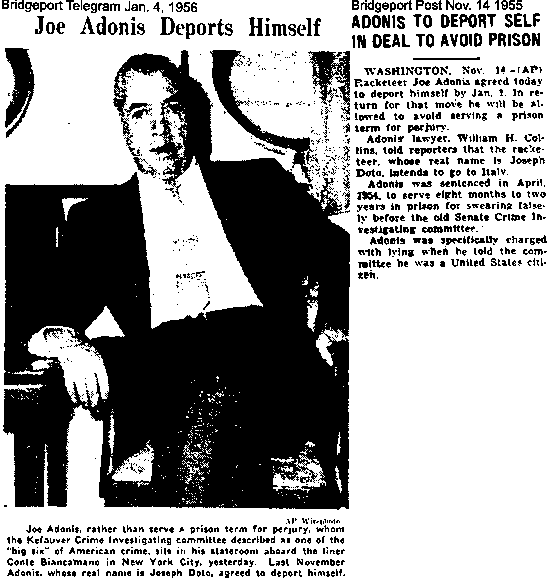
Adonis, who had long claimed to be an American native and who had settled in Fort Lee, NJ, in the mid-1940s (his Dearborn Road home was about a quarter mile from the Bluff Road home of Albert Anastasia), was shown to be an immigrant in the 1950s. Birth records indicating a 1901 birth in Passaic, New Jersey, were found to be fraudulent. Italian birth certificates, immigration records and early statements made by Adonis and his family members to authorities conflicted with statements Adonis made under oath before a New Jersey grand jury. Adonis was ordered to be deported in 1953. He fought that order in the courts. A voluntary deportation to Italy occurred in 1956 in the wake of a perjury charge stemming from the Kefauver Committee hearings.

One of the legendary fallings out between the American Mafiosi and the Kennedy Administration was allegedly over arrangements for the Mafia to support Kennedy's candidacy for President in return for Kennedy allowing Adonis back into the country. According to this tale, President John Kennedy was reportedly willing to welcome Adonis home, but Attorney General Robert Kennedy blocked the move.

The Italian government decided to inflict an exile within an exile upon Adonis on June 20, 1971. A Milan court demanded that he be restricted to the town of Ancona on Italy's Adriatic coast. Adonis died there of natural causes on Nov. 26, 1971. His remains were returned to the United States and buried Dec. 6 in Madonna Roman Catholic Cemetery in Fort Lee, NJ.


The Adonis funeral was relatively low-key. A cortege of fifteen automobiles, led by three cars of flowers, drove from Macagna's Funeral Home in Cliffside Park, New Jersey, to the funeral Mass at Epiphany Church. A private service was then held for Adonis's family - his wife, son and three daughters - and close friends at the chapel in Madonna Cemetery. The family and most attendees left before Adonis's casket was lowered into his grave. A number of reporters and photographers kept close watch on the event. There were no reports of known underworld figures in attendance.


Related Links:

Sources:

  • "Joe Adonis one of 8 cited in Dewey reply," Brooklyn Daily Eagle, Dec. 3, 1937, p. 1.
  • Investigation of Organized Crime in Interstate Commerce, Part 7, New York - New Jersey, Hearings before the Special Committee to Investigate Organized Crime in Interstate Commerce, U.S. Senate, 81st Congress 2nd Session, 82nd Congress 1st Session, Washington D.C.: U.S. Government Printing Office, 1951, p. 280-301.
  • Joseph Doto, Index of Births in New Jersey, 1901, A-H, certificate 37513.
  • Mary Doto, New York City Index to Death Certificates, certificate no. 15279, July 21, 1934.
  • Michael Doto, New York City Index to Death Certificates, certificate no. 9874, April 27, 1939.
  • Murray, Leo, "Offer birth certificates from Italy in Adonis case," Paterson NJ Morning Call, Jan. 15, 1954, p. 1.
  • New York State Census of 1915, Kings County, Brooklyn, Ward 10, Election District 11.
  • New York State Census of 1925, Kings County, Brooklyn, Assembly District 8, Election District 15. 
  • Passenger manifest of S.S. Citta di Milano, departed Naples on April 23, 1904, arrived New York on May 9, 1904.
  • Passenger manifest of S.S. Montserrat, departed Naples on June 23, 1909, arrived New York on July 11, 1909.
  • Plosia, Les, "Few turn out for Adonis burial," Passaic NJ Herald-News, Dec. 7, 1971, p. 12.
  • United States Census of 1920, New York State, Kings County, Brooklyn, Ward 14, Enumeration District 446.
  • United States Census of 1930, New York, Kings County, Brooklyn, Ward 10, Assembly District 8, Enumeration District 24-1079.
  • United States Census of 1940, New York, Kings County, Brooklyn, Assembly District 9, Enumeration District 24-1087.