Showing posts with label Carbone. Show all posts

Petrosino, Joseph (1860-1909) - New York PD

Born Padula, Italy, Aug. 30, 1860.

Killed Palermo, Sicily, March 12, 1909.


Lieutenant Joseph Petrosino achieved great success in the fight against Italian and Sicilian organized criminal groups in the United States. When he attempted to take the fight to the Mafia's home island, he was assassinated.

On a visit to Palermo in western Sicily, officially to gather information on the identities of Mafiosi who might have fled to the U.S., Petrosino was shot through the body, in the throat and in the head while he stood beside a garden in the Piazza Marina on March 12, 1909. He was 48.

His visit to Sicily was supposed to have been a secret. But many sources agree that Police Commissioner Bingham released fairly specific information about the trip through the New York Herald and other newspapers before Petrosino landed in Europe. Mafiosi in the U.S. were able to mobilize their Old World fellows to act against the lieutenant.

Many believe Vito Cascio Ferro, a Mafia leader on both sides of the Atlantic, organized and/or participated in the assassination. (An often retold and probably untrue story has Cascio Ferro excusing himself from a dinner party thrown by a local government official to do the deed. Cascio Ferro promptly returned to dinner afterward.) It is also known that several mafiosi traveled to Sicily just before the attack on Petrosino.

Petrosino joined the New York City police department in 1883, despite failing to meet the department's height requirement. Capt. "Clubber" Williams was his mentor. He rose through the ranks, reaching the detective sergeant level in 1895 under then-police commissioner (and later U.S. President) Theodore Roosevelt.
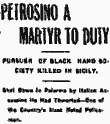
Petrosino would be considered brutal by today's standards. He did not hesitate to use threats and force to extract information from street thugs. While his tactics would be frowned upon by many today, they were accepted at the time (forensic science was in its infancy) and highly effective. Petrosino was placed in charge of the Italian Squad, a group of Italian and Sicilian officers whose job was to check organized criminal activity in ethnic neighborhoods.
Petrosino's greatest successes came against transplanted Neapolitan criminals - those belonging to the Camorra. He was less fortunate in dealing with the Sicilian Mafiosi, but may have been on the verge of acquiring some very effective tools in the form of documentary evidence from Italian police agencies.

Among Petrosino's more noteworthy adventures were: saving Angelo Carbone from execution by extracting a murder confession from another man; deporting Camorra leaders Tony Strolle and Enrico Alfano; and identifying both the victim and the perpetrators of the infamous barrel murder in 1903 (though the ring leaders, including Ignazio Lupo, Vito Cascio Ferro and Giuseppe Morello, managed to escape prosecution).

Many of Petrosino's cases were chronicled in a 1914 series of newspaper articles by A.R. Parkhurst under the title, "Perils of Petrosino." His career was also the subject of a number of pulp fiction volumes in the U.S. and Italy.

Related links:

Crocevera, Isadoro (1873-1920)

Born Palermo, Sicily, Dec. 23, 1873

Killed Buffalo, NY, Aug. 8, 1920

A member of a New York City-based counterfeiting gang led by Giuseppe Morello, Isadoro Crocevera was one of a few gang members arrested for passing counterfeit currency in 1903. He was charged along with Giuseppe DePrima, Giuseppe Giallombardo and Salvatore Romano. Federal Judge E.H. Thomas sentenced the three men March 17, 1903, to prison terms in Sing Sing. Giallombardo was given five years, DePrima four years, and Crocevera three years.

The counterfeiting case was neither Crocevera's first involvement with the Mafia underworld nor his last. In Palermo, Sicily, during the 1890s, Palermo native Crocevera was known to have been friendly with Giuseppe DiCarlo, later the crime boss of Buffalo, NY. Immigrants to the U.S., both settled for a while in New York City (after Crocevera's release from prison, probably in 1905). DiCarlo moved on to Buffalo, NY, a few years later. Crocevera remained in Brooklyn but visited DiCarlo regularly. Their visits were interrupted for a period of about two and a half years before they last got together.

During Crocevera's final visit to Buffalo, he became involved in a gunfight near DiCarlo's saloon, 166 Front Ave., Buffalo. In the Aug. 8, 1920, shooting, Buffalo resident Vincent Vaccaro was wounded in the leg; Crocevera was shot in the back and killed. Police decided that Joseph DiCarlo Jr. and Crocevera argued with brothers Vincent and Anthony Vaccaro, possibly over the division of rum-running profits.

DiCarlo was charged with causing Vincent Vaccaro's injury. Vincent Vaccaro accepted responsibility for killing Crocevera, but there was some suspicion that he was shielding his brother. Anthony Vaccaro was formally charged with killing Crocevera. Nothing came of the charges.

Crocevera had worked at the Brooklyn docks. At the time of his death, he was a stevedore foreman for the Pierce Brothers firm. Many Sicilian and Italian immigrants found employment at the docks, and stevedoring was often a cover for organized criminals.

Crocevera left behind a large family - a wife, Marianna Carbone Crocevera, and seven children - at 63 Duffield Street, Brooklyn. Just months before his Crocevera's death, he was visited by a relative from Palermo, Sicily. On Jan. 5, 1920, his 41-year-old brother-in-law Giorgio Mazza entered the port of Boston, heading to Crocevera's residence in Brooklyn.