Showing posts with label Palermo. Show all posts

Gambino, Carlo (1902-1976)

Born Palermo, Sicily, Aug. 24, 1902.

Died Massapequa, NY, Oct. 15, 1976.


Gambino was born in Palermo, Sicily, to Tommasso and Felice Castellano Gambino. He is believed to have entered the United States in December 1921 through Norfolk, Virginia. U.S. officials charged that he entered the country illegally as a stowaway on the S.S. Vincent Florio. Gambino settled on East 182nd Street in the Bronx, where he worked as a butcher and associated with the D'Aquila Mafia faction dominated by his relatives the Castellanos of Brooklyn. The Castellanos also were engaged in the butcher business. Behind the scenes, Gambino ran a successful bootlegging operation.

On Dec. 1926, Gambino married Catherine Castellano (born 1907 in New York to Joseph and Concetta Cossato Castellano) in Brooklyn. Gambino's brother Paulo served as his best man. (In 1930, Paolo married Catherine Castellano, born 1912 to Frank and Providencia Guglemini Castellano. Carlo Gambino was his best man.)The couple settled in Brooklyn. Their first child, Felicia (later Phyllis Sinatra), was born in 1927 while they lived at 1692 83rd Street in Brooklyn. A son, Thomas, was born in 1929. At that time, the family lived at 8302 17th Avenue in Brooklyn.

During the Castellammarese War, the Castellano wing of the old D'Aquila organization was loyal to Al Mineo, a boss imposed on the crime family by boss of bosses Giuseppe Masseria. After Mineo's November 1930 murder, Gambino and the Castellanos sided with Masseria rival Salvatore Maranzano, the ultimate victor in the war.

In 1934, alcohol tax authorities charged Gambino with possessing untaxed alcohol and with running an unlicensed wholesale and retail liquor business. The charges were later dismissed. In the same year, he was charged with stealing $1000 through a "pill game" in Brockton, Massachusetts. Gambino paid back the money, and he was not prosecuted.

He first ran into trouble with immigration authorities when he visited Montreal, Canada, in 1935 and attempted to return to New York. He was refused a visa by the U.S. consulate in Montreal. He was permitted reentry into the U.S. at Rouses Point, NY, but a warrant was subsequently issued for his arrest. That warrant was later cancelled by an immigration official.
In the late 1930s, U.S. authorities discovered evidence that Gambino was engaged in large-scale stock speculation under assumed identities. He was closely affiliated with the management of the Bank of Sicily Trust Company at that time.

In 1939, he was sentenced to serve 22 months in prison for violating tax laws. He served that sentence at the federal penitentiary at Lewisburg, Pennsylvania. After his release, he and his brother engaged in the theft and sale of American wartime ration stamps.

He became prominent in the Mangano Family (which had been led by D'Aquila, Al Mineo and then Frank Scalise in the years leading up to 1931 underworld reorganization) He established a residence at 2230 Ocean Parkway in Brooklyn and served as a principal owner in the S.G.S. Associates labor consulting firm.

Narcotics agents felt strongly that Carlo and Paolo Gambino were smuggling illegal aliens and heroin into the U.S. from Sicily in cooperation with Sicilian underworld leader Santo Sorge.

After Vincent Mangano's disappearance in 1951. He was named underboss to Albert Anastasia in 1956. Anastasia was killed the next year, and Gambino took over family leadership. He was noted among the attendees at the Apalachin convention of the nation's Mafiosi in 1957. It is likely that his election as boss of the former Anastasia Crime Family was on the agenda of that meeting. His rival within the organization, Armand Thomas Rava, was also present. Rava subsequently disappeared. Gambino purchased the support of Rava's close friend Aniello Dellacroce by appointing him underboss.

Following the convention, the Immigration and Naturalization Service considered deporting Gambino. Agents located him in the Flower Hospital at Fifth Avenue and 105th Street in New York and were told that he was suffering from a serious heart condition.

Gambino is believed to have been at least partly responsible for inciting revolts within the conservative Mafia clans of Profaci (later known as Colombo) and Bonanno. He was a one-time supporter and later opponent of both Joe Colombo and Joe Gallo, big names in the former Profaci Family. Some claim Gambino gave his consent to the (ultimately fatal) shooting of Colombo in 1971.

In 1970, Gambino was charged with conspiracy to transport stolen property. He was granted a severance from other defendants in the case due to poor health. Gambino won release on his own recognizance, and the trial was postponed for years.

Gambino died of a heart attack Oct. 15, 1976, at his home at Massapequa, Long Island. His underboss Aniello Dellacroce had much support to take over the family but agreed instead to serve under Paul Castellano, who was a relative and an apprentice of Gambino.

Related Links:

Esposito, Giuseppe (1847-?)

b. Alia, Palermo province, Sicily, c1847.
d. Unknown.

Giuseppe Esposito, also known as Giuseppe Randazzo and Vincenzo Rebello, served as lieutenant to the infamous Antonino Leone back in 1874 Sicily. He emigrated to the U.S. and briefly found underworld success in New Orleans before being captured by private detectives and deported to Italy to stand trial for murder.

Esposito and Leone are believed to have been responsible for the kidnaping of English businessman John Forester Rose. (According to legend, they sent several of his body parts back to his family with ransom demands). The two leaders were cornered by Italian police in 1875, but Esposito escaped to become the new boss of the island's most feared band of central hill-country brigands.

After some of Esposito's closest allies were captured, he turned himself in to friendly authorities in Alia, Sicily. Charged with a number of crimes, including murder and extortion, Esposito was transported to Palermo to stand trial. During the trip, he escaped. His escape appears to have been organized by Palermo Mafiosi, with whom he had at least friendly relations.

In the late 1870s, Esposito fled to New York via Marseilles, France. He quickly moved on to New Orleans. Adopting a new name, Vincenzo Rebello, Esposito married and began to settle into a life of crime. He was immediately recognized as leader by the various Mafia factions already in place in New Orleans. Esposito and his right hand man Joe Provenzano quickly controlled much of the profitable activity on the New Orleans docks and in the produce markets.

Esposito was betrayed by a New Orleans associate known only by the code name of Panesolo. Panesolo sent word to Italian authorities that Esposito was living in the Crescent City. Private detectives of the Mooney and Boland firm were hired to track him down. New Orleans Police Detectives Mike and David Hennessy (cousins) aided by arresting Esposito near the St. Louis Cathedral on July 5, 1881. Esposito was quickly transported to New York for an extradition hearing.

Overwhelming support from the Sicilian community there and from New Orleanians who traveled to testify on his behalf, coupled with Esposito's insistence that the authorities had misidentified him, delayed the proceedings until he could be positively identified in late September.

Upon his return to Italy, he was convicted of murders in Rome and jailed for life. Some of his former allies in New Orleans converted his possessions there to their own use and failed to provide for a wife and children he left behind. From his Italian jail cell, Esposito tried unsuccessfully to sue those New Orleanians.

Esposito's New Orleans crime organization split into two factions: the Stuppagghieri Mafia commanded by the Matranga family and a Giardinieri Mafia led by the Provenzano clan. The split eventually led to a number of deaths, including the 1890 assassination of New Orleans Police Chief David Hennessey.

Some historians doubt that Esposito was a proper Mafioso, insisting that he was no more than a bandit (and forgetting that the traditional, honored society of the Sicilian Mafia had largely degenerated into a collection of thieves, cut-throats and political radicals by the mid-1870s). In his History of New Orleans, author John Kendall defined the "brigand" view of Esposito:


"Esposito had terrorized the vicinity of Palermo. From boyhood he had been a criminal. In his maturity he was a mountain desperado, plundering, burning, and murdering. Captured by the Italian police after a desperate battle, in which his band of brigands was destroyed, he escaped from custody, and fled to America. The press teemed with stories of his terrible exploits in Italy, and he was sought throughout the world..."

However, the FBI later asserted that Esposito "was the first known Sicilian Mafia member to emigrate to the United States. He and six other Sicilians fled to New York after murdering eleven wealthy landowners, the chancellor and vice chancellor of a Sicilian province." The FBI account leans very strongly on the word "known," as Mafia organizations existed at least in New Orleans and New York at the time Esposito arrived.

Read more:


Catania, Joseph "Baker" (1901-1931)

Born Palermo, Sicily, 1901.

Killed Bronx, NY, Feb. 3, 1931.

"Joe the Baker" Catania, a relative of the Terranova family, rose to prominence within the Bronx-East Harlem Mafia of in the 1920s and was a key figure in the Castellammarese War of 1930-31. There appears to be no significant family relationship between Catania and "Joe the Grocer" Catania, who was murdered in Brooklyn in 1902.

Sons of Antonio Catania, who ran a Manhattan bakery, Joseph and his brother James were both known by the "Baker" nickname. The Catania family entered the U.S. gradually between 1900 and 1903. The family initially settled in the Arthur Avenue neighborhood of the Bronx, then moved short distances to Hughes Avenue and then to Bassford Avenue.

Catania was arrested numerous times for assault, burglary and disorderly conduct in the mid-1920s, but the charges were repeatedly dropped. In 1928, Catania was one of seven known criminals in attendance at a Bronx banquet held in honor of Magistrate Vitale. The presence of the hoodlums led to Vitale's downfall and helped bring an end to the Jimmy Walker Administration in New York City.

By the outbreak of the Castellammarese War, around 1930, Catania was a major force in the Bronx-East Harlem underworld. Evidence of his importance: When peace feelers were sent by Catania's superior, Mafia boss of bosses Giuseppe Masseria, to Castellammarese rebel leader Salvatore Maranzano, Maranzano stated that he could not end the war yet because Joe Baker still lived. It is often said that Catania earned Maranzano's hatred by stealing his liquor shipments. However, it seems at least as likely that Catania stood in the way of Maranzano allies in the Bronx.

The 29-year-old Baker was shot six times in the head and body by a Maranzano hit squad at 11:45 a.m. on Feb. 3, 1931, in front of 647 Crescent Avenue in the Bronx. He was rushed to Fordham Hospital, where he died.

With Ciro Terranova and his allies picking up much of the tab, Catania was given perhaps the most elaborate gangland funeral in New York history. The cost was estimated at $40,000, including a $15,000 solid bronze coffin (the cost of the coffin is obviously overstated). Forty cars were needed to carry the floral displays, the largest of which - a 13-foot-high creation bearing the words "Our Pal" - was purchased by Terranova.

Terranova was apparently deeply affected by the loss of Catania (his wife's nephew) as well as a trusted aide and friend. At the funeral home, Terranova reportedly put his hand on Catania's coffin and swore to avenge his death. Maranzano spies learned of this and attempted unsuccessfully to corner and eliminate Terranova at that location.

Buccola, Philip (1886-1987)

Born Palermo, Sicily, Aug. 6, 1886.

Died Palermo, Sicily, 1987.


Buccola (also "Bruccola") is widely believed to have ascended to the leadership of the Boston-based Mafia Family in the Prohibition Era.

Some sources indicate he became boss upon the death of Gaspare Messina in 1924.(1) One problem with this view is the fact that Messina did not die in that year - Nick Gentile indicates that Messina briefly served as American Mafia boss of bosses about 1930.(2) Gentile's account fits better with the traditionally accepted 1932 timing of Buccola's recognition as Boston boss by the national Mafia commission.

Born in Palermo, Sicily, Buccola arrived in the United States in the fall of 1920 and worked for a time as a fight promoter. He appears to have led a Sicilian gang in Boston's East Side for a while.(3) His education, relative affluence and links to the Palermo underworld served him as he rose to the top of Boston's Sicilian underworld.(4)

Buccola might have cooperated with non-Mafia bootlegging czar Charles "King" Solomon and the rest of the Seven Group ("Big Seven") in rum-running operations in the late 1920s and early 1930s. It is possible that Solomon's leadership in the New England bootlegging rackets was a cause of some friction between him and Buccola. At least one source indicates that Solomon's 1933 murder was ordered by Buccola.(5)

The relationship between Buccola and Mafioso Joe Lombardo is something of a mystery. It appears that Lombardo, deemed responsible for the December 1931 assassination of Irish Gustin Gang boss Frankie Wallace,(6) was at least part of a New England-wide Mafia leadership in the 1940s. There are several theories regarding Lombardo's poorly documented role: He might have been an overall boss, using others as front men or division leaders;(7) He might have served as Buccola's underboss;(8) or he might have led a faction within the North Side Mafia.

Based upon information provided by turncoat Vincent Teresa, Lombardo was overall boss near the end of the Prohibition Era. It remains possible, however, that Lombardo was less a regional crime czar than an influential member of a panel of Mafia leaders, which might have included Boston's Gaspare Messina and Providence's Frank Morelli.

Targeted by law enforcement as a result of assuming control over Morelli's Rhode Island operations around 1947,(9) Buccola retired to his estates back in Sicily in 1954. Day-to-day Mafia affairs in Providence and Boston were turned over to Raymond Patriarca. Buccola kept a hand in Boston affairs while chicken farming outside Palermo. He reportedly died at the age of 101 in 1987.(10)

Related Links:


Notes:
  1. . A number of organized crime websites insist that Gaspare Messina died in 1924 and was replaced by Buccola. See: Machi, Mario. "New England - Boston, MA," AmericanMafia.com (http://www.americanmafia.com/Cities/New_England-Boston.html); and "New England Mafia Homepage" (http://www.geocities.com/Hollywood/Academy/4448/).
  2. . Gentile, Nick. Vita di Capomafia (Rome: Editori Riuniti, 1963). Interestingly, the statement of FBI investigator James F. Ahearn to the Senate Permanent Subcommittee on Investigations in 1988 (Organized Crime 25 Years After Valachi) indicates that Buccola was not identified as Boston Mafia head until the late 1940s.
  3. . Teresa, Vincent. My Life in the Mafia (Garden City, NY: Doubleday & Co., 1973), p. 44.
  4. . O'Neill, Gerard and Dick Lehr, The Underboss (New York: St. Martin's Press, 1989) p. 31. O'Neill and Lehr suggest that Buccola was sent to Boston by Palermo Mafia authorities in order to take command there.
  5. . O'Neill, Gerard, op. cit, p. 32.
  6. . O'Neill, Gerard, op. cit, p. 15-17.
  7. . Teresa, Vincent, op. cit, p. 43-44. Teresa suggested that the Sicilian criminal organizations in various New England areas, such as Boston, Providence, Springfield, were run as separate crime families through the 1940s. He explained that Lombardo, based at his Pinetree Stables in Framingham, served as boss of bosses for the New England region.
  8. . O'Neill, Gerard, op. cit. p. 17.
  9. . According to Vincent Teresa, Lombardo in 1947 selected East Side gang leader Buccola to assume leadership authorities previously held by Frank Morelli. This scenario is repeated in Peterson, Virgil W. The Mob (Ottawa IL: Green Hill Publishers, 1983), p. 384.
  10. . O'Neill, Gerard, op. cit. p. 31.

Petrosino, Joseph (1860-1909) - New York PD

Born Padula, Italy, Aug. 30, 1860.

Killed Palermo, Sicily, March 12, 1909.


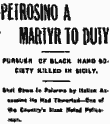
Lieutenant Joseph Petrosino achieved great success in the fight against Italian and Sicilian organized criminal groups in the United States. When he attempted to take the fight to the Mafia's home island, he was assassinated.

On a visit to Palermo in western Sicily, officially to gather information on the identities of Mafiosi who might have fled to the U.S., Petrosino was shot through the body, in the throat and in the head while he stood beside a garden in the Piazza Marina on March 12, 1909. He was 48.

His visit to Sicily was supposed to have been a secret. But many sources agree that Police Commissioner Bingham released fairly specific information about the trip through the New York Herald and other newspapers before Petrosino landed in Europe. Mafiosi in the U.S. were able to mobilize their Old World fellows to act against the lieutenant.

Many believe Vito Cascio Ferro, a Mafia leader on both sides of the Atlantic, organized and/or participated in the assassination. (An often retold and probably untrue story has Cascio Ferro excusing himself from a dinner party thrown by a local government official to do the deed. Cascio Ferro promptly returned to dinner afterward.) It is also known that several mafiosi traveled to Sicily just before the attack on Petrosino.

Petrosino joined the New York City police department in 1883, despite failing to meet the department's height requirement. Capt. "Clubber" Williams was his mentor. He rose through the ranks, reaching the detective sergeant level in 1895 under then-police commissioner (and later U.S. President) Theodore Roosevelt.

Petrosino would be considered brutal by today's standards. He did not hesitate to use threats and force to extract information from street thugs. While his tactics would be frowned upon by many today, they were accepted at the time (forensic science was in its infancy) and highly effective. Petrosino was placed in charge of the Italian Squad, a group of Italian and Sicilian officers whose job was to check organized criminal activity in ethnic neighborhoods.
Petrosino's greatest successes came against transplanted Neapolitan criminals - those belonging to the Camorra. He was less fortunate in dealing with the Sicilian Mafiosi, but may have been on the verge of acquiring some very effective tools in the form of documentary evidence from Italian police agencies.

Among Petrosino's more noteworthy adventures were: saving Angelo Carbone from execution by extracting a murder confession from another man; deporting Camorra leaders Tony Strolle and Enrico Alfano; and identifying both the victim and the perpetrators of the infamous barrel murder in 1903 (though the ring leaders, including Ignazio Lupo, Vito Cascio Ferro and Giuseppe Morello, managed to escape prosecution).

Many of Petrosino's cases were chronicled in a 1914 series of newspaper articles by A.R. Parkhurst under the title, "Perils of Petrosino." His career was also the subject of a number of pulp fiction volumes in the U.S. and Italy.

Related links:

Balsamo, Giuseppe "Battista"

Balsamo was a Mafia leader in Brooklyn at the dawn of the 20th Century, according to some of his descendants, self-described experts in Brooklyn underworld history. The descendants say he was a transplanted Sicilian Mafioso who settled in Brooklyn in 1895 and became Brooklyn's "first godfather."
Giuseppe Balsamo reportedly retired from Mafia leadership in the 1920s, turning his organization over to Vincent and Phillip Mangano. 
These claims have been made in two books. The first of the books was published under a number of different titles, including Under the Clock and Crime Incorporated (authored in 1988 by William Balsamo and George Carpozi). The second book, Young Al Capone, by brothers William and John Balsamo, was published in 2011. Both books contain fiction elements and unsupportable assertions.

Balestrere, James (1891-c1959)

Born Bagheria, Sicily, June 24, 1891.

Died Kansas City, MO, Oct. 19, 1959.

Born near Palermo, Sicily, Balestrere initially settled with his family in Milwaukee(1), in spring 1903(2). When he was a teenager, his family moved to the Kansas City area.
Balestrere became a big shot in the Kansas City outfit during Prohibition. Though a stone mason(3) by trade, he is believed to have teamed with the DiGiovanni brothers - Joseph and Pietro - in a bootlegging-related venture, supplying sugar to moonshine operations.(4)

After Prohibition the K.C. mob appeared to be under the control of Charles Binaggio, connected to the Pendergast political machine. Binaggio might also have had a hand in St. Louis-area gambling(5). Some believe Binaggio was merely a front man, while underworld orders continued to come from Joseph DiGiovanni(6).

At that time, Balestrere put his mason skills to use constructing a local restaurant/casino. (He previously worked operating a grocery store and a drug store.) The gambling establishment became known as "the White House." In the late 1930s, Balestrere also managed a keno game for Pendergast.(7)

Binaggio and his chief lieutenant Charles "Mad Dog" Gargotta were murdered on April 5, 1950, at a political headquarters(8). At the time, Missouri Senator James P. Kem called the murders an outgrowth of "the unholy alliance between politics and the underworld in Kansas City."(9).

Balestrere reportedly was a senior partner in the leadership group that followed Binaggio (or one which existed for some time under cover of Binaggio). Control of the K.C. mob looks to have been shared by Balestrere, Thomas "Tano" Lococo, Charles Carollo and former Binaggio ally Anthony Gizzo(10).

Some pronounce Gizzo the supreme boss in the city's underworld from 1950 until his death of natural causes(11). However, the Kefauver Committee, after hearing Balestrere's testimony in September 1950, decided that Balestrere was the big man(12).

Related Links:

Notes:
  1. . Fox, Blood and Power, p. 37. A Mafia clan in Milwaukee had a similar-sounding name spelled "Balestrieri" or "Balestreri."
  2. . Passport application dated Feb. 21, 1923; U.S Census Records, 1930.
  3. . Ibid. World War I Draft Records, 1917.
  4. . Fox, op. cit. In testimony before the Kefauver Committee, Sept. 30, 1950, Balestrere admitted only to supplying sugar to those engaged in the manufacture of "moonshine": "Kefauver clears Kansas City police," New York Times, Oct. 1, 1950, p. 81. Roots of the sugar business were traced back to a black market enterprise during World War I: May, Allan. "The History of the Kansas City Family," ItalKC.com.
  5. . Kefauver Committee Report #3.
  6. . "Organized Crime Syndicates" website - Kansas City
  7. . "Kefauver clears...," op. cit.
  8. . "Binaggio, Kansas City political figure...," Sedalia (Mo) Democrat, Apr. 6, 1950, p. 1.
  9. . "President asked to halt Kansas City crime wave," Sikeston (Mo) Herald, Apr. 20, 1950, p. 10.
  10. . Kefauver Committee, op. cit. Virgil Peterson testimony to Kefauver panel.
  11. . "Organized Crime Syndicates," op. cit.
  12. . Kefauver Committee, op. cit.
  13. . Hayde, Frank R., The Mafia and the Machine, Fort Lee NJ: Barricade, 2007; "James G. Balestrere," Find-a-Grave ( http://www.findagrave.com/cgi-bin/fg.cgi?page=gr&GRid=16782970 ).

D'Aquila, Salvatore "Toto" (1873-1928)

Born Palermo, Sicily, 1873

Killed New York, NY, Oct. 10, 1928.

Palermo-born D'Aquila ran a cheese importing business in New York when he wasn't occupied with the day-to-day business of one of the more successful Mafia organizations.

D'Aquila began his underworld career as a Bronx-based underling in the Mafia of American boss of bosses Giuseppe Morello. His personal criminal pursuits are not well known. He was arrested in 1906 as a confidence man and arrested again in 1909 on unknown charges. Both times, the charges were dropped.

D'Aquila moved to Brooklyn, where he likely became an important lieutenant under Morello brother-in-law Ignazio Lupo. When Morello and Lupo were jailed for counterfeiting in 1910, D'Aquila was selected as leader of the Lupo operation and as boss of bosses of the American Mafia.

D'Aquila meddled extensively in the business of other American crime families. He is believed to have inserted his own loyal followers as spies into other families.

Despite D'Aquila's vast strength, he did not succeed in uniting all of New York City's Mafiosi. He attempted to put down an insurrection in East Harlem through the assassinations of the Lomonte brothers. Italian colonies on Manhattan's Lower East Side also eluded his grasp.

The questionable loyalty of his underworld subjects in Manhattan apparently nagged at D'Aquila. When Morello and Lupo were released from federal prison around 1920, D'Aquila passed death sentences against his former superiors and ten of their closest allies in order to eliminate the potential rivals. One of those condemned by D'Aquila was his loyal henchman Umberto Valenti, then powerful enough to concern the boss of bosses.

Valenti reached an accord with D'Aquila by promising to eliminate Manhattan Mafia upstart Giuseppe Masseria, who had become the Morello faction's standard-bearer. Through guile and luck, Masseria survived Valenti attempts on his life and managed to kill D'Aquila's gunman in 1922.

The events of the early 1920s cost D'Aquila a key ally. Saverio "Sam" Pollaccia, a close friend of D'Aquila's who followed him from the Bronx to Brooklyn, abandoned D'Aquila and became a personal adviser to Masseria.

The boss of bosses' authority waned, particularly in New York, through the next few years. D'Aquila retreated back into the South Bronx about 1925-1926, moving into a home across the street from the entrance to the Bronx Zoo. D'Aquila was cornered and killed during a visit to a Manhattan doctor in 1928. Giuseppe Masseria became the new boss of bosses and retained Giuseppe Morello as his chief strategist.

While a number of D'Aquila loyalists sided with Brooklyn Castellammarese leader Salvatore Maranzano in the Castellammarese War of 1930-31, the old Brooklyn-Bronx D'Aquila unit was officially taken over by Masseria supporter Al Mineo and his right-hand man Steve Ferrigno.

After the deaths of Mineo and Ferrigno, the unit was run by Frank Scalise during the later Castellammarese War and was then turned over to Vincent Mangano in the 1931 underworld reorganization. It survives to this day as the Gambino Family.

Related Links:

Agnello, Raffaele (c1829-1869)

Born Palermo, Sicily, c.1829.

Killed New Orleans, LA, April 1, 1869.

Raffaele Agnello was a Palermo, Sicily, Mafioso who set up a Mafia organization in New Orleans just after the American Civil War.

Agnello settled in the Crescent City before the war in 1860. He resided for a time with his brother Joseph in New Orleans' Fifth Ward (the central third of the French Quarter). When Confederate forces and the local police abandoned New Orleans during the Civil War, Agnello served in a home-guard police force of immigrants (who were considered neutral in the War Between the States). He continued in that role during the federal occupation of the city.

Agnello became a powerful underworld leader in New Orleans' Little Palermo in the later 1860s. His gang of transplanted Palermitani came into conflict with a community of immigrants from Messina who gained the support of a local gang led by native New Orleanian Joseph "J.P." Macheca.

After a bitter and bloody feud, Agnello appeared to have defeated his rivals. However, he was then ambushed and killed in 1869 in front of Macheca's fruit store near Old Levee Street and Toulouse Street. A blunderbuss pistol was fired in Agnello's face while he walked with his godson and bodyguard Frank Sacarro. Sacarro shot at and wounded his godfather's assassin, but the gunman fled through a nearby bakery shop.

Agnello's brother Joseph continued a losing struggle for years before he, too, was murdered. Joseph Agnello was shot to death on a vessel moored at the Picayune Tier on April 20, 1872.

The Macheca organization later gave way to the "Stuppagghieri" Mafia organization run by the Matranga family.

Related Links:

Crocevera, Isadoro (1873-1920)

Born Palermo, Sicily, Dec. 23, 1873

Killed Buffalo, NY, Aug. 8, 1920

A member of a New York City-based counterfeiting gang led by Giuseppe Morello, Isadoro Crocevera was one of a few gang members arrested for passing counterfeit currency in 1903. He was charged along with Giuseppe DePrima, Giuseppe Giallombardo and Salvatore Romano. Federal Judge E.H. Thomas sentenced the three men March 17, 1903, to prison terms in Sing Sing. Giallombardo was given five years, DePrima four years, and Crocevera three years.

The counterfeiting case was neither Crocevera's first involvement with the Mafia underworld nor his last. In Palermo, Sicily, during the 1890s, Palermo native Crocevera was known to have been friendly with Giuseppe DiCarlo, later the crime boss of Buffalo, NY. Immigrants to the U.S., both settled for a while in New York City (after Crocevera's release from prison, probably in 1905). DiCarlo moved on to Buffalo, NY, a few years later. Crocevera remained in Brooklyn but visited DiCarlo regularly. Their visits were interrupted for a period of about two and a half years before they last got together.

During Crocevera's final visit to Buffalo, he became involved in a gunfight near DiCarlo's saloon, 166 Front Ave., Buffalo. In the Aug. 8, 1920, shooting, Buffalo resident Vincent Vaccaro was wounded in the leg; Crocevera was shot in the back and killed. Police decided that Joseph DiCarlo Jr. and Crocevera argued with brothers Vincent and Anthony Vaccaro, possibly over the division of rum-running profits.

DiCarlo was charged with causing Vincent Vaccaro's injury. Vincent Vaccaro accepted responsibility for killing Crocevera, but there was some suspicion that he was shielding his brother. Anthony Vaccaro was formally charged with killing Crocevera. Nothing came of the charges.

Crocevera had worked at the Brooklyn docks. At the time of his death, he was a stevedore foreman for the Pierce Brothers firm. Many Sicilian and Italian immigrants found employment at the docks, and stevedoring was often a cover for organized criminals.

Crocevera left behind a large family - a wife, Marianna Carbone Crocevera, and seven children - at 63 Duffield Street, Brooklyn. Just months before his Crocevera's death, he was visited by a relative from Palermo, Sicily. On Jan. 5, 1920, his 41-year-old brother-in-law Giorgio Mazza entered the port of Boston, heading to Crocevera's residence in Brooklyn.