Showing posts with label Prohibition. Show all posts

Conti, Gregorio (1874-1919)

Born Comitini, Sicily, March 17, 1874.
Killed Pittsburgh, PA, Sept. 24, 1919.
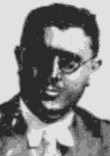
Downtown Pittsburgh's earliest documented Mafia boss, Gregorio Conti was a duplicitous underworld leader and an unscrupulous businessman. His treachery appears to have been repaid through his assassination at the dawn of the U.S. Prohibition Era.

Conti's native town of Comitini was engaged in sulfur mining and in the farming of grapes, olives and citrus at the time of his birth to Giacomo and Gesua Terrana Conti. Gregorio Conti may have learned about wines and distilled spirits as a young man in Sicily. He appears to have run his own business before deciding to follow his brother - Dr. Gaetano Conti - across the Atlantic.

Gregorio Conti sailed from Palermo on Sept. 17, 1907, and arrived in New York harbor on Oct. 3. He left behind in Sicily his wife and their two young children. He was accompanied on the voyage by fellow Comitinesi Giuseppe Cusumano and Vincenzo Terrana. Cusumano was a nephew of Conti and a trained chemist. Terrana, a surgeon, appears to have been a relative of Conti's mother. All three continued on from New York to Pittsburgh, meeting up with Dr. Gaetano Conti at 29 Chatham Street in the heart of the city's central Hill District. (Dr. Conti maintained the same office until his death in 1927.)

Gaetano already was a man of some importance in the community, serving as physician for the Italian consulate at Pittsburgh. In 1909, Dr. Conti was involved in a criminal investigation of the consulate after his signature was found on phony papers documenting the physical incapacitation of Italian immigrants seeking to avoid military service in their native country. Dr. Conti and Vice Consul Natali reported that seals, stamps and other materials of the consul's office had been stolen by a short-term office worker and used to generate the fraudulent documents, which were then sold. One of several suspects in the case accused Dr. Conti of being behind the racket, saying he paid the doctor $70 for a certificate of incapacitation.

Gregorio Conti was naturalized a citizen of the U.S. early in 1913. Later in the year, his wife and their children sailed from Sicily to join him in Pittsburgh. Conti had opened a business, Pittsburgh Wine & Liquors, at 801 Wylie Avenue, a couple doors down from his brother's offices. The Conti family resided in an apartment above the business. Giuseppe Cusumano worked for his uncle.

Conti seems to have attained a leadership position in downtown Pittsburgh's Sicilian underworld organization at about the time that the city's most successful produce merchant, Salvatore "Banana King" Catanzaro was seriously hurt in a stabbing incident. Conti may have assumed leadership of an organization formerly run by Catanzaro. (As Catanzaro recovered in spring 1914, Pittsburgh produce merchants threw him a large party. The guests included a number of names linked with Sicilian organized crime in the region.)

Western Pennsylvania of that period was home to a large number of small Neapolitan, Calabrian and Sicilian criminal organizations. The Sicilian Mafia units were linked through a loose regional network.

Nick Gentile, whose memoirs recounted many events in early U.S. Mafia history, joined Conti in Pittsburgh in 1915. By then, Conti was well established as boss of the Hill District Mafia and was already rubbing many the wrong way. Gentile noted that Conti frequently picked fights with Cusumano (a problem Gentile resolved by sponsoring Cusumano as a Mafioso, entitled to respect), increased his profits by selling fraudulently labeled liquor and secretly cooperated in Neapolitan Camorra extortion of Sicilian residents.

Gentile claims that he initiated a personal war against the once-dominant Camorra that resulted in its complete capitulation to the Sicilian Mafia. By about 1917, Neapolitan and Calabrian gangs had been incorporated into a regional Mafia-dominated network.

In the spring of 1918, Gentile and grocery business partners Samuel DiBella and Orazio Leone (Leone and DiBella were likely related) were convicted of conspiring to defraud their suppliers out of $22,000 in produce. The men filed a legal appeal. Conti pressured successful fruit merchant J.C. Catalano to provide $4,000 bail for Gentile's release. Once out of prison, Gentile left the country to return to Sicily, and Catalano's bail was forfeited. The merchant demanded that Conti personally compensate him for the loss or acquire repayment through Gentile. Conti stalled for time.

J.C. Catalano (left) is photographed with other Pittsburgh
produce merchants in 1916. (Pittsburgh Gazette Times).

The following year, the Wartime Prohibition Act (too late to provide any Great War benefit but intended to remain in effect through demobilization) made the sale, manufacture and transport of alcoholic beverages illegal. That closed Conti's legitimate business. Any continued sale of alcohol would have exposed Conti to enforcement by Justice Department and its Bureau of Investigation.

In September, Conti suddenly decided that he, his family and his fortune would return to Sicily. This decision coincided with rumors that he recently had earned $5,500 by convincing some Italian purchasers from New Castle, PA, that 110 cases of bottled river water was actually 110 cases of whiskey.

Conti and his wife obtained passports on Sept. 12, 1919, stating that they needed to return to Italy immediately to settle Giovanna's family estate. They prepared to travel by train to New York City on Sept. 25 and then take a steamer to Italy in early October.

On the eve of their departure from Pittsburgh, Gregorio Conti was shot four times through the back while sitting in his automobile, at Twenty-first and Smallman Streets, with J.C. Catalano, J.C.'s cousin Philip Catalano and Orazio Leone. Conti was alive but unconscious when police arrived. He was dead upon arrival at St. Francis Hospital. The official cause of death was "shock and hemorrhage due to gunshot wounds through heart (murder)."

Pittsburgh Press, Sept. 24, 1919.
The Catalanos and Leone were apprehended. They admitted they were with Conti but claimed that a small man unknown to them jumped on the vehicle's runningboard, shot Conti and ran off before they could react to prevent it or detain the shooter. Police investigated the claim, though Captain of Detectives Clyde Edeburn doubted that anyone outside of the automobile could have shot Conti through the back of the driver's seat. Edeburn also noted that the murder weapon was recovered and turned out to be a pistol that required time-consuming manual cocking before each shot could be fired.

Conti's immediate successor as underworld boss of downtown Pittsburgh is unknown. Salvatore Calderone, an Apollo-based Mafia elder statesman and head man of the regional Mafia network, probably played a role in managing the organization. The next documented Mafia boss in Pittsburgh was Stefano Monastero.

Link:


Sources: 

  • Certificate of Death, Allegheny County Pennsylvania, file no. 88497, registered no. 7570, filed Sept. 26, 1919.
  • Declaration of Intention, no. 13546, U.S. District Court for the Western District of Pennsylvania, Oct. 15, 1910.
  • Declaration of Intention, no. 13547, U.S. District Court for the Western District of Pennsylvania, Oct. 15, 1910.
  • Gentile, Nick, with Felice Chilante, Vita di Capomafia, Rome: Crescenzi Allendorf, 1993, p. 51-54, 56-57, 62-67.
  • Naturalization Petition, no 7775, U.S. District Court for the Western District of Pennsylvania, Nov. 6, 1912.
  • Passenger manifest of S.S. Argentina, departed Palermo on June 14, arrived New York City on June 28, 1911.
  • Passenger manifest of S.S. Canada, departed Palermo on Nov. 5, 1913, arrived New York on Nov. 17, 1913.
  • Passenger manifest of S.S. Carpathia, departed Palermo on Sept. 17, 1907, arrived New York City on Oct. 3, 1907.
  • Passenger manifest of S.S. Ivernia, departed Palermo on April 24, 1912, arrived New York on May 9, 1912.
  • Passport application, no. 117780, U.S. District Court at Pittsburgh PA, Sept. 12, 1919.
  • Passport application, no. 117781, U.S. District Court at Pittsburgh, PA, Sept. 12, 1919.
  • Pennsylvania Wills and Probate Records, Allegheny County, Ancestry.com.
  • United States Census of 1920, Pennsylvania, Allegheny County, Ward 8, Enumeration District 444.
  • World War I draft registration card, serial no. 3830, order no. A663, stamped 37-1-21C, Pittsburgh, PA, Sept. 12, 1918.

  • "Fruit dealer gets damages," Pittsburgh Press, May 5, 1911, p. 3.
  • "Gigantic fraud practiced upon Italian consul," San Francisco Call, Aug. 15, 1909, p. 25.
  • "Italian graft arrests," Philadelphia Inquirer, Aug. 18, 1909, p. 3.
  • "Many attend banquet; all banana merchants," Pittsburgh Gazette Times, May 8, 1914, p. 2.
  • "Indictments," Pittsburgh Daily Post, Jan. 11, 1917, p. 12.
  • "Court news," Pittsburgh Daily Post, May 24, 1918, p. 14.
  • "Men are convicted for $22,000 fraud," Pittsburgh Press, May 27, 1918, p. 7.
  • "Court news," Pittsburgh Daily Post, Sept. 6, 1918, p. 13.
  • "Police take three suspects in Conti murder," Pittsburgh Gazette Times, Sept. 26, 1919, p. 1.
  • "Nation goes dry under wartime act," New York Times, July 1, 1919, p. 1.
  • "Murdered in Auto," Pittsburgh Press, Sept. 24, 1919, p. 1.
  • "Italian is shot to death at Pittsburgh," Harrisburg PA Evening News, Sept. 24, 1919, p. 1.
  • "Wine merchant foully killed," Wilkes Barre Times Leader, Sept. 25, 1919, p. 18.
  • "Three held in Conti murder case," Pittsburgh Post, Sept. 26, 1919, p. 1.
  • "Police weave strong web about Italians held in murder case," Pittsburgh Press, Sept. 26, 1919, p. 34.
  • "Police take three suspects in Conti murder," Pittsburgh Gazette Times, Sept. 26, 1919, p. 1.
  • "Bail refused accused trio in Conti case," Pittsburgh Gazette Times, Sept. 27, 1919.
  • "Conti murderer now known to detectives," Pittsburgh Press, Sept. 27, 1919, p. 10.
  • "Conti murder suspects held for coroner," Pittsburgh Post, Sept. 28, 1919, p. 12.
  • "Police still lack clue in Conti case," Pittsburgh Gazette Times, Sept. 30, 1919, p. 9.
  • "Three men jailed in murder case," Pittsburgh Post, Oct. 3, 1919, p. 2.
  • "Three accused as accessory in Conti case," Pittsburgh Gazette Times, Oct. 3, 1919, p. 12.
  • "3 murder suspects held without bail," Pittsburgh Press, Oct. 3, 1919, p. 29.
  • "Murder suspects are released on bail," Pittsburgh Press, Oct. 5, 1919, p. 10.
  • "In Pennsylvania," Indiana PA Patriot, Oct. 11, 1919, p. 4.
  • "Dr. Gaetano Conti," Pittsburgh Press, Oct. 26, 1927, p. 8.

Abbatemarco, Michael (1894-1928)

Born Brooklyn, NY, Sept. 3, 1894.
Killed Brooklyn, NY, Oct. 6, 1928.

Known as "Mike Schatz" ("Schatz" is a German word for "sweetheart") or "Mike Shots," Michael Abbatemarco was an influential Brooklyn gangster of the Prohibition Era. He was a top lieutenant in the Frank Yale organization of Brooklyn. His relatives are counted among the early building blocks of the Profaci Crime Family presence in the Gowanus area.

The Abbatemarco family roots extend back to the southern portion of the Province of Salerno in Italy. Michael Abbatemarco's parents, Anthony and Rose, traveled to the the United States in the mid-1880s. By 1910 they were settled in the Gowanus section of Brooklyn. Michael was born Sept. 3, 1894, in Brooklyn. He grew up in the Italian neighborhoods of Carroll Street, President Street and Union Street. As a teenager, he worked for a time with his father at a "manure dump," making fertilizer. He later worked for a meat market and as a truckman. In the Great War, Abbatemarco served his country in Europe with the Army's Sixteenth Engineers and returned home in April 1919.

Early in 1920, he was living in his parents home, 265 Third Avenue in Brooklyn, in the same Gowanus neighborhood where he grew up. His brother Frank, then 21, and 17-year-old sister Christina also lived there. Their neighbors and close friends were the Cardellos. Michael Cardello, a stonecutter, and his wife Antoinette, had six sons and four daughters ranging in age from one year to 25 years.

The Prohibition Era provided enormous rewards for those willing to break the law, and Michael Abbatemarco apparently gave into the temptation. He moved to Manhattan's Catherine Street, just across the East River from Brooklyn, and became involved in rum-running. At about the same time, Abbatemarco took a bride, an Irish-American woman, Tessie McNab. The couple had a son in 1921 and named him Anthony.

The dangers of illegal activity quickly became apparent. Michael Abbatemarco and two companions were arrested for smuggling Jan. 7, 1922, at the South Fourth Street Pier in Brooklyn. A customs inspector arrived at the pier while Abbatemarco and his associates were moving an unknown cargo from the S.S. St. Mary, just arrived from Havana, to a motorboat. Shots were fired, and one of the smugglers, Richard Price, was wounded. Several other men who were part of the smuggling effort escaped in the motorboat. Abbatemarco appears to have avoided any significant punishment for his activities at the South Fourth Street Pier.

Michael moved himself and his family back to Brooklyn around 1923. Through the Prohibition Era, Michael Abbatemarco increased in importance within the Brooklyn underworld organization of Frankie Yale. Some suggested Abbatemarco held a monopoly on Prohibition Era beer sales. He became a leading figure in the underworld following the murder of Yale in July 1928, though most sources agree that Anthony "Little Augie Pisano" Carfano succeeded to the leadership of Yale's organization.

Immediately after Yale's death, Abbatemarco purchased a flashy new automobile and changed his address. He moved from his home at 321 First Street in Brooklyn to a two-story yellow brick home at 38 Seventy-Ninth Street in the borough's Bay Ridge section. But Abbatemarco did not have long to enjoy his new riches.

Brooklyn Daily Eagle, Oct. 7, 1928.
On the evening of October 5, 1928, Abbatemarco played poker at a coffeehouse, Union Street and Fourth Avenue, with several other men, including Tony and Jamie Cardello. It was after 3 a.m. when Abbatemarco left the card game for home. Jamie Cardello reportedly walked him to the curb. A gangster by the name of Ralph Sprizza may have been with Abbatemarco at the time. Abbatemarco got into his coupe and drove away. He and the car were next seen at 4:15 a.m. in front of 2421 Eighty-Third Street in Bensonhurst, Brooklyn. Abbatemarco was slumped dead behind the wheel with bullet wounds in his neck, forehead, right cheek and chest. The car's engine was still running.

A young man named Jack Simon, who was walking by just before the killing, told police he saw a man get out of the stopped car. He recalled hearing some gunshots a short time later and turned to see the man walking through a vacant lot to 84th Street. Police discovered a just-fired handgun in the lot.

Detectives explored a number of motives for the slaying of Abbatemarco: He may have been double-crossed by an underworld associate, he may have been disciplined for double-crossing someone else, he may have been a casualty of a civil war in the former Yale gang, or he may have been killed due to a personal grudge or romantic affair.

Abbatemarco's funeral
Abbatemarco's funeral was nearly as impressive as that of his former underworld boss, Yale. His coffin, of silvered bronze, had an estimated value between $6,000 and $10,000. The funeral cortege included more than 100 cars and fourteen cars of floral decorations. Due to his service in the Great War, a military honor guard - eight riflemen from the Eighteenth Infantry, First Division, at Fort Hamilton - participated in the funeral. Anthony Carfano was conspicuously absent from the funeral, though he reportedly sent a large floral piece - a tower of roses topped by a fluttering dove. Newspapers noted that Carfano had not been in Brooklyn, except for quick visits, since the murder of Yale. John "Ross" DeRosa, believed to be a manager of Carfano's interests in the borough, did attend the Abbatemarco services. Burial was at Holy Cross Cemetery. Abbatemarco's wife Tessie and mother Rosa wept and swooned at the gravesite.

In February of 1929, police arrested Ralph "The Captain" Sprizza, 33, in connection with the murder of Michael Abbatemarco. Sprizza, originally from Naples, was largely a product of the same Gowanus neighborhood as Abbatemarco and had served two prison sentences for burglary. A member of Profaci's crime family, he was said to have been the last person to see Abbatemarco alive. Police suggested to the press they had evidence that Sprizza fired the bullets that took Abbatemarco's life. Sprizza denied any involvement in the killing.

Abbatemarco's brother Frank, nephew Anthony Abbatemarco and relative Joseph Magnasco went into the Brooklyn-based Profaci Crime Family. They became associated with the President Street crew that later became controlled by the Gallo brothers. Frank Abbatemarco and Joseph Magnasco were both murdered. Anthony Abbatemarco increased in underworld stature as Joseph Colombo took over the leadership of the Profaci family. He became a strong faction leader in the Profaci-Colombo organization and eventually rose to the position of crime family underboss.

Sources:

  •  New York State Census of 1915.
  •  Passenger manifest of S.S. Cheribon, sailed from Naples, arrived New York City March 9, 1887.
  •  SAC New York, FBI memo, NARA #124-10287-10228, June 22, 1964.
  •  United States Census of 1910.
  •  United States Census of 1920.
  •  United States Census of 1930.
  •  World War I Draft Registration Card of Michael Abbatemarco, June 1917.
  •  “Brooklyn engineers home on the Panaman,” Brooklyn Standard Union, April 23, 1919, p. 12.
  •  “Man fleeing from customs inspector is shot twice,” New York Tribune, Jan. 8, 1922, p. 14.
  •  “Obituaries,” Brooklyn Standard Union, Nov. 2, 1922.
  •  “In memoriam,” Brooklyn Standard Union, Jan. 5, 1928, p. 16.
  •  “Uale friend slain in car as he sits at driving wheel,” Brooklyn Standard Union, Oct. 6, 1928, p. 1.
  •  “Uale’s successor slain in auto by lone gunman, jealousy in gang hinted,” Brooklyn Daily Eagle, Oct. 6, 1928, p. 1.
  •  Daniell, F. Raymond, “Yale successor slain near place where chief died,” New York Evening Post, Oct. 6, 1928, p. 1.
  •  “Uale gang leader slain like his chief,” New York Times, Oct. 7, 1928, p. 1
  •  Rogers, Wilbur E., “Search for rival whom slain gang chief had defied,” Brooklyn Daily Eagle, Oct. 7, 1928, p. 1.
  •  “Beer racket clue at Philadelphia in gang slaying,” Brooklyn Daily Eagle, Oct. 8, 1928, p. 1.
  •  “Gang chief buried with honor guard,” New York Evening Post, Oct. 10, 1928, p. 1.
  •  “Wife of slain beer racketeer swoons in rite at son’s grave,” Brooklyn Standard Union, Oct. 10, 1928, p. 13.
  •  “Throng at funeral of slain Uale aide,” New York Times, Oct. 11, 1928.
  •  “Arraign suspect in gang murder of Abbatemarco,” Brooklyn Daily Eagle, Feb. 5, 1929, p. 5.
  •  “Killing of aide to Uale is laid to man in quiz,” Brooklyn Standard Union, Feb. 5, 1929, p. 1.


Yale, Frank (1893-1928)

[This bio is an excerpt from a larger article, "What do we know about Frankie Yale?"]

Born Longobucco, Italy, Jan. 22, 1893.

Killed Brooklyn, NY, July 1, 1928.

Frankie Yale
Frankie Yale was a Brooklyn gangster and businessman with ties to Giuseppe "Joe the Boss" Masseria and Al Capone. His 1928 assassination coincided with dramatic changes in the Brooklyn underworld and the Mafia of the United States.

Yale was born Jan. 22, 1893, in Longobucco, a town in the southern mainland Italian region of Calabria. His father, Domenick Ioele, was born about 1860. His mother, Isabella DeSimone Ioele, was born between 1863 and 1865. Frank had two brothers, John and Angelo, and a sister, Assunta. Domenick Ioele crossed the Atlantic to America in 1898. John and Frank joined him in New York in the early 1900s. Isabella, Assunta and Angelo followed on Sept. 4, 1907. Domenick worked as a wholesale produce merchant. John was employed as a postcard printer. Frank "Yale" found early work as a railroad guard.

Yale's first arrest occurred in October 1912. He was convicted of disorderly conduct and fined $10. In July 1913, he was arrested with Michael Petro and Andrew Bombara for first-degree robbery and second-degree assault. In court, the victim refused to identify the defendants. Yale become involved in some gang conflicts, including a brawl that drew police officers to a Bath Beach, Brooklyn, coffeehouse on Feb. 1, 1917. Yale, then 23, and two other men were arrested for carrying revolvers. On May 21, Yale was convicted on a weapons charge and was given a stay in the penitentiary on Blackwell's Island.

In the same year, Yale married Mary DeLapere. In June 1918, daughter Isabella was born to the couple. Another daughter, Rose, was born in October 1919. In January, 1920, the young Yale family lived with Mary's parents in a multi-family home at 6605 14th Avenue in Brooklyn. At that time, Yale reported that he was employed as an undertaker.

Yale was noted in Chicago at the time of "Big Jim" Colosimo's May 1920 murder and was briefly considered a suspect in the killing.

Yale was wounded in the chest during a two-day gang fight at Manhattan's Park Row in February 1921. Another brawling gangster, Michael Demosci, was killed in a shootout. In June, Yale was arrested in connection with the decapitation murder of Ernesto Melchiorre at Coney Island. He was quickly released for lack of evidence. A short time later, on July 15, Yale's car was riddled with heavy-caliber bullets fired from a passing vehicle. Robert (Rocco) Lawrence of 72nd Street and Yale's brother Angelo were wounded in the attack. Frank Yale and companions Anthony "Little Augie Pisano" Carfano and "Babe" Cannalle were unharmed. Silvio Melchiorre, brother of the recently murdered Ernesto, was killed eight days later. Yale was suspected of involvement but there was no evidence to hold him.

In the early 1920s, Giuseppe "Joe the Boss" Masseria eliminated a bothersome rival and assembled a strong Mafia organization in Manhattan. He quickly welcomed Yale and Carfano into his growing underworld empire.

As a businessman, Yale was involved in a funeral home, in a restaurant, some laundries, a taxi company and a cigar manufacturing plant. "Frankie Yale" cigars included with the crime boss's image on the box. Yale provided generously to charities in Brooklyn and was a donor to St. Rosalia's Roman Catholic Church.

In the early morning of July 9, 1923, another attempt was made to murder him. Gunmen shot and killed the only occupant of the Yale automobile, driver Frank Forte. Police and press concluded that Forte was killed by accident.

Yale made another trip west to Chicago in November 1924, following the death of highly regarded Chicago Mafia leader Michele Merlo. Yale traveled along with Brooklyn Mafioso Saverio "Sam" Pollaccia. The visit of the Brooklyn mobsters coincided with the Nov. 10 murder of Chicago's North Side Gang boss, Dean O'Banion.

Chicago Police recalled that Yale had been in town when Colosimo was killed and suspected him of involvement in the O'Banion murder. Yale and Pollaccia were held, as police checked into their alibis. When their stories checked out, they were released.

Yale's father, Domenico, died at his Brooklyn home on March 3, 1926. His March 6 funeral was said to be among the largest recalled in Brooklyn.

That summer, Yale and his wife separated. Yale began spending time with a woman in Manhattan, though he continued to support Mary and their daughters. He quietly sought a divorce. That summer, Yale married again. He and his wife Lucita were joined in a civil ceremony in Brooklyn. Some said that Lucita had formerly been married to a murdered Mott Street restaurateur.

When friction began between Capone and Sicilian Mafia bosses in Chicago, Masseria stepped in to make Capone his personal vassal, a capodecina in the Masseria organization. At about the same time, Masseria became quite close to Yale lieutenant Carfano. Yale, targeted by rivals for many years, was growing less important to his primary underworld protector, Masseria.

Capone and Yale reportedly partnered in a rum-running operation. Rumors got back to Capone that Yale was cheating him. Capone responded by having a spy named James DeAmato inserted into Yale's organization. In July 1927, DeAmato was found dead on a Brooklyn street.

On May 2, 1928, a daughter was born to Frank and Lucita Yale. Later in the year, Mary Yale was granted an interlocutory divorce decree including alimony of $35 a week.

At about 4 p.m. on July 1, 1928, Yale was driving his Lincoln automobile along 44th Street in Brooklyn, when he was overtaken by a black sedan. Shots were fired into the Lincoln's rear window, and Yale accelerated in an effort to escape. The two cars came abreast between 9th and 10th Avenues, and a volley was fired by pistols and a sawed-off shotgun into Yale's car. Yale's skull was crushed by the slugs, and his car veered off the road, crashing into the stone steps in front of 923 44th Street. He died immediately.

Yale was given an elaborate gangland sendoff, arranged by the Graziano & Janone Funeral Home and his lieutenant Anthony Carfano. A funeral Mass was celebrated at St. Rosalia's Church. An estimated 15,000 people turned out to catch a glimpse of Yale's reported silver coffin, believed to be worth $15,000. The funeral cortege included 200 automobiles of mourners and a "mountain of floral tributes, gaudy enough to have satisfied even the show-loving gang leader."

The police investigation of Yale's killing eventually pointed to Capone. Three of Capone's associates reportedly had left him in Miami Beach and headed north on a train that reached New York City hours before the murder. Investigators learned that Capone had threatened Yale following the slaying of James DeAmato. Later, ballistic evidence linked the weapons used in the Yale killing with those used in the St. Valentine's Day Massacre in Chicago. Police arrested various individuals in connection with the Yale murder but were unable to assemble a convincing case against any of them.

Though the loss of his powerful Brooklyn group leader should have negatively impacted Giuseppe Masseria, Masseria appears to have suffered no ill effect. By the end of the 1928, Masseria was proclaimed boss of bosses of the Mafia in the United States. Two other men appear to have benefited greatly from the elimination of Yale. Anthony Carfano took charge of many of Yale's lucrative rackets. And Giuseppe Profaci, who quietly led a small Mafia organization comprised of relatives and fellow immigrants from Villabate, Sicily, assumed control of Yale men and territory in southern Brooklyn. The added strength and prestige instantly made Profaci a significant player in the national Mafia network.

Sources:

  •  "1,000 suspects seized by Chicago police," New York Times, Nov. 17, 1924.
  •  "10,000 guarded in Frank Yale's $50,000 burial," New York Evening Post, July 5, 1928, p. 18.
  •  "2 men wounded when gangsters attack in motor," Brooklyn Daily Eagle, July 15, 1921, p. 18.
  •  "Auto gunmen wound two in car and flee," New York Tribune, July 16, 1921, p. 13.
  •  "Capone subpoenaed in murder of Yale," New York Times, July 8, 1928, p. 3.
  •  "Decision reserved in case of justices' pistol permits," New York Tribune, Feb. 25, 1922, p. 7.
  •  "Frank Yale saved again in gang feud; friend shot dead," Brooklyn Daily Eagle, July 9, 1923, p. 18.
  •  "Gangster shot dead in daylight attack," New York Times, July 2, 1928, p. 1. 
  •  "Give up monument at Uale son's request," Brooklyn Standard Union, March 12, 1926, p. 6.
  •  "Gun that slew Yale traced to Chicago and Capone arsenal," New York Times, Jan. 18, 1930, p. 1.
  •  "Gunmen kill man in crowded street; old feud suspected," New York Tribune, July 24, 1921, p. 7.
  •  "Gunmen kill one, wound 2, in Park Row," New York Tribune, Feb. 7, 1921, p. 3.
  •  "Hold merchant for perjury," Brooklyn Daily Eagle, July 9, 1913, p. 2.
  •  "Hunt Yale's slayer at showy funeral," New York Times, July 6, 1928.
  •  "In the real estate market: Parochial school to cost $175,000," Brooklyn Daily Eagle, May 24, 1928.
  •  "Permits by justices to carry guns valid," New York Evening World, March 2, 1922, p. 2.
  •  "Police reports clash on fatal Yale bullet," New York Times, Jan. 29, 1930. 
  •  "Prison, then exile for daring robber," Brooklyn Daily Eagle, May 21, 1917, p. 3. 
  •  "Question gangster in Marlow murder," New York Times, July 19, 1929, p. 16. 
  •  "Ruby Goldstein stops Cecolli in first round," Brooklyn Standard Union, May 3, 1927, p. 11.
  •  "Say three carried guns," Brooklyn Daily Eagle, Feb. 2, 1917, p. 20.
  •  "Shot dead for another," New York Times, July 9, 1923.
  •  "Uale breaking ground for parochial school," Brooklyn Daily Eagle, July 2, 1928, p. 3.
  •  "Uale, gangster, left estate of $3,000 only," New York Times, Oct. 15, 1930.
  •  "Warren rebuffs plea to fight gangs," New York Times, July 12, 1928, p. 1.
  •  "Yale killed by Chicago gun," New York Sun, Jan. 18, 1930, p. 2.
  •  Critchley, David, The Origin of Organized Crime in America: The New York City Mafia, 1891-1931, New York: Routledge, 2009.
  •  Domenico Ioele Death Certificate, No. 5158, Kings County, NY, March 3, 1926.
  •  Frank Uale Death Certificate, Borough of Brooklyn, City of New York, No. 14764, July 1, 1928, filed July 3, 1928.
  •  Gentile, Nick, Vita di Capomafia, Rome: Editori Riuniti, 1963.
  •  Pasley, Fred D., Al Capone: The Biography of a Self-Made Man, Garden City NY: Garden City Publishing Company, 1930.
  •  Passenger manifest of S.S. Nord America, departed Naples on Aug. 22, 1907, arrived New York City on Sept. 4, 1907.
  •  Thompson, Craig, and Allen Raymond, Gang Rule in New York: The Story of a Lawless Era, New York: Dial Press, 1940.
  •  U.S. Census of 1910, Brooklyn borough, New York, Supervisor's District 2, Enumeration District 1073, Ward 30. 
  •  U.S. Census of 1920, Brooklyn borough, New York, Supervisor's District 3, Enumeration District 955, Ward AD-16.
  •  U.S. Census of 1930, Brooklyn borough, New York, Supervisor's District 32, Enumeration District 23-1389, Ward AD-16.
  •  World War I draft registration card of Frank Uale, June 1917.
  •  World War I draft registration card of Angelo Ioele.


Zwillman, Abner "Longie" (1904/5-1959)

Born Newark, NJ, July 27, 1904/5.
Died (apparent suicide) West Orange, NJ, Feb. 26, 1959.

Abner Zwillman was born July 27, 1905 (some records indicate 1904) in Newark, New Jersey. He was one of seven children born to Reuben and Anna Slavinsky Zwillman, Russian immigrants. Zwillman was raised in one of Newark's poorer neighborhoods. He reportedly dropped out of grammar school in the eighth grade. Zwillman's departure from school roughly coincided with the disappearance of his father from available records.

In the late 1920s and early 1930s, as Zwillman advanced in rank within the Newark underworld, he had his first brushes with the law. He was arrested by the Newark Police Department on March 8, 1927, for assault and battery. The charge was later dismissed. In November 1928, an additional charge of assault and battery was filed against him, this time by the Essex County Sheriff's Office. Zwillman remained free until December 1930. He was convicted on the charge on Dec. 11, 1930, and was sentenced to six months in Essex County Penitentiary and a $1,000 fine.

Outwardly a fruit and vegetable dealer, Zwillman actually controlled much of the illicit alcohol flowing into the State of New Jersey during Prohibition. Around 1926, he had begun a close association with New York racketers Louis "Lepke" Buchalter, Benjamin "Bugsy" Siegel, Meyer Lansky, Jacob "Gurrah" Shapiro, Morris Samuel "Dimples" Wolinsky and Benjamin "Cuddy" Kutlow, and also became acquainted with Mafiosi Willie Moretti, Charlie "Lucky" Luciano, Frank Costello, "Trigger Mike" Coppola, Giuseppe "Joe Adonis" Doto, Anthony "Little Augie Pisano" Carfano, Gerardo Catena and Charles and Rocco Fischetti.

His underworld relationships were not always positive. Press reports discussed a rivalry between Zwillman, de facto political boss of Newark's Third Ward, and Ruggiero "Richie the Boot" Boiardo of the First Ward. At one point, Zwillman's Third Ward Political Club at Waverly and Avon Streets was held up by armed intruders, presumably Boiardo men. There followed a peace conference between the Newark factions, brokered by Mafia leaders.

With the end of Prohibition, Zwillman moved to 120 Hansbury Avenue and later to South Munn Avenue in East Orange from 1936 to 1946. On July 7, 1939, he married Newark native Mary Mendels Steinbach, previously divorced mother of a five-year-old son. The wedding was attended by 300 people, and the press indicated that most of the attendees were racketeers from eastern U.S. criminal syndicates. After returning from a honeymoon lasting 40 days, Zwillman found himself in a federal courtroom. Called as a witness before a Southern District of New York grand jury looking into the disappearance of Lepke Buchalter, Zwillman was asked about his business and business associates. He refused to answer the questions. Judge Johnson J. Hayes found Zwillman in contempt and sentenced him to six months in prison. The conviction was overturned on appeal.

The Zwillman family moved to 50 Beverly Road in West Orange in 1946. Costly improvements made to the household in the following years caught the attention of federal investigators, who determined that the improvements could not have been paid for with the meager income Zwillman and his wife reported on their tax returns.

In the summer of 1950, Zwillman appeared before the U.S. Senate's Kefauver Committee for questioning in its investigation of organized crime in interstate commerce. At that time, Zwillman was regarded as the boss of the New Jersey underworld. His rackets included gambling operations and coin-operated vending and jukebox machines (a racket allegedly shared with Charlie Luciano). His legitimate business interests included Public Service "PS" Tobacco cigarette vending company (shared with Luciano's close friend Michael Lascari), Federal Automatic washing machine company, E&S Trading scrap iron company, A&S Trading machinery company and Greater Newark GMC Truck Sales Co.He was said to have considerable influence in politics and labor unions.

A first effort to prosecute Zwillman for tax evasion failed in summer 1953, when a federal grand jury would not indict. In the spring of 1954, Zwillman was indicted by a federal grand jury in Newark on two counts of income tax evasion. The charges related to tax returns filed by Zwillman and his wife in 1947 and 1948. Trial began before Judge Reynier J. Wortendyke Jr. in January 1956 and concluded with a hung jury on March 1.

In January 1959, an FBI microphone installed at Newark's Supreme Beverage Company overheard Zwillman men conversing about steps that were taken to ensure that Zwillman would not be convicted in the 1956 trial. Federal prosecutors early in February filed charges against Peter Dominick LaPlaca, Samuel "Big Sue" Katz and Edward A. Goodspeed for offering and paying bribes to two jurors in the 1956 Zwillman tax trial.

On Feb. 26, 1959, Zwillman was found dead in his West Orange home. That morning, his wife discovered his lifeless body suspended from its neck by an electrical cord tied to a basement rafter. She told police she recalled her husband getting up in the middle of the night complaining of chest pains. Zwillman had reportedly battled deep depression since Senate investigators recently began examining his role in the jukebox industry.

(See an expanded Zwillman article on the American Mafia website: The Capone of New Jersey - Abner 'Longie' Zwillman.)

Sources:

  •   Abner Zwillman FBI files.
  •  Organized Crime in Interstate Commerce (Kefauver Committee) hearings, Volume 12.
  •  New York Times archives.
  •  Washington Post archives.
  •  1910 and 1940 U.S. Census.
  •  1927 Newark City Directory.