Showing posts with label Siegel. Show all posts

Zwillman, Abner "Longie" (1904/5-1959)

Born Newark, NJ, July 27, 1904/5.
Died (apparent suicide) West Orange, NJ, Feb. 26, 1959.

Abner Zwillman was born July 27, 1905 (some records indicate 1904) in Newark, New Jersey. He was one of seven children born to Reuben and Anna Slavinsky Zwillman, Russian immigrants. Zwillman was raised in one of Newark's poorer neighborhoods. He reportedly dropped out of grammar school in the eighth grade. Zwillman's departure from school roughly coincided with the disappearance of his father from available records.

In the late 1920s and early 1930s, as Zwillman advanced in rank within the Newark underworld, he had his first brushes with the law. He was arrested by the Newark Police Department on March 8, 1927, for assault and battery. The charge was later dismissed. In November 1928, an additional charge of assault and battery was filed against him, this time by the Essex County Sheriff's Office. Zwillman remained free until December 1930. He was convicted on the charge on Dec. 11, 1930, and was sentenced to six months in Essex County Penitentiary and a $1,000 fine.

Outwardly a fruit and vegetable dealer, Zwillman actually controlled much of the illicit alcohol flowing into the State of New Jersey during Prohibition. Around 1926, he had begun a close association with New York racketers Louis "Lepke" Buchalter, Benjamin "Bugsy" Siegel, Meyer Lansky, Jacob "Gurrah" Shapiro, Morris Samuel "Dimples" Wolinsky and Benjamin "Cuddy" Kutlow, and also became acquainted with Mafiosi Willie Moretti, Charlie "Lucky" Luciano, Frank Costello, "Trigger Mike" Coppola, Giuseppe "Joe Adonis" Doto, Anthony "Little Augie Pisano" Carfano, Gerardo Catena and Charles and Rocco Fischetti.

His underworld relationships were not always positive. Press reports discussed a rivalry between Zwillman, de facto political boss of Newark's Third Ward, and Ruggiero "Richie the Boot" Boiardo of the First Ward. At one point, Zwillman's Third Ward Political Club at Waverly and Avon Streets was held up by armed intruders, presumably Boiardo men. There followed a peace conference between the Newark factions, brokered by Mafia leaders.

With the end of Prohibition, Zwillman moved to 120 Hansbury Avenue and later to South Munn Avenue in East Orange from 1936 to 1946. On July 7, 1939, he married Newark native Mary Mendels Steinbach, previously divorced mother of a five-year-old son. The wedding was attended by 300 people, and the press indicated that most of the attendees were racketeers from eastern U.S. criminal syndicates. After returning from a honeymoon lasting 40 days, Zwillman found himself in a federal courtroom. Called as a witness before a Southern District of New York grand jury looking into the disappearance of Lepke Buchalter, Zwillman was asked about his business and business associates. He refused to answer the questions. Judge Johnson J. Hayes found Zwillman in contempt and sentenced him to six months in prison. The conviction was overturned on appeal.

The Zwillman family moved to 50 Beverly Road in West Orange in 1946. Costly improvements made to the household in the following years caught the attention of federal investigators, who determined that the improvements could not have been paid for with the meager income Zwillman and his wife reported on their tax returns.

In the summer of 1950, Zwillman appeared before the U.S. Senate's Kefauver Committee for questioning in its investigation of organized crime in interstate commerce. At that time, Zwillman was regarded as the boss of the New Jersey underworld. His rackets included gambling operations and coin-operated vending and jukebox machines (a racket allegedly shared with Charlie Luciano). His legitimate business interests included Public Service "PS" Tobacco cigarette vending company (shared with Luciano's close friend Michael Lascari), Federal Automatic washing machine company, E&S Trading scrap iron company, A&S Trading machinery company and Greater Newark GMC Truck Sales Co.He was said to have considerable influence in politics and labor unions.

A first effort to prosecute Zwillman for tax evasion failed in summer 1953, when a federal grand jury would not indict. In the spring of 1954, Zwillman was indicted by a federal grand jury in Newark on two counts of income tax evasion. The charges related to tax returns filed by Zwillman and his wife in 1947 and 1948. Trial began before Judge Reynier J. Wortendyke Jr. in January 1956 and concluded with a hung jury on March 1.

In January 1959, an FBI microphone installed at Newark's Supreme Beverage Company overheard Zwillman men conversing about steps that were taken to ensure that Zwillman would not be convicted in the 1956 trial. Federal prosecutors early in February filed charges against Peter Dominick LaPlaca, Samuel "Big Sue" Katz and Edward A. Goodspeed for offering and paying bribes to two jurors in the 1956 Zwillman tax trial.

On Feb. 26, 1959, Zwillman was found dead in his West Orange home. That morning, his wife discovered his lifeless body suspended from its neck by an electrical cord tied to a basement rafter. She told police she recalled her husband getting up in the middle of the night complaining of chest pains. Zwillman had reportedly battled deep depression since Senate investigators recently began examining his role in the jukebox industry.

(See an expanded Zwillman article on the American Mafia website: The Capone of New Jersey - Abner 'Longie' Zwillman.)

Sources:

  •   Abner Zwillman FBI files.
  •  Organized Crime in Interstate Commerce (Kefauver Committee) hearings, Volume 12.
  •  New York Times archives.
  •  Washington Post archives.
  •  1910 and 1940 U.S. Census.
  •  1927 Newark City Directory.


Lansky, Meyer (1902-1983)

Born Grodno, Russia, July 4, 1902.

Died Miami, FL, Jan. 15, 1983.


Lansky was a long-time friend and "business" associate of Charlie Luciano, Benjamin Siegel, Frank Costello and other big-name Prohibition Era gangsters.

He was born Maier Suchowljansky in Grodno, Russia. Various dates of birth range from 1898 to 1902. Social Security death records and FBI files contain a birthdate of July 4, 1902. Some believe that his birthdate was erroneously recorded upon his entry into the U.S. and was actually Aug. 28, 1900. Lansky appears to have used the 1902 date in official papers.

The Jewish community in his native Grodno surrounded by and often assaulted by non-Jewish residents of the area. Lansky's earliest memories reportedly were of Jewish versus Gentile warfare. Lansky, his mother and his younger brother Jacob "Jake" sailed to America in 1911. They arrived in New York harbor on April 4, and were met by Lansky's father Max, who had traveled to the U.S. years earlier and was living on Lewis Street on the Lower East Side of Manhattan, in sight of the Williamsburg Bridge. They subsequently moved a very short distance to an apartment building near the corner of Columbia and Grand Streets.

In that neighborhood, populated by Jewish immigrants from Eastern Europe, Lansky met and befriended Benjamin Siegel (known as "Bugsy"). A friendship also developed with young Salvatore Lucania - later known as Charlie Luciano - who lived nearby. Luciano, Lansky and Siegel cooperated on some minor criminal enterprises, possibly working for Arnold Rothstein on occasion, and in scuffles with the nearby Irish-dominated gangs. They joined in racketeering ventures - likely including bootlegging, narcotics smuggling and labor racketeering - with Louis "Lepke" Buchalter, and possibly had business relationships with Dutch Schultz.

On Oct. 23, 1918, a teenage Lansky was arrested for felonious assault. He was later discharged. During Prohibition, Lansky, Siegel and Luciano engaged in rum-running. Lansky and Siegel regularly served as guards for illegal liquor shipments sent from New York to Chicago by Dutch Goldberg, Charlie Kramer and Bill Heisman. The two men also may have worked at hijacking competitors' liquor shipments. In the late 1920s, Lansky was suspected of involvement in the murder of Kiddy Kolbrenner, he was arrested for felonious assault, for violation of penal law and for homicide. Each time, he was discharged.

Luciano was absorbed into the New York Mafia organization of "Joe the Boss" Masseria, and Lansky and Siegel served informally as his advisors and enforcers.

In the early 1930s, Lansky became a trusted financial adviser to the Mafia's ruling Commission. His presence in Chicago in the spring of 1932 was documented by his April 19 arrest. He began setting up gambling facilities in Miami and Cuba and stayed regularly at the Hotel Nacional de Cuba in Havana. He also initially supported Siegel's vision of a gambling and entertainment Mecca in Las Vegas. Lansky reportedly held a secret financial interest in the Flamingo for many years.


In 1939, Lansky reportedly attended a top-level meeting of racketeers which considered how best to handle the law enforcement pursuit of fugitive Lepke Buchalter. Buchalter was wanted on narcotics charges and other racketeering offenses. Prosecutors in Brooklyn also were investigating Buchalter's connections to a series of murders. At the meeting, Lansky, Doc Rosen, Longie Zwillman and others decided that Buchalter must leave the country. Buchalter remained and eventually turned himself over to the authorities.

Lansky is generally credited with serving as an early 1940s go-between for the jailed Luciano and officials with U.S. Naval Intelligence. Lansky was among the noteworthy underworld visitors to Luciano at Great meadows Prison in Comstock, NY.

After World War II, Lansky and his brother Jake ran a gambling house near Miami known as the Colonial Inn. They took part in gambling operations in Saratoga and Hollywood. Lansky is believed to have collaborated with Frank Costello and Phil Kastel in the opening of the Beverly Club just outside of New Orleans in 1946.

In 1948, as Florida began to crack down on illegal gambling, Lansky sold off Colonial Inn. Pressure by the U.S. government against organized crime increased in the late 1940s, and Lansky was called before the Kefauver Committee Oct. 11, 1950. By that time, he was invested in a number of legitimate enterprises, including alcohol distributorships, food companies and coin-operated machines.

Lansky's major gambling investment, the Riviera Hotel in Havana, was lost with a change in Cuban leadership. Tourists had been discouraged from traveling to Cuba during the revolution of Fidel Castro's force. When Castro took over the government and embraced Communism, tourism shut down completely. The hotel, which by some estimated cost $14 million to build, had not be open long enough to recover more than a third of the initial investment.

Lansky's health, already an issue while developing his casino in Cuba, suffered further upon the casino's shutdown. He dealt with ulcers and chest pains and was hospitalized after a heart attack.

U.S. federal law enforcement agencies hounded Lansky for much of the rest of his life. In the early 1970s, he attempted to retire to Israel. Under pressure from the U.S., which wanted Lansky back home to face charges of skimming from the Flamingo, the Israeli government refused his request for permanent citizenship in 1971. Late in 1972, the Israeli Supreme Court backed the decision and Lansky was forced to attempt to find refuge elsewhere.

An airplane exodus took him first to Switzerland, then to Rio, then to Buenos Aires and on to Paraguay, where he hoped to set up a quiet life for himself. But U.S. authorities headed him off, and Paraguayan officials refused to let Lansky off the plane. The aircraft continued on with stops in La Paz, Lima and Panama before returning Lansky to Miami and the waiting American officials.

Lansky avoided conviction but three other attempts to go to Israel were blocked. He died in Miami on Jan. 15, 1983.


Doto, Giuseppe "Joe Adonis" (1901-1971)

Born Montemarano, Italy, Nov. 22, 1901.

Died Ancona, Italy, Nov. 26, 1971.

Adonis was born Giuseppe Antonio Doto in Montemarano, an Italian village within the province of Avellino, not far from the City of Naples. His family brought him to the United States when he was a child. His father Michele/Michael Doto (whose surname was also written "Dato" and "Adone") reached the U.S. first, in 1904, settling with an uncle on President Street in Brooklyn. Adonis and three brothers crossed the Atlantic with their mother in the summer of 1909. They joined Michele, then living on Brooklyn's Carroll Street. Some reports indicate the family lived for a time in Great Barrington, Massachusetts, but these could not be confirmed.

Over the years, Giuseppe Doto used a number of aliases before settling on the one that became famous. He referred to himself as "James Arrosa" or "Joseph Arroso" in the mid-1920s and as "Joseph DeMio" in the early 1930s. He likely picked up his "Adonis" alias from the "Adone" surname previously used by his family around the time of the 1915 New York State Census. The name "Adonis" referred to a human character in Greek mythology known for his physical attractiveness and his great hunting ability. The origins of the Adonis myth appear to blur with those of the hunter Orion, and these hunter tales may have been regional adaptations of a single original story. Both characters had tragic encounters with Greek goddesses.

A longtime Brooklynite, Joe Adonis was arrested for assault and battery in 1922 (not prosecuted), for grand larceny and robbery in 1926 (discharged), disorderly conduct in 1927 (fined), liquor smuggling in 1931 (not indicted), assault and robbery in 1937 (discharged) and kidnapping and extortion in 1940 (dismissed). He was affiliated early in his criminal career with regional Mafia bigshots Frank Yale and Anthony "Little Augie" Pisano (Anthony Carfano). These associations may have brought Adonis into the orbit of late 1920s Sicilian Mafia boss of bosses Giuseppe Masseria. Adonis, Pisano, Vito Genovese and Mike Miranda became the most prominent Neapolitans working within the Giuseppe Masseria organization.

Unsupported legends: According to some writers, who provide no supporting documentation, Adonis attended a May 13-15, 1929, national "convention" of bootleggers in Atlantic City. There is no hard evidence that Adonis was in Atlantic City at this time or that the "convention" involved anyone outside of visiting Chicago gang bosses. Some sources have named Adonis one of the gunmen who assassinated boss of bosses Giuseppe Masseria at Gerardo Scarpato's Nuova Villa Tammaro restaurant in Coney Island on April 15, 1931.

Mafia informant Joseph Valachi stated that Adonis - who directed criminal activity at the Brooklyn docks alongside Albert Anastasia and ran the Brooklyn eatery known as Joe's Italian Kitchen on Carroll Street and Fourth Avenue - was among those targeted for elimination by Maranzano after the conclusion of the Castellammarese War in 1931. Following Maranzano's assassination later that year, the Mafia reorganized. Adonis reportedly became a major player in the reorganized underworld, though his precise role, if any, in the Mafia hierarchy remains hazy.

Adonis's specific crime family affiliation has also been hazy. Some sources named him a top lieutenant in the Brooklyn Family of Vincent and Philip Mangano, while others placed him within Luciano's own Manhattan-based organization. Nicholas Gage suggested that Adonis was actually the first post-war leader of what became the Mangano Family, but this conflicted with accounts of better informed sources. (Gage did not offer a sufficient explanation for how or why Adonis became less than a Family boss later on.) Joe Bonanno, who probably knew Adonis' title, doesn't speak of it in his autobiography, and Valachi seems not to know anything about the Brooklyn mobster's status.

Evidence suggests that Adonis's authority - and close personal associations - overlapped the Mangano mob territory in Brooklyn, but that he owed his primary allegiance to his long-time friends Luciano and Frank Costello, based in Manhattan.

Adonis's mother, Maria DeVito Doto, passed away in the summer of 1934. His father died in April 1939.

Eventually, Adonis seemed to be everywhere and into everything - alcohol, gambling, drugs, union rackets, political shenanigans... He had established relationships with several Mafia Families and with some non-Italian gangs as well. Adonis was known to be a trusted ally and confidant of Frank Costello, who presided over Luciano's Manhattan Family after Luciano went to prison in the 1930s. Adonis joined Costello and Jewish mobsters Meyer Lansky and Benjamin Siegel in ownership of the Colonial Inn casino in Miami Beach and participated in gambling ventures in the Saratoga, New York, area. Adonis also shared a gambling empire in New Jersey with Mafioso Willie Moretti, Costello's close ally. His involvement in the Automotive Conveying Company of Cliffside Park, New Jersey, caught the attention of the U.S. Senate's Kefauver Committee and New Jersey prosecutors.

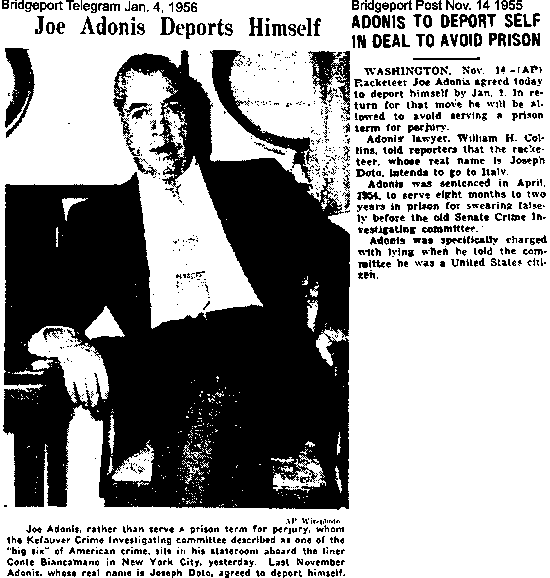
Adonis, who had long claimed to be an American native and who had settled in Fort Lee, NJ, in the mid-1940s (his Dearborn Road home was about a quarter mile from the Bluff Road home of Albert Anastasia), was shown to be an immigrant in the 1950s. Birth records indicating a 1901 birth in Passaic, New Jersey, were found to be fraudulent. Italian birth certificates, immigration records and early statements made by Adonis and his family members to authorities conflicted with statements Adonis made under oath before a New Jersey grand jury. Adonis was ordered to be deported in 1953. He fought that order in the courts. A voluntary deportation to Italy occurred in 1956 in the wake of a perjury charge stemming from the Kefauver Committee hearings.

One of the legendary fallings out between the American Mafiosi and the Kennedy Administration was allegedly over arrangements for the Mafia to support Kennedy's candidacy for President in return for Kennedy allowing Adonis back into the country. According to this tale, President John Kennedy was reportedly willing to welcome Adonis home, but Attorney General Robert Kennedy blocked the move.

The Italian government decided to inflict an exile within an exile upon Adonis on June 20, 1971. A Milan court demanded that he be restricted to the town of Ancona on Italy's Adriatic coast. Adonis died there of natural causes on Nov. 26, 1971. His remains were returned to the United States and buried Dec. 6 in Madonna Roman Catholic Cemetery in Fort Lee, NJ.


The Adonis funeral was relatively low-key. A cortege of fifteen automobiles, led by three cars of flowers, drove from Macagna's Funeral Home in Cliffside Park, New Jersey, to the funeral Mass at Epiphany Church. A private service was then held for Adonis's family - his wife, son and three daughters - and close friends at the chapel in Madonna Cemetery. The family and most attendees left before Adonis's casket was lowered into his grave. A number of reporters and photographers kept close watch on the event. There were no reports of known underworld figures in attendance.


Related Links:

Sources:

  • "Joe Adonis one of 8 cited in Dewey reply," Brooklyn Daily Eagle, Dec. 3, 1937, p. 1.
  • Investigation of Organized Crime in Interstate Commerce, Part 7, New York - New Jersey, Hearings before the Special Committee to Investigate Organized Crime in Interstate Commerce, U.S. Senate, 81st Congress 2nd Session, 82nd Congress 1st Session, Washington D.C.: U.S. Government Printing Office, 1951, p. 280-301.
  • Joseph Doto, Index of Births in New Jersey, 1901, A-H, certificate 37513.
  • Mary Doto, New York City Index to Death Certificates, certificate no. 15279, July 21, 1934.
  • Michael Doto, New York City Index to Death Certificates, certificate no. 9874, April 27, 1939.
  • Murray, Leo, "Offer birth certificates from Italy in Adonis case," Paterson NJ Morning Call, Jan. 15, 1954, p. 1.
  • New York State Census of 1915, Kings County, Brooklyn, Ward 10, Election District 11.
  • New York State Census of 1925, Kings County, Brooklyn, Assembly District 8, Election District 15. 
  • Passenger manifest of S.S. Citta di Milano, departed Naples on April 23, 1904, arrived New York on May 9, 1904.
  • Passenger manifest of S.S. Montserrat, departed Naples on June 23, 1909, arrived New York on July 11, 1909.
  • Plosia, Les, "Few turn out for Adonis burial," Passaic NJ Herald-News, Dec. 7, 1971, p. 12.
  • United States Census of 1920, New York State, Kings County, Brooklyn, Ward 14, Enumeration District 446.
  • United States Census of 1930, New York, Kings County, Brooklyn, Ward 10, Assembly District 8, Enumeration District 24-1079.
  • United States Census of 1940, New York, Kings County, Brooklyn, Assembly District 9, Enumeration District 24-1087.