Showing posts with label Lottery. Show all posts

Abbatemarco, Frank (1899-1959)

Born Brooklyn, NY, July 4, 1899.
Killed Brooklyn, NY, Nov. 4, 1959.

A link between the older Frank Yale organization of Brooklyn and the Giuseppe Profaci Crime Family, Frank Abbatemarco was one of several members of the Abbatemarco-Magnasco clan to be gunned down in mob hits.

Frank Abbatemarco was born in Brooklyn on July 4, 1899, fourth son of Anthony and Rose Abbatemarco and younger brother of Prohibition Era-racketeer Michael "Mike Schatz" Abbatemarco. Abbatemarco's parents left the Salerno province of Italy in the mid-1880s and settled in the Gowanus section of Brooklyn. They lived and raised their family in the Italian neighborhoods of Carroll Street, President Street and Union Street. They formed a close relationship with their neighbors, the Cardello family. (Four Cardellos also became members of the Profaci-Colombo Crime Family.)

As a teenager, Frank Abbatemarco found work in a local lumber yard. Within a couple of years, he was a employed as a teamster for a firm on Manhattan's lower west side. But legitimate work was not for him.

About 1921, Abbatemarco married. He and his wife Mary settled into a home on President Street in the Park Slope neighborhood of Brooklyn, just east of Gowanus. In the spring of 1922, their son Anthony was born.

In October of 1922, Abbatemarco was sentenced to two years in Atlanta Federal Prison following a conviction for conspiracy to sell morphine. Abbatemarco confessed that he alone was guilty of the charge in an apparent effort to win the release of a number of codefendants. One defendant, Michael Esposito, was discharged. However, Giovanni Bombara, Vincenzo Raiola, John Panico and Gaetano Sorentino were also convicted.

Following the assassination of Brooklyn gang leader Frank Yale on July 1, 1928, Yale-affiliated gangsters appear to have been divided between regional crime families. Those from South Brooklyn, including the Abbatemarcos, seem to have been assigned to the Profaci Crime Family. It was not a smooth transition. Michael "Mike Schatz" Abbatemarco, reportedly the head of a beer monopoly, was murdered that October after leaving an all-night poker game with some of the Cardellos.

Frank Abbatemarco, on the other hand, became an important member of Profaci's organization and ran a lucrative lottery in South Brooklyn. The authorities seem to have been aware of Abbatemarco's criminal activities in the early 1930s. He was arrested in New York City on Aug. 27, 1931, for vagrancy and discharged two weeks later. The following year, he was taken in by Jersey City, New Jersey, police on suspicion, and later released. New York Police arrested him again in May of 1934, releasing him a few days later.

At some point, Abbatemarco acquired his late brother's nickname and was known as "Frankie Schatz" or "Frankie Shots."

As his importance in the underworld increased, so did his independence. By the early 1950s, he was a Mafia capodecina leading an independent-minded crew of policy racketeers and burglars based in the Gowanus and Park Slope areas of South Brooklyn. The members of his crew would later figure prominently in a civil war within the Profaci organization.

The 53-year-old Abbatemarco and a number of his men were arrested by the Special Rackets Squad of the Brooklyn District Attorney's Office on March 25, 1952. Frank Abbatemarco and his son Anthony, 30, were accused of leading a policy racket believed to rake in $2.5 million a year. Initially held as material witnesses in the case were Lawrence Gallo, 24; his brother Joseph Gallo, 23; Carmine Persico, 18; and several other men. Lawrence Gallo was found to be in possession of 20 new suits recently stolen from a warehouse in Manhattan.

In mid-April, Frank and Anthony Abbatemarco, Lawrence Gallo, Carmine Persico, Frank Iliano, Charles Brown, Walter Hare, Charles Wilson and Willie Huff were charged with conspiracy to operate a lottery. All initially pleaded not guilty. On June 24, Frank and Anthony Abbatemarco pleaded guilty to lottery charges. Frank was sentenced to a year in Riker's Island Penitentiary. Anthony was sentenced to nine months in the facility.

In the later 1950s, the independence of the South Brooklyn crew became a problem for crime boss Joe Profaci. The Abbatemarcos, the Gallos and Persico, feeling entitled to retain the bulk of the policy racket proceeds, began withholding required tribute payments to Profaci.

The late Frank Abbatemarco.
Brooklyn Daily Eagle, Nov. 6, 1959.

On Nov. 4, 1959, Frank Abbatemarco became the second member of his family to be murdered after socializing with the Cardellos. At 7:55 p.m., he was leaving a tavern owned by Anthony Cardello when he was confronted by two men wearing topcoats, fedoras pulled down low and scarves across their faces. Abbatemarco was shot at the door of the tavern and turned and ran back inside. The gunmen pursued. As Abbatemarco shouted, "No, no," they fired repeatedly into his body. They then turned casually and walked out the door.

Rumors indicated that the Gallos themselves had been persuaded by Profaci to set up or possibly even to perform the murder of their old friend and underworld chief Abbatemarco. The Gallos reportedly believed their reward would be control over the old Abbatemarco lottery. Profaci made a bad situation worse when he snubbed the Gallos and presented that racket to his own relatives.

Frank Abbatemarco's son Anthony, rumored also to be a Profaci target, went into hiding. He later became a puzzling character in the Gallo civil war against Profaci, but survived to lead a powerful faction within the Profaci-Colombo Crime Family.

Links:


Sources:

  •  Bonanno, Bill, and Gary B. Abromovitz, The Last Testament of Bill Bonanno: The Final Secrets of a Life in the Mafia, New York: Harper, 2011 (Kindle version), p. 196.
  •  Frank Abbatemarco Identification Record, Record no. 461 379, Federal Bureau of Investigation, published within Carr, Charlie, New York Police Files on the Mafia, Hosehead Productions, 2012, p. 644.
  •  Cook, Fred, MAFIA! Greenwich, CT: Fawcett Gold Medal, 1973, p. 205-207.
  •  Cressey, Donald R., Theft of the Nation, New York: Harper Colophon, 1969, p. 201.
  •  Raab, Selwyn, Five Families: The Rise, Decline and Resurgence of America’s Most Powerful Mafia Empires, New York: Thomas Dunne Books, 2006, p. 322-323.
  •  New York State Census of 1915.
  •  Passenger manifest of S.S. Cheribon, sailed from Naples, arrived New York City March 9, 1887.
  •  United States Census of 1910.
  •  United States Census of 1920.
  •  United States Census of 1930.
  •  “Drug sellers jailed pending an appeal,” Brooklyn Standard Union, Oct. 31, 1922.
  •  “Uale’s successor slain in auto by lone gunman, jealousy in gang hinted,” Brooklyn Daily Eagle, Oct. 6, 1928, p. 1.
  •  “Uale friend slain in car as he sits at driving wheel,” Brooklyn Standard Union, Oct. 6, 1928, p. 1.
  •  Daniell, F. Raymond, “Yale successor slain near place where chief died,” New York Evening Post, Oct. 6, 1928, p. 1.
  •  “Uale gang leader slain like his chief,” New York Times, Oct. 7, 1928, p. 1.
  •  “Ex-convict seized in policy ring raid,” New York Times, March 26, 1952.
  •  “Raids smash $2,500,000 policy ring,” Brooklyn Daily Eagle, March 26, 1952, p. 1.
  •  “Racket jurors to get more policy ring info,” Brooklyn Daily Eagle, March 27, 1952, p. 3.
  •  “9 deny lottery charges,” New York Times, April 16, 1952.
  •  “Two gunmen kill gambling figure,” New York Times, Nov. 5, 1959.
  •  “Mafia strikes boro again! Police hunt killers here,” Brooklyn Daily, Nov. 6, 1959, p. 3.
  •  Buckley, Thomas, “Ex-detective chief says gang war dooms Gallos,” New York Times, Aug. 15, 1963.
  •  Gage, Nicholas, “Colombo family underboss flees after failure to overthrow chief,” New York Times, June 5, 1977.
  •  Krajicek, David J., “Frankie Abbatemarco is the opening casualty in the Profaci family civil war,” New York Daily News, Sept. 19, 2010.


Johnson, Enoch "Nucky" (1883-1968)

Born Galloway Township, NJ, Jan. 20, 1883

Died Atlantic City, NJ, Dec. 9, 1968.

"Nucky" Johnson was lord of Atlantic City, New Jersey, during the Prohibition Era. He was involved in rum-running, numbers rackets and other illicit enterprises and simultaneously served in a number of government roles.

Johnson was a big shot in southern Jersey Republican politics. He was local sheriff and Atlantic County treasurer for several terms. He had Atlantic City so under control that it was deemed safe for a peace conference of Chicago's leading gangsters in spring 1929.

The meeting, held from May 13-16 at the President Hotel (one source says it was the Breakers Hotel) is known to have included Al Capone and Frankie Rio of Chicago. Other Chicago crime bosses and Mafia leaders from the major cities of the East likely also attended, but there is no supporting evidence for their presence. (This has not prevented some authors from presenting lists of attendees, the meeting agenda and portions of meeting dialogue.)

Under Nucky Johnson, Atlantic City was one of the leading import centers for illegal booze. Johnson, along with gin merchants up and down the East Coast and in Cleveland, created a bootlegging cartel later known to authorities as the Seven Group. That association included Italian Mafiosi as well as non-Italian elements.

In the early 1940s, federal agents brought tax evasion charges against Johnson. He was convicted of non-payment of taxes owed on $124,000 of numbers racket income in 1936 and 1937. In Camden, NJ, on Aug. 1, 1941, District Court Judge Albert B. Maris sentenced him to 10 years in prison and a $20,000 fine.

Nucky was unsuccessful in appeals to the Circuit Court in Philadelphia and the U.S. Supreme Court. On the eve of his sentencing, July 31, playboy Johnson got married to former showgirl Florence Osbeck in Atlantic City. The two reportedly had dated for seven years.

Johnson did his time in Lewisburg, Pa., and returned to his Atlantic City home. He died of natural causes on Monday, Dec. 9, 1968. He was 85 years old.

Link:


Gallucci, Giosue (1864-1915)

Born Naples, Italy, Dec. 10, 1864.

Killed New York, NY, May 21, 1915.


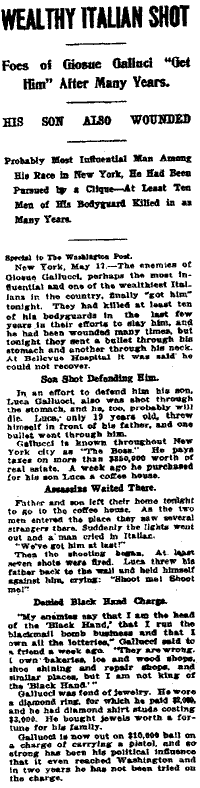
Gallucci reigned as the king of the Italian Harlem rackets from the turn of the Twentieth Century to his assassination in 1915.

Gallucci arrived in the United States about 1891. By 1898, American authorities already were complaining about his criminal activity and seeking to have him deported. They noted that he and his brothers, Genaro, Vincenzo and Francesco, had criminal records in Italy before they crossed the Atlantic. Giosue Gallucci's record in his native country included arrests for theft and blackmail.

With great influence over his fellow Italians in East Harlem, Gallucci established strong political and business connections. He employed Neapolitan and Sicilian street gangs as his enforcers and established successful local criminal enterprises, as well as legitimate businesses, including a coffeehouse, a bakery and a cigar factory.

Gallucci's base of operations was a building at 318 East 109th Street, which housed his living quarters in addition to his coffeehouse and bakery.

The more lucrative of Gallucci's underworld rackets included an Italian lottery and a protection fee his men extorted from sellers of produce.

Gallucci's brother Vincenzo was murdered Nov. 20, 1898, reportedly on orders from an Italian "secret society similar to the Mafia" (likely the Neapolitan Camorra). Two gunmen laid in wait for him at the corner of Canal and Mulberry Streets in Manhattan and shot him as he arrived there. Francesco D'Angelo and Luigi LaRosa were accused of the killing. They pleaded guilty to manslaughter and were given prison sentences of 20 years and 15 years, respectively.

Genaro Gallucci's activities as a collector of protection payments caught the attention of authorities, and he fled New York City for a time. When he returned in the late summer of 1909, New York Police captured him and immigration officials began efforts to deport him to Italy. On Nov. 14, 1909, Genaro Gallucci was shot to death while inside his brother's East 109th Street business.

Though Giosue Gallucci was called the "king" of the East Harlem rackets, he was also victimized by Black Hand extortionists. He was especially harassed by Neapolitan gang leader Aniello "Zopo the Gimp" Prisco, who was believed responsible for killing Genaro Gallucci.

To resolve matters, Gallucci set up a meeting with Prisco on the evening of Dec. 16, 1912. Prisco probably did not expect an ambush as the meeting was planned for a barbershop run by his allies, the DelGaudio brothers. But Gallucci took suddenly ill and could not leave the back room of his East 109th Street bake shop. He sent a messenger to find Prisco and bring him to the shop.

When "Zopo" arrived, he was promptly shot in the head by Gallucci bodyguard John Russomano. The king told the police the killing was in self-defense. He asserted that Prisco had come to rob him of $100. Russomano, he said, drew a pistol. Prisco turned to fire at Russomano, and Russomano got off the first shot. The police accepted the explanation - not surprising, considering Gallucci's political clout - but Russomano and Gallucci were marked for death by the survivors in Prisco's gang.

Gallucci's prestige began to wither in 1913, as a gang war with Prisco's old outfit stretched on, and he was scrambling to maintain control of the underworld in 1914 and 1915. Rival lotteries were springing up right under his nose. Gallucci and his son Lucca were gunned down at Lucca's coffeehouse business, 336 East 109th Street, on May 17, 1915.

The two victims were brought to Bellevue Hospital. Lucca died there the next day. Gallucci lingered until May 21 before succumbing to his injuries. His death left open the coveted position of East Harlem underworld/political boss and triggered gangland feuding. (Gallucci's story is similar to that of Chicago's "Big Jim" Colosimo, a criminal and political leader who was victimized by extortionists and apparently murdered by men he previously commanded.)

Related Links:

Flegenheimer, Arthur (1902-1935)

Born Bronx, NY, Aug. 6, 1902

Killed Newark, NJ, Oct. 23, 1935.


Arthur "Dutch Schultz" Flegenheimer was probably the last of the big-time independent criminal operators. Never an inducted member of the Mafia, he had some personal and business relationships with its members. Those relationships ultimately led to his demise.

Born in the Bronx, Schultz grew up in street gangs. He spent more than a year in prison for a burglary committed at age 17. He emerged from prison in time to join Arnold Rothstein's bootlegging operation. In that venture, he came into contact with such notables as Charlie "Lucky" Luciano and Jack "Legs" Diamond.

Schultz and longtime friend Joey Noe became partners in a speakeasy and a beer distribution business and later coerced owners of other speakeasies into becoming outlets for Schultz beer. The Coll brothers were affiliated with the Schultz-Noe mob before going out on their own.

Some bad blood developed between Shultz-Noe and the Rothstein-Diamond organization. Diamond looked to be responsible for Noe's death on Oct. 15, 1928 (Noe lingered at Bellevue Hospital until finally succumbing to his injuries on Nov. 21, 1928.)

Schultz's men attempted retaliation several times, but the bullet-riddled Diamond simply refused to die until blasted in his sleep on Dec. 18, 1931.

The Schultz men appear to have had better luck pursuing revenge against Rothstein, who was gunned down in his hotel on Nov. 4, 1928, just before Noe passed away. Others were suspected of involvement in Rothstein's murder, but Schultz involvement appears likely.

Schultz had a close relationship with Harlem's Tammany boss Jimmy Hines, a useful situation as the gangster muscled in on Harlem numbers rackets and forcefully established a restaurant "union" protection racket. As a show of good faith to the American Mafia, Schultz provided Ciro Terranova, Mafia boss in Harlem, a share of his numbers business.

The relationship between Schultz and the Mafia appeared cordial as the Dutchman's old friend Luciano stepped to power in 1931. Schultz remained largely apart from the nationwide criminal Syndicate welded by Luciano and his allies. Secretly, Mafia leaders were envious of the Dutchman's operations, particularly the lucrative numbers.

New York prosecutor Thomas Dewey and the FBI's J. Edgar Hoover began pursuing Schultz at the end of the Prohibition Era. Public Enemy No. 1 Schultz couldn't be touched for his rackets and his murders, so the government went after him - as it had with Capone - for federal income tax evasion.

Schultz was surprisingly successful in his court battles. After a deadlocked jury in Syracuse and an Aug. 24, 1935, not-guilty verdict in the small town of Malone, NY, where Schultz threw some money around in advance of the trial, it appeared the gangster had the government on the ropes.

But Dewey wasn't ready to quit. He prepared to charge Schultz with state tax evasion. Schultz left the state, heading into Newark, NJ, while he worked on a strategy. The pressure was on Hines as well, so Tammany was little help to the outlaw.

Schultz approached the Mafia's ruling Commission with a plan. With Mafia help, Schultz offered to bump off Dewey. Some accounts indicate that Schultz made a personal appearance at a meeting of the Commission. Others say he sent a message through Albert Anastasia.

Fearing law enforcement's wrath, the Commission decided it wanted no part of the assassination proposal. Enraged by the lack of support, Schultz swore he would see to Dewey's murder himself.

The Commission then acted against Schultz, using members of its enforcement arm (often referred to as "Murder Inc.") to eliminate Schultz and his gang leadership at Newark's Palace Chop House on Oct. 23, 1935. Under orders from Lepke Buchalter, salaried hitmen Mendy Weiss and Charlie "Bug" Workman did the job. Schultz clung to life at Newark County Hospital for 20 hours, speaking a prolonged stream-of-consciousness nonsense that historians are still puzzling over today.

The Luciano Mafia carved up Schultz's Bronx-area rackets.

Related Links:

Coppola, Michael (1900-1966)

Born Fisciano, Salerno, Italy, July 29, 1900.
Died Oct. 1, 1966.

"Trigger Mike" Coppola became a major figure in the New York Mafia upon the death of Joe Masseria in April of 1931. A highly regarded gunman to that point, Coppola was given control of many of the Bronx and East Harlem rackets formerly controlled by Ciro Terranova, who slipped into retirement.

Coppola entered the U.S. as a child. In 1918, he became a citizen upon his father's naturalization.[1]

As a young man in East Harlem, Coppola involved himself in hold-ups. In 1922, he reportedly was convicted of grand larceny and served a prison sentence at Sing Sing. Upon his release from prison in March 1925, he involved himself in gambling and bootlegging.[2] The gangster allies of his youth included Tommy Lucchese, Joseph Stracci and Joseph Rao. Coppola appears to have become a significant member of Charlie Luciano's inner circle, based in downtown Manhattan, later in the decade.[3]

Coppola is believed to have been involved in some way in the armed robbery of Magistrate Vitale's Bronx banquet in 1929 - a banquet attended by Terranova and a number of his underworld and political allies. That robbery and the subsequent recovery of all items taken exposed city government connections with the mob. Following the robbery, attendee John "Zacci" Savino was found to be in possession of a letter referring to Vitale and the holdup. The letter was signed "M.C."[4]

In spring 1930, Coppola was noted traveling from Cuba to Florida in the company of Luciano ally Meyer Lansky.[5] Authorities suspected Coppola in the late 1930s of involvement in the smuggling of narcotics into the United States.[6]

New York Police believed he had a role in setting up the November 1946 beating death of Republican political organizer Joseph Scottoriggio in East Harlem. Scottoriggio had been actively supporting Frederick Bryan against underworld-favored Congressman Vito Marcantonio. Coppola's old friend Joey Rao and later Coppola himself were taken into custody as a material witness following the killing. Early in 1947, authorities sought Coppola's wife Doris and her father David L. Lehmann, believing they knew something about the Scottoriggio killing. By summer, Doris was located and brought before a grand jury.[7] Early the next year, Doris, then twenty-seven, died during childbirth at St. Vincent's Hospital in New York.[8] Some insist that Michael Coppola arranged her death in order to eliminate a witness to the Scottoriggio slaying.

Coppola's rackets included a monopoly on coin-operating vending and gaming machines. He was also involved in numbers gambling, sports bookmaking, loansharking, labor racketeering and perhaps narcotics. His territory included areas in Brooklyn, Bronx, and Manhattan, as well as Miami Beach, Florida. Miami Beach became his home around 1950.[9] Anthony "Fat Tony" Salerno oversaw some operations for Coppola.[10]

An odd gangland connection was uncovered in February 1955. Authorities investigating Buffalo Mafioso Joseph DiCarlo learned that DiCarlo had recently hosted a wedding reception for his daughter said to have cost $35,000. DiCarlo had avoided paying a Prohibition Era government fine by pleading poverty, and investigators believed the wedding proved DiCarlo was lying. It was discovered, however, that the bills for the lavish wedding reception had been sent not to DiCarlo but to Michael Coppola.[11]

In the early 1960s, Coppola was indicted for evading income taxes during the years 1956-59. According to prosecutors, he owed a total of $385,494 in addition to penalties of up to $40,000. While there were no financial records of Coppola's dealings, the IRS calculated his taxes by approximating his net worth. In 1962, Coppola was sentenced to a year in prison, four years' probation and a $40,000 fine. He served nine months of his prison term and was released in late November.[12] By 1964, the government claimed that Coppola's tax debt had risen to almost a million dollars. A settlement of $400,000 was reached in May of 1964.

In 1963, informant Joseph Valachi identified Coppola as a leading figure in the U.S. Mafia.

Notes

  1.  Coppola's date of birth is not entirely certain. Doerner, Fred W. Jr., "Crime conditions in the Miami Division," FBI report, file no. , NARA record no. 124-10208-10000, Nov. 15, 1963, p. 55; Walsh, Edward T. Jr., "Paul Joseph Correale," FBI report, file no. 92-4264-9, NARA record no. 124-90066-10151, Sept. 26, 1960, p. 13.
  2.  FBI interview with Coppola, Jan. 14, 1939.
  3.  Doerner, Fred W. Jr., p. 55; FBI interview with Coppola, Jan. 14, 1939.
  4.  "Vitale guests granted writ; hit '3d degree,'" Brooklyn Daily Eagle, Dec. 31, 1929, p. 1.
  5.  Passenger manifest of S.S. Gov. Cobb, departed Havana, Cuba, on April 2, 1930, arrived Key West, Florida, April 2, 1930.
  6.  Walsh, Edward T. Jr., p. 13.
  7.  "Mrs. Coppola still gone," New York Times, Jan. 14, 1947, p. 27; "Beaten party aide visited by Dewey," New York Times, Nov. 7, 1946, p. 15; "Election captain dies of beating; Dewey and police pledge capture," New York Times, Nov. 12, 1946, p. 1; "Scottoriggio death still is unsolved," New York Times, Nov. 13, 1946, p. 1; "Mrs. Coppola held in election killing," New York Times, July 16, 1947, p. 1; Turkus, Burton B., and Sid Feder, Murder, Inc.: The Story of the Syndicate, reprint of 1951 edition, New York: Da Capo Press, 1992, p. 129.
  8.  "Mrs. Coppola dies after baby is born," New York Times, March 19, 1948, p. 48; New York City Death Index, certificate no. 6862, March 18, 1948; "5,000 at Coppola rites," New York Times, March 23, 1948, p. 27.
  9.  Doerner, Fred W. Jr., p. 55.
  10.  Walsh, Edward T. Jr., p. 13, 15; SAC Miami, "Miami winter season 1958-1959," FBI memorandum to Director, File no. 62-75147-29-742, NARA record no. 124-90110-10015, p. 7.
  11.  "Some of DiCarlo party bills reported going to 'Trigger,'" Buffalo Courier Express, Feb. 17, 1955.
  12.  Doerner, Fred W. Jr., p. 55.


Celantano, Anthony

b. about 1890.

Anthony Celantano, outwardly the owner of a busy shoeshine stand on Kenmare Street, actually was an important Italian-American gang leader in Manhattan's Little Italy in the 1910s.

In 1913-1914, his Kenmare Street Gang battled against the East Village-based Jimmy Curley Gang, led by James "Jimmy Curley" Carioggi (Carioggi was also known as "Gold Mine Jimmy" because of the gold-filled teeth in his mouth). Celantano was nearly killed in that conflict. On Feb. 12, 1914, seven Curley Gang members burst into the Tivoli Restaurant, 341 Broome Street, where Celantano and his wife were dining. Curley's men drew revolvers and robbed the restaurant and its patrons. One of the intruders drew a knife and repeatedly stabbed Celantano in the abdomen. The seven gangsters scattered, but police apprehended three of them, including Carioggi and underling Joe "Orlando" Lopanto. Celantano's wounds were believed at the time to be fatal, but he eventually recovered at St. Francis Hospital.

James Carioggi was not as fortunate. He quickly made plans to move his girlfriend Kate Wilson and himself to far-off Plattsburgh, New York. On March 2, as the couple packed, two gunmen showed up at their residence, 321 East 11th Street. Kate was able to convince the men that her boyfriend was not at home. The packing was completed, and Kate was sent on her way. Carioggi was to follow shortly. The next day, Carioggi paid a visit to his widowed mother and sisters at their apartment, 200 First Avenue. He left the apartment just before 7 p.m. A few minutes later, he was shot down on East 13th Street between First Avenue and Avenue A. Rev. Francis Edwards of Grace Chapel was having supper in his rectory, overlooking East 13th Street, when he was startled by the gunshots. He telephoned police.

When police arrived, they found that Carioggi had been taken inside the bookstore of John Morelli, 418 East 13th Street, by three bystanders: Tony Cordici, Andrew Enea and John Sicca. Carioggi was rushed to St. Francis Hospital with two gunshot wounds to his abdomen. He died shortly after arriving there.

Celantano was still recovering from his stab wounds at the same facility. Detectives questioned him about the Carioggi murder. "I don't know anything about it," was all Celantano would say. The Jimmy Curley Gang had a number of other rivals - police recalled that Carioggi was suspected in the 1913 shooting of Tommy Lynch of the Gas House Gang - and the authorities could not make a case against the Kenmare Gang.

Some time after Celantano returned to work, New York Police Detective Amedeo Polignano went under cover in an effort to penetrate his organization. Polignano in spring 1915 had dealt a blow to anarchist forces in New York by revealing a bomb plot against St. Patrick's Cathedral. Immediately after that, he turned his attention to organized crime and an interstate lottery (known to authorities as a "policy" racket) syndicate he believed was controlled by Celantano.

Posing as a new immigrant, Polignano went to work as a bootblack at Celantano's shoeshine stand, 10-12 Kenmare Street. He periodically played the lottery and expressed an interest in its operation. He always expressed gratitude toward Celantano for giving him work at the shoeshine stand. Eventually, he served as a trusted messenger for the policy syndicate and distributor of policy slips. He remained under cover until Feb. 10, 1917, when New York Police arrested twenty-one members of the policy ring, including Celantano. (One of the suspects, Pasquale Lampassa, a bartender from East Harlem, was charged with bribery, after he offered detectives $38 and promised them another $42 if they would let him go.)

Though Celantano was charged only with possession of policy slips, Polignano testified before Magistrate Corrigan in West Side Court that Celantano was the leading policy racketeer in the country. According to the detective, Celantano received winning lottery numbers by cable from Italy and then transmitted the numbers to associates around New York and across the country. Police Captain Thomas J. Tunney estimated for the press that the syndicate was bringing in profits of between $600,000 and $1,000,000 a year from the lottery.

Celantano attended his Feb. 15 arraignment dressed in a rich, fur-lined overcoat, with diamond rings glittering on his fingers. Polignano described his suspicions regarding the prisoner: "He kept to himself, save for a small circle of friends, and although we watched him for months, we were never able to connect him with enough to furnish conclusive evidence. But we were sure we had the right man in him. He was too prosperous. His shoe shining stand was busy enough to bring him in a good living, but it couldn't account for his automobiles and diamonds and his fine apartment."

The detective further testified that he learned of intense competition among gangs for control of the policy racket. He said more than twenty murders were committed in the rivalry, including a number that took place at the notorious Murder Stable up in East Harlem.

Sources:

  •  "Unarmed; held for murder," New York Sun, July 17, 1913, p. 14.
  •  "Gunmen stab enemy," Tacoma WA Times, Feb. 12, 1914, p. 1.
  •  "Diners are held up by gunmen in N.Y. restaurant," Pendleton OR East Oregonian, Feb. 12, 1914, p. 1. 
  •  "James Carioggi," New York City Death Index, certificate no. 7386, March 3, 1914.
  •  "East Side gang leader shot dead," New York Tribune, March 4, 1914, p. 2.
  •  "Gang ethics balk quest for slayer of 'good' gunman," New York Evening World, March 4, 1914, p. 4.
  •  "Noted gangster killed," New York Times, March 4, 1914, p. 1.
  •  "Policy kings taken in bomb squad raid," New York Sun, Feb. 12, 1914, p. 4.
  •  "Bootblack breaks up big policy ring," New York Sun, Feb. 16, 1917, p. 4.
  •  "Prisoner is accused as policy ring head," New York Tribune, Feb. 16, 1917, p. 13.