Showing posts with label Adonis. Show all posts

Alo, Vincent (1904-2001)

Born New York City, May 26, 1904.
Died Florida, March 9, 2001.

Vincent Alo
Vincent "Jimmy Blue Eyes" Alo was a key figure in the post-Prohibition Genovese Crime Family and a liaison between the Sicilian-Italian Mafia and the organization of Meyer Lansky. His career was the inspiration for a number of fictional underworld characters, most notably "Johnny Ola" of The Godfather Part II movie.

Alo was born in 1904 in East Harlem to Salvatore and Giulia (or Julia) Scalzo Alo, immigrants from Cosenza, Italy. Salvatore worked as a tailor in a clothing factory. Vincent Alo had an older sister, Elizabeth, and two younger brothers, Frank and Joseph. (Two other sisters show up in census records for 1905 and 1910, but they are missing from later censuses, suggesting they did not live long into childhood.) In the early 1910s, the Alo family moved to Hoffman Street near Arthur Avenue in the Bronx.

Alo left school and went to work as a clerk for a Wall Street company after just a single year of high school. Reportedly frustrated by the clerical work, in the early 1920s Alo began participating in robberies.

In October of 1923, he was caught by police following a jewelry store robbery. He was charged with second degree robbery and possession of a firearm. A conviction the following month resulted in a sentence of five to twelve years in prison. Inside Great Meadow State Prison in Washington County, New York, Alo did further work as a clerk.

Following his release, "Jimmy Blue Eyes" Alo became connected with Mafiosi engaged in rackets in the Bronx. This apparently provided him a measure of protection from prosecution. Alo was arrested in March 1932, once again for robbery and firearm possession, but managed to be discharged the following day. During the 1930s, he and his underworld colleagues were affiliated with the organization run by Charlie Luciano. Alo was believed to be among the leaders of a policy (lottery) ring operating in Bronx and Westchester Counties of New York in the mid-1930s.

In this period, Alo and his associates established gambling operations in eastern Florida. The FBI noted that Alo was one of the partners in the Plantation Casino in Broward County, Florida, in 1936. Other partners included Julian "Potatoes" Kaufman, Giuseppe "Joe Adonis" Doto and Jake Lansky, brother of Meyer Lansky. Alo rented a home on Dewey Street in Hollywood, Florida, which became his winter racket headquarters.

Meyer Lansky
Alo took a bride in August 1936. His wife, Florence Rose Gelinas Miller, was previously married and was the mother of two sons. Alo, his new wife and two stepsons, lived together on Holland Avenue in the Bronx and Dewey Street in Hollywood, Florida. While in Florida, Alo developed a love of the sport of golf.

The FBI learned that Alo became a partner in The Farm casino in Broward County by late 1939 and that in that winter he hosted a gathering at his Florida home attended by organizers from the International Longshoremen's Association in New York.

In the next decade, the FBI was told that "Jimmy Blue Eyes" had become a top Harlem lieutenant in the crime family then commanded by Frank Costello. Alo's home addresses changed. In New York, he moved into an apartment building at 315 Riverside Drive on the Upper West Side of Manhattan. In Florida, he moved to 1228 Monroe Avenue near Hollywood Lakes and Hollywood Beach.

His Florida business interests expanded to include a partnership with Meyer and Jake Lansky in the Club Greenacres casino in Hollywood; a seven-and-a-half percent interest in the Colonial Inn casino in Hollywood; and a share of the Ha-Ha Club in Hallandale. Alo was believed to be a stand-in for Joe Adonis in Florida. The Colonial Inn was a substantial underworld endeavor, involving Meyer and Jake Lansky, Frank Costello friend Frank Erickson, Joe Adonis and Richard Melvin. Alo was also alleged to be a partner with Frank Erickson in a horse race bookmaking racket operated out of the Hollywood Beach Hotel. Alo was one of a number of underworld figures who frequently visited the Wofford Hotel in Miami Beach. Other regular guests were Adonis, Costello, the Lanskys, Clevelanders George "King" Angersola and Alfred "Big Al" Polizzi, New Jersey racketeers Abner "Longie" Zwillman and Guarino "Willie Moore" Moretti, Youngstown Ohio gambling boss Joseph DiCarlo, and Detroit gambler William "Lefty Clark" Bischoff.

The FBI was told that the Ha-Ha Club in Hallandale was "a night club which catered to sex perverts." Later in the 1940s, perhaps after Alo ended his financial relationship with it, the club was targeted by local law enforcement. County officials shut the business down in 1947, stating that "its cast is composed of men who impersonate women and that its performances are conducted in a suggestive, indecent and obscene manner." The ownership of the Ha-Ha Club at that time was said to be Federal Amusement Company and Charles "Babe" Baker. The Florida Supreme Court upheld the closing of the club for conducting "lewd, indecent or nasty" performances and noted "the lawful evidence presents a dirty picture."

In the post-World War II years, Alo worked alongside Meyer Lansky in setting up gambling operations in Havana, Cuba. Alo was noted in immigration records returning with his wife from a brief trip to Cuba in April of 1946.

Alo was arrested for vagrancy by New York Police in August 1947. The vagrancy charge was baseless but it allowed the police to question Alo about his underworld relationships and about the Jan. 8 murder of waterfront labor leader Anthony Hintz. Alo admitted knowing Frank Costello, Joe Adonis and Meyer Lansky. When presented with a list of names of suspects in the Hintz murder, Alo admitted not only knowing them but also seeing them in Florida shortly before the murder was committed. He claimed not to have any awareness of the murder plot, telling investigators, "If they wanted to kill someone, that's their business."

Federal agents determined that Alo was part of an "Eastern Criminal Syndicate," including Costello, Erickson, Adonis and the Lanskys, that in 1949 operated the plush Hallandale Beach casino known as Club Boheme. The same group was said to have run the Club Greenacres and the recently closed Colonial Inn. In May of 1950, records seized from the New York City offices of Frank Erickson defined his business relationships with alleged Syndicate members, as well as Mert Wertheimer and others in Broward County, Florida.


The discovery was made just in advance of hearings before the U.S. Senate's Kefauver Committee. In July, Daniel P. Sullivan, operating director of the Crime Commission of Greater Miami, testified before the Kefauver panel. He detailed the underworld gambling operations in Broward, Palm Beach and Dade Counties. According to Sullivan, the Colonial Inn gambling partnership included the Lanskys, Alo, Adonis, Erickson, Bert Briggs, Claude Litteral and Samuel L. Bratt. Originally, the group included Detroit gamblers led by Mert Wertheimer, Reubin Mathews and Danny Sullivan, but the Detroit interest was bought out by New Yorkers after 1946.

Following Kefauver hearings into Florida gambling rackets, Florida Governor Fuller Warren became involved in the fight against the rackets. Warren removed a local sheriff for accepting bribes and ordered an investigation of law enforcement corruption at Daytona Beach. Grand juries were formed to investigate the Florida rackets. These issued indictments against Alo, the Lanskys, Bischoff, Litteral, Bratt, George Sadlow, Frank Shireman and others for their roles in the running of Colonial Inn, Club Greenacres and Club Boheme.

On Sept. 16, 1950, Alo and nine other accused gambling racketeers appeared in criminal court in Fort Lauderdale, Florida. They all entered guilty pleas to the gambling charges. They were sentenced to pay cash fines. Alo, Bischoff, Louis Oliver and T.E. Alexander were fined $1,000 each. Jake and Meyer Lansky, Bratt and Sadlow were fined $2,000 each. Litteral and Shireman were fined $3,000 each.

New York Police began a harassment campaign against known hoodlums in 1957. Alo was rounded up with more than 150 other reputed racketeers. Most were charged with vagrancy. Alo was held for questioning for several days. It probably was not a coincidence that Alo afterward began spending much more of his time in Florida. He gave up his Riverside Drive apartment, but maintained a presence in Manhattan by renting rooms at 19 West 55th Street.

FBI reports in 1958 suggested that Jake Lansky represented the financial interests of "Jimmy Blue Eyes" Alo and Meyer Lansky in the operation of the gambling casino at the Hotel Nacional in Havana, Cuba.  Those interests, along with other investments by American racketeers in Cuban gambling enterprises, were lost following the Castro  revolution. The hotel-casinos of the Havana area were nationalized by Castro in 1960.

A police raid in September 1963 turned up records of a Bronx loan shark racket apparently financed by Vincent Alo. Bronx District Attorney Isidore Dollinger brought evidence to a grand jury that Alo, a top lieutenant of crime boss Vito Genovese, backed the enterprise. According to Dollinger, the racketeers lent an estimated $4 million a year, preying on indebted gamblers and charging interest rates as high as 156 percent. Alo's brother Frank, a Bronx resident, was called to testify before the grand jury. Frank Alo refused to make any statement, citing Fifth Amendment protections.

Sixty-one-year-old Vincent Alo was himself called before a federal grand jury in December of 1965. Officials identified Alo as a top figure in Harlem and Bronx gambling rackets and said he also had influence in waterfront and garment center rackets.

A year later, a federal grand jury in Los Angeles, California, investigated a fall 1965 gathering of mobsters in southern California. The meeting coincided with the Major League Baseball World Series between the Los Angeles Dodgers and Minnesota Twins. Attendees included Vincent Alo and Anthony "Fat Tony" Salerno of the Genovese Crime Family, Miami Beach bookmaker Ruby Lazarus, and Jerome Zarowitz and Elliott Paul Price, gambling operators for Caesar's Palace in Las Vegas, Nevada.

Alo was believed to be part of another meeting of racketeers in 1969. That meeting reportedly occurred in Miami Beach, Florida. The meeting was said to have included Anthony "Big Tuna" Accardo, Paul "the Waiter" Ricca, John "Jackie the Lackey" Cerone and Dominic "the Angel" Angelini of Chicago; Carlo Gambino, Meyer Lansky, Vincent Alo and Anthony "Tony Goebels" Ricci of New York. Officials surmised that fourteen Kansas City mobsters, arrested as they arrived in Miami a month earlier, were also to be part of the meeting. There was some speculation that Chicago racketeer Sam "Momo" Giancana, in self-imposed exile after serving a year in prison for contempt, was also to be present.

Though Alo was constantly under law enforcement scrutiny, he had avoided prison time since the jewelry store robbery sentence of his youth. The authorities began to catch up with Alo as he moved toward retirement. In October 1969, a federal grand jury in New York indicted "Jimmy Blue Eyes" for obstructing justice by giving false and evasive answers in a Securities and Exchange Commission investigation. SEC previously questioned him about Mafia influence in the Tel-A-Sign advertising company.

'Johnny Ola'
Alo was convicted in September 1970 of two counts of giving false and evasive answers to the SEC. On Oct. 27, the sixty-six-year-old was sentenced to serve five years in Atlanta Federal Prison. He served three years of that sentence before being released. A year after he got out of federal prison, The Godfather Part II appeared in theaters. The character of "Johnny Ola" (played by Dominic Chianese), Italian aide to Havana's Jewish gambling czar Hyman Roth (Lee Strasberg), paralleled Alo's earlier career.

"Jimmy Blue Eyes" was in his seventies when he next came to the attention of law enforcement. He was described in 1978 as a capodecina under Frank "Funzi" Tieri in the Genovese Crime Family. The Pennsylvania Crime Commission noted Alo's connection with Miami Beach attorney Alvin I. Malnik, who happened to own two resort hotels in the Pocono Mountains and who also happened to be a close friend of Meyer Lansky. According to the crime commission, Malnik once sent Alo to represent him in business negotiations. The commission stated that the Pocono resorts were home to money laundering, gambling, prostitution and other rackets.

Alo's old friend Meyer Lansky died at Miami Beach, Florida, early in 1983. Alo's wife Florence died in Las Vegas in April 1990. "Jimmy Blue Eyes" lived quietly another eleven years, dying in Florida in March 2001.

Sources:


  •  Arrest record of Vincent Alo, New York City Police Department, Feb. 24, 1951.
  •  Daniel P. Sullivan testimony, Investigation of Organized Crime in Interstate Commerce - Part 1, Florida, Hearings Before a Special Committee to Investigate Organized Crime in Interstate Commerce, United States Senate, 81st Congress, 2nd Session, Washington, D.C.: U.S. Government Printing Office, 1950, p. 152-174.
  •  Federal Amusement Company, a Florida corporation, and Charles (Babe) Baker, v. State of Florida, upon the relation of Frank Tuppen, appeal from the Circuit Court for Broward County, Supreme Court of Florida Division A, Oct. 3, 1947.
  •  Nevada Death index, April 8, 1990.
  •  New York City Birth Index, Certificate no. 23392, May 26, 1904.
  •  New York City Marriage Index, certificate no. 1907, June 6, 1902.
  •  New York City Marriage Index, Certificate no. 24281, Aug. 26, 1936.
  •  New York State Census of 1905, County of New York, Assembly District 33, Election District 10.
  •  New York State Census of 1915, Bronx County, Assembly District 34, Election District 68, Block 4.
  •  New York State Census of 1925, Washington County, Town of Fort Ann, Assembly District 1, Election District 1.
  •  Passenger manifest of S.S. Britannia, arrived New York City on June 25, 1894.
  •  Passenger manifest of S.S Monarch, departed Hamilton, Bermuda, on Aug. 9, 1939, arrived Miami, Florida, on Aug. 11, 1939.
  •  SAC Miami, "Criminal Intelligence Program," FBI memorandum, MM 92-515, Sept. 5, 1963, p. 1
  •  Salvatore Alo Declaration of Intention, Supreme Court of New York at Bronx, No. 106279, April 21, 1931.
  •  Social Security Death Index.
  •  U.S. Census of 1910, New York State, New York County, Ward 12, Enumeration District 295.
  •  U.S. Census of 1920, New York State, Bronx County, Assembly District 7, Enumeration District 395.
  •  U.S. Census of 1930, State of New York, Nassau County, Hempstead Town, Seaford Village, Enumeration District 30-132.
  •  U.S. Census of 1940, State of Florida, Broward County, Hollywood City, Enumeration District 6-41.
  •  Vincent Alo fingerprint record, Federal Bureau of Investigation, May 28, 1971.
  •  "Vincent Alo," FBI memo, March 28, 1952, p. 1- 6.


  •  Carr, Charlie, New York Police Files on the Mafia, Hosehead Productions, 2012, p. 388.
  •  Janson, Donald, "Crime figures found involved in Poconos," New York Times, April 17, 1978, p. 1.
  •  Lansky, Meyer II, "The Real Johnny Ola: Vincent 'Jimmy Blue Eyes' Alo," The Blog, huffingtonpost.com, Dec. 15, 2014, updated Feb. 13, 2015, accessed March 1, 2016.
  •  Whitney, Craig R., "Realty man denies he knew of employe's alleged link to Mafia," New York Times, Jan. 24, 1970, p. 14.
  •  "3 balk at inquiry on loan-shark case," New York Times, Oct. 24, 1963, p. 18.
  •  "Alo, reputed Mafia figure, faces jail in S.E.C. case," New York Times, Sept. 29, 1970, p. 48.
  •  "Fem impersonators irk Florida court," The Billboard, Oct. 18, 1947, p. 38.
  •  "Florida crime drive is suddenly speeded," New York Times, Aug. 25, 1950, p. 40.
  •  "Miami Beach secret Mafia meet probed," Cumberland MD Evening Times, April 8, 1969, p. 1.
  •  "Police jail 155 hoodlums in New York," Troy NY Times, June 15, 1957, p. 8.
  •  "Reputed Mafia man indicted after an S.E.C. investigation," New York Times, Oct. 28, 1969, p. 16.
  •  "Senate group hearings on crime open here tomorrow," Brooklyn Daily Eagle, March 11, 1951, p. 2.
  •  "U.S. jury on coast said to investigate gamblers' meeting," New York Times, Dec. 18, 1966, p. 71.
  •  "U.S. jury hears Mafia figure," New York Times, Dec. 4, 1965, p. 28.
  •  "Vincent 'Jimmy Blue Eyes' Alo," Find A Grave, findagrave.com, accessed March 2, 2015.


Carfano, Anthony (1897-1959)

Born c1897.

Killed Queens, NY, Sept. 25, 1959.

Anthony Carfano, also known as Li'l Augie Pisano, was a noteworthy associate of Giuseppe Masseria, Al Capone, Frank Costello, Charlie Luciano and Joe Adonis.

Carfano came to power in the Masseria organization of the late 1920s. A former prizefighter and a close friend of "Joe the Boss" Masseria, he became caretaker of Masseria's Brooklyn interests after the death of Frank Yale.

Upon the reorganization of the Mafia in 1931, Carfano established gambling interests in southern Florida, smoothing the ruffled feathers of the Tampa Mafia organization nearby. The extent of gambling operations was discovered in the 1950 investigation of the Kefauver Committee. In 1955, there was some evidence that Carfano was involved in siphoning union funds into underworld rackets, but charges were eventually dropped. Carfano was questioned and released following the 1957 assassination of Albert Anastasia in New York.

Carfano was murdered on Sept. 25, 1959. He and a female companion - former beauty queen Mrs. Janice Drake - were found dead in Carfano's black 1959 Cadillac. They apparently had been shot by gunmen hiding in the car's back seat. Carfano and Drake had been dining at Marino's restaurant on Manhattan's East Side when they were called away.

Buchalter, Louis "Lepke" (1897-1944)

Born New York, NY, Feb. 6, 1897.

Executed Ossining, NY, March 4, 1944.


Louis "Lepke" Buchalter had the distinction of being the first organized crime lord to be sent to the electric chair.

New York-born Buchalter was the administrative head of a Syndicate enforcement group known in the media as "Murder, Inc." Under Lepke, the Murder, Inc., group performed cold-blooded hits (devoid of detectable motive) ordered by the Mafia's ruling commission.

Buchalter, who worked closely with Joe Adonis and Albert Anastasia, also controlled labor unions in Manhattan's garment industry and apparently dabbled in narcotics trafficking.

He was convicted of racketeering and sentenced to Leavenworth Penitentiary in April of 1940. The 1940 arrest and subsequent court testimony of admitted Murder Inc. killer Abe "Kid Twist" Reles aided New York State prosecutors in convicting Lepke of murder.

Legal wrangling delayed the execution of a death sentence until 1944, when Lepke was electrocuted in Sing Sing prison.

Related Links:

Anastasia, Albert (1902-1957)

Born Tropea, Italy, Feb. 26, 1902.

Killed New York, NY, Oct. 25, 1957.


The Mafia's "Lord High Executioner" was born Umberto Anastasio in a Calabrian village called Tropea. The date of his birth is variously recorded as Feb. 26, 1902; Sept. 26, 1902; and 1903. As teenagers, he and his brothers worked on Atlantic steamships. They jumped ship in New York and entered the U.S. illegally.

As Umberto Anastasio became known as a Brooklyn gangster, he adjusted his name to Albert Anastasia. The adjustment to his surname was reportedly to save his Anastasio relatives from embarrassment. (One of his brothers entered the U.S. legally and became a parish priest in New York.)

Anastasia became an accomplished underworld enforcer, earning him the nickname of "Lord High Executioner." Some also referred to him as "the Mad Hatter." Anastasia became a powerful leader on the Brooklyn waterfront, where brother Anthony "Tough Tony" was a leader in the longshoremen's union.

A devoted friend of underworld giants like Charlie Luciano, Frank Costello, Joe Adonis and Nicola Gentile, Anastasia had a long rivalry with Neapolitan underworld leader Vito Genovese and with some of the traditional Sicilian Mafiosi in Brooklyn.

Anastasia supported boss of bosses Giuseppe Masseria in the Castellammarese War of 1930-31. After the war, Anastasia emerged as the underboss in the Mangano Family. He also reportedly supervised a largely Jewish gang of Brooklyn killers used as Mafia enforcers. That gang became known as Murder, Inc.

Anastasia is believed to have approached the Mafia Commission asking to support Dutch Schultz by eliminating New York State Prosecutor Tom Dewey. Mob boss Joe Bonanno suggested that Luciano had Anastasia float that idea before the Commission, so Luciano himself would not be linked with it. The proposal was rejected and ultimately led to the murder of Schultz.

Dewey later hoped to use hitman-turned-state-witness Abe Reles' testimony to prosecute Anastasia as the official go-between for the Mafia hierarchy and Murder Inc. But Reles suddenly decided to step out of a high-rise hotel window, ending the state's case against Anastasia.


In 1951, with the Manganos suddenly gone (Philip was found murdered, and Vincent disappeared), Anastasia rose to the leadership of that crime family. As Anastasia reached the pinnacle of the Mafia underworld, an old rivalry with Vito Genovese turned deadly. Anastasia was shot to death Oct. 25, 1957, as he sat in a barber's chair in the Park Sheraton hotel lobby. The killing appeared to be part of a effort by Genovese to eliminate the Costello-Anastasia influence in the underworld (Costello was shot in the head - but survived - just a few months earlier and turned control of his organization over to Genovese).

However, the assassination might have been the result of Anastasia's recent moves to establish a gambling/narcotics empire in Cuba outside of the influence of usual Mafia-Cuba go-betweens Meyer Lansky and Santo Trafficante. Anastasia had made a recent trip to Havana and later scheduled a meeting with representatives of Cuban gaming interests in New York. Carlo Gambino, who succeeded Anastasia as boss, Genovese, Lansky and Trafficante all had motives to do away with Anastasia and could have cooperated on the assassination.

Addresses used by Anastasia:
  •  387 Columbia Street, Brooklyn, NY
  •  151 Sackett Street, Brooklyn, NY
  •  636 Arthur Street, Utica, NY
  •  1146 73rd Street, New York, NY
  •  75 Bluff Road, Palisades (Fort Lee), NJ
Criminal record of Anastasia (according to FBI files):

  •  1921 Mar 17 - charged in Brooklyn with homicide, convicted, sentenced to electrocution on July 3, 1921, retrial later ordered, acquitted Aug. 21, 1922.
  •  1922 - charged with homicide, indictment later dismissed.
  •  1923 Apr 06 - charged in Brooklyn with felonious assault, discharged on April 24, 1923.
  •  1923 Jun 06 - charged in Brooklyn with possession of a firearm, convicted, sentenced to two years at Blackwell's Island Penitentiary.
  •  1928 - arrested for homicide, not prosecuted.
  •  1932 - arrested for homicide, not prosecuted. 
  •  1933 - charged with homicide, not convicted.
  •  1941 - Kings County district attorney assembles murder case related to the May 1939 killing of Morris Diamond, but abandons it after the November 1941 death of turncoat witness Abe Reles.
  •  1942 Jan 21 - arrested for harboring, not prosecuted.
  •  1954 Apr 14 - stripped of citizenship acquired through military service, reversed on appeal.
  •  1954 Mar - indicted by federal grand jury for income tax evasion, mistrial in Florida declared Nov. 21, 1954, retrial in Camden, NJ, results in guilty plea and a June 3, 1955 sentence of a year in federal penitentiary.
  •  1956 Mar 28 - released from Milan, Michigan, federal penitentiary.


Related Links:

Doto, Giuseppe "Joe Adonis" (1901-1971)

Born Montemarano, Italy, Nov. 22, 1901.

Died Ancona, Italy, Nov. 26, 1971.

Adonis was born Giuseppe Antonio Doto in Montemarano, an Italian village within the province of Avellino, not far from the City of Naples. His family brought him to the United States when he was a child. His father Michele/Michael Doto (whose surname was also written "Dato" and "Adone") reached the U.S. first, in 1904, settling with an uncle on President Street in Brooklyn. Adonis and three brothers crossed the Atlantic with their mother in the summer of 1909. They joined Michele, then living on Brooklyn's Carroll Street. Some reports indicate the family lived for a time in Great Barrington, Massachusetts, but these could not be confirmed.

Over the years, Giuseppe Doto used a number of aliases before settling on the one that became famous. He referred to himself as "James Arrosa" or "Joseph Arroso" in the mid-1920s and as "Joseph DeMio" in the early 1930s. He likely picked up his "Adonis" alias from the "Adone" surname previously used by his family around the time of the 1915 New York State Census. The name "Adonis" referred to a human character in Greek mythology known for his physical attractiveness and his great hunting ability. The origins of the Adonis myth appear to blur with those of the hunter Orion, and these hunter tales may have been regional adaptations of a single original story. Both characters had tragic encounters with Greek goddesses.

A longtime Brooklynite, Joe Adonis was arrested for assault and battery in 1922 (not prosecuted), for grand larceny and robbery in 1926 (discharged), disorderly conduct in 1927 (fined), liquor smuggling in 1931 (not indicted), assault and robbery in 1937 (discharged) and kidnapping and extortion in 1940 (dismissed). He was affiliated early in his criminal career with regional Mafia bigshots Frank Yale and Anthony "Little Augie" Pisano (Anthony Carfano). These associations may have brought Adonis into the orbit of late 1920s Sicilian Mafia boss of bosses Giuseppe Masseria. Adonis, Pisano, Vito Genovese and Mike Miranda became the most prominent Neapolitans working within the Giuseppe Masseria organization.

Unsupported legends: According to some writers, who provide no supporting documentation, Adonis attended a May 13-15, 1929, national "convention" of bootleggers in Atlantic City. There is no hard evidence that Adonis was in Atlantic City at this time or that the "convention" involved anyone outside of visiting Chicago gang bosses. Some sources have named Adonis one of the gunmen who assassinated boss of bosses Giuseppe Masseria at Gerardo Scarpato's Nuova Villa Tammaro restaurant in Coney Island on April 15, 1931.

Mafia informant Joseph Valachi stated that Adonis - who directed criminal activity at the Brooklyn docks alongside Albert Anastasia and ran the Brooklyn eatery known as Joe's Italian Kitchen on Carroll Street and Fourth Avenue - was among those targeted for elimination by Maranzano after the conclusion of the Castellammarese War in 1931. Following Maranzano's assassination later that year, the Mafia reorganized. Adonis reportedly became a major player in the reorganized underworld, though his precise role, if any, in the Mafia hierarchy remains hazy.

Adonis's specific crime family affiliation has also been hazy. Some sources named him a top lieutenant in the Brooklyn Family of Vincent and Philip Mangano, while others placed him within Luciano's own Manhattan-based organization. Nicholas Gage suggested that Adonis was actually the first post-war leader of what became the Mangano Family, but this conflicted with accounts of better informed sources. (Gage did not offer a sufficient explanation for how or why Adonis became less than a Family boss later on.) Joe Bonanno, who probably knew Adonis' title, doesn't speak of it in his autobiography, and Valachi seems not to know anything about the Brooklyn mobster's status.

Evidence suggests that Adonis's authority - and close personal associations - overlapped the Mangano mob territory in Brooklyn, but that he owed his primary allegiance to his long-time friends Luciano and Frank Costello, based in Manhattan.

Adonis's mother, Maria DeVito Doto, passed away in the summer of 1934. His father died in April 1939.

Eventually, Adonis seemed to be everywhere and into everything - alcohol, gambling, drugs, union rackets, political shenanigans... He had established relationships with several Mafia Families and with some non-Italian gangs as well. Adonis was known to be a trusted ally and confidant of Frank Costello, who presided over Luciano's Manhattan Family after Luciano went to prison in the 1930s. Adonis joined Costello and Jewish mobsters Meyer Lansky and Benjamin Siegel in ownership of the Colonial Inn casino in Miami Beach and participated in gambling ventures in the Saratoga, New York, area. Adonis also shared a gambling empire in New Jersey with Mafioso Willie Moretti, Costello's close ally. His involvement in the Automotive Conveying Company of Cliffside Park, New Jersey, caught the attention of the U.S. Senate's Kefauver Committee and New Jersey prosecutors.

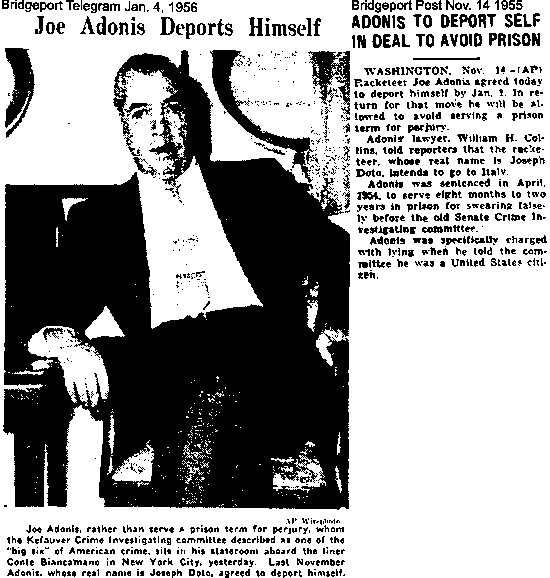
Adonis, who had long claimed to be an American native and who had settled in Fort Lee, NJ, in the mid-1940s (his Dearborn Road home was about a quarter mile from the Bluff Road home of Albert Anastasia), was shown to be an immigrant in the 1950s. Birth records indicating a 1901 birth in Passaic, New Jersey, were found to be fraudulent. Italian birth certificates, immigration records and early statements made by Adonis and his family members to authorities conflicted with statements Adonis made under oath before a New Jersey grand jury. Adonis was ordered to be deported in 1953. He fought that order in the courts. A voluntary deportation to Italy occurred in 1956 in the wake of a perjury charge stemming from the Kefauver Committee hearings.

One of the legendary fallings out between the American Mafiosi and the Kennedy Administration was allegedly over arrangements for the Mafia to support Kennedy's candidacy for President in return for Kennedy allowing Adonis back into the country. According to this tale, President John Kennedy was reportedly willing to welcome Adonis home, but Attorney General Robert Kennedy blocked the move.

The Italian government decided to inflict an exile within an exile upon Adonis on June 20, 1971. A Milan court demanded that he be restricted to the town of Ancona on Italy's Adriatic coast. Adonis died there of natural causes on Nov. 26, 1971. His remains were returned to the United States and buried Dec. 6 in Madonna Roman Catholic Cemetery in Fort Lee, NJ.


The Adonis funeral was relatively low-key. A cortege of fifteen automobiles, led by three cars of flowers, drove from Macagna's Funeral Home in Cliffside Park, New Jersey, to the funeral Mass at Epiphany Church. A private service was then held for Adonis's family - his wife, son and three daughters - and close friends at the chapel in Madonna Cemetery. The family and most attendees left before Adonis's casket was lowered into his grave. A number of reporters and photographers kept close watch on the event. There were no reports of known underworld figures in attendance.


Related Links:

Sources:

  • "Joe Adonis one of 8 cited in Dewey reply," Brooklyn Daily Eagle, Dec. 3, 1937, p. 1.
  • Investigation of Organized Crime in Interstate Commerce, Part 7, New York - New Jersey, Hearings before the Special Committee to Investigate Organized Crime in Interstate Commerce, U.S. Senate, 81st Congress 2nd Session, 82nd Congress 1st Session, Washington D.C.: U.S. Government Printing Office, 1951, p. 280-301.
  • Joseph Doto, Index of Births in New Jersey, 1901, A-H, certificate 37513.
  • Mary Doto, New York City Index to Death Certificates, certificate no. 15279, July 21, 1934.
  • Michael Doto, New York City Index to Death Certificates, certificate no. 9874, April 27, 1939.
  • Murray, Leo, "Offer birth certificates from Italy in Adonis case," Paterson NJ Morning Call, Jan. 15, 1954, p. 1.
  • New York State Census of 1915, Kings County, Brooklyn, Ward 10, Election District 11.
  • New York State Census of 1925, Kings County, Brooklyn, Assembly District 8, Election District 15. 
  • Passenger manifest of S.S. Citta di Milano, departed Naples on April 23, 1904, arrived New York on May 9, 1904.
  • Passenger manifest of S.S. Montserrat, departed Naples on June 23, 1909, arrived New York on July 11, 1909.
  • Plosia, Les, "Few turn out for Adonis burial," Passaic NJ Herald-News, Dec. 7, 1971, p. 12.
  • United States Census of 1920, New York State, Kings County, Brooklyn, Ward 14, Enumeration District 446.
  • United States Census of 1930, New York, Kings County, Brooklyn, Ward 10, Assembly District 8, Enumeration District 24-1079.
  • United States Census of 1940, New York, Kings County, Brooklyn, Assembly District 9, Enumeration District 24-1087.