Showing posts with label Carfano. Show all posts

Strollo, Antonio (1899-1962)

b. New York, NY, June 14, 1899.
disappeared from Fort Lee, NJ, April 8, 1962.

A longtime leader in the Genovese Crime Family, Anthony "Tony Bender" Strollo oversaw rackets in Greenwich Village and on the East Side of Manhattan. Strollo was a longtime ally of Vito Genovese, but the two apparently had a serious falling out after Genovese was convicted on narcotics charges. The conflict proved fatal for Strollo.

Antonio Strollo was born in New York City on June 14, 1899, to Leone and Jennie Strollo, immigrants from Italy. He had two older siblings, brothers Samuel and Dominick. In the early 1900s, Leone Strollo was a laborer, and the family lived at 181 Thompson Street in Manhattan's Greenwich Village. The family address changed only slightly, to 177 Thompson Street, by 1920. At that time, Leone Strollo ran his own candy store and his sons Antonio and Dominick worked as teamsters / truck drivers.

Antonio Strollo appears to have been married just after 1920. He and a wife named Rose can be found in the 1930 U.S. Census in a Thompson Street apartment. Strollo still claimed to be working as a truck driver at the time, but he was already engaged in racketeering, likely as a part of the Giuseppe Masseria Mafia organization. The marriage with Rose did not survive long after 1930 (Rose's fate is uncertain as of this writing).

During the 1930-31 Castellammarese War, Strollo sided with Masseria, Charlie Luciano and Vito Genovese. Following the brief reign of Salvatore Maranzano, Strollo became a lieutenant in the Luciano organization and a key ally of Genovese. Joseph Valachi was one of the Mafiosi under the command of Strollo.

Strollo's business interests at the time included numerous night clubs and restaurants. He also oversaw rackets at Manhattan's West Side docks.

At the end of March 1932, Strollo married again. This time, his bride was Edna Goldenberg, a New York native. The couple traveled to Bermuda in the spring for a honeymoon, returning to New York on May 25. Their home for a time was 45 Christopher Street in the Village. The 1940 U.S. Census shows two daughters in the home.

Soon after, the Strollos relocated across the Hudson River in the area of Fort Lee, New Jersey. Strollo's racket territory increased, and he became a power on the Jersey City docks by the early 1950s. A political scandal was triggered when news got out of a March 14, 1952, meeting between Strollo and Jersey City Mayor John V. Kenny. Kenny tried for a time to deny the meeting, arranged by actor Phil Regan and held in Regan's suite at Manhattan's Warwick Hotel, but eventually acknowledged that it took place. Kenny said he met with Strollo in order to resolve some conflicts with labor along the docks.

Strollo is believed to have pushed Anthony Provenzano into leadership positions of Local 560 of the International Brotherhood of Teamsters. Provenzano started his career in organized labor (and likely also in labor racketeering) as the Local 560 shop steward for the H.P. Welch Company. He eventually won election to the local presidency. Provenzano would become a strong ally and later a determined enemy of Teamsters President James R. Hoffa.

By the late 1950s, the New York Police Department reported that Strollo oversaw loan sharking, bookmaking and gambling activities in the Greenwich Village area and managed his underworld enterprises from a growing collection of nightclubs, bars and coffee houses.

As one of the last people to see Anthony "Little Augie Pisano" Carfano alive, Strollo was a leading suspect in the Carfano murder in September 1959. Strollo, Carfano, Mrs. Alan Drake and several others spent time together at the Copacabana and at Marino's Restaurant, 716 Lexington Avenue, before Carfano and Drake hurriedly left together, following a telephone call to Carfano at Marino's. Carfano and Drake were found shot to death in a car parked in Jackson Heights, Queens.

Federal narcotics charges resulted in hefty prison sentences for Vito Genovese, Joe Valachi and others around 1959. Strollo escaped punishment but was a likely participant in the narcotics offenses. When Valachi attempted to jump bail and leave the country, Strollo convinced him to return to New York City. Valachi may have provided information to federal authorities before this time, but his experiences in prison - particularly his sense that then-crime family boss Vito Genovese had branded him a traitor - led him to cooperate fully and enthusiastically with the Justice Department.

At almost the same moment that Genovese turned on Valachi, Genovese ordered that Strollo be eliminated. At about 10 p.m. on April 8, 1962, Strollo told his wife he needed to go out. She later reported to police that he drove off with an unknown associate in a 1961 Cadillac. Strollo was never seen or heard from again.

Strollo's rackets in the Genovese Crime Family were handed over to Pasquale "Patsy Ryan" Eboli, brother of Thomas Eboli.

Later in the year, the FBI monitored a conversation between Mafiosi Anthony Russo and Angelo "Gyp" DeCarlo. In that conversation, Russo told of an earlier talk he had with Ruggiero "Richie the Boot" Boiardo and Chicago Outfit boss Sam Giancana. Boiardo apparently was taking complete credit for the murder of Antonio Strollo and made no mention of an order from Vito Genovese.

Sources:

  •  New York City Birth Records, Certificate no. 22743, June 14, 1899
  •  United States Census of 1900, New York State, New York County, Enumeration District 1062.
  •  United States Census of 1920, New York State, New York County, Ward 8, Assembly District 2, Enumeration District 204.
  •  New York State Census of 1925, Kings County, Assembly District 7, Election District 22.
  •  United States Census of 1930, New York State, New York County, Assembly District 2, Enumeration District 31-68.
  •  New York City Marriage Index, Certificate no. 7134, March 30, 1932.
  •  Passenger manifest of S.S. Monarch of Bermuda, departed from Hamilton, Bermuda, on May 23, 1932, arrived New York on May 25, 1932.
  •  United States Census of 1940, New York State, New York County, Assembly District 10, Enumeration District 31-884.
  •  Grutzner, Charles, "Kenny admitted lie to jury on talk with pier gangster; police got $108,000 bribe bid," New York Times, Dec. 18, 1952.
  •  Perlmutter, Emanuel, "New lead on Pisano slaying provided by racketeer friend," New York Times, Oct. 1, 1959, p. 30.
  •  "Pisano hurried to his death after mysterious phone call," New York Times, Oct. 2, 1959, p. 16.
  •  Hindes, Eugene J., "Salvatore Granello...," FBI report 92-3960-30, NARA no. 124-90066-10093, June 27, 1962, p. 44.
  •  Flynn, James P., "Crime conditions in the New York division," FBI report CR 62-9-34-692, NARA no. 124-10348-10068, Dec. 3, 1962, p. 21-22.
  •  Andrews, Leon F. Jr., "La Causa Nostra Buffalo Division," FBI report 92-6054-296, NARA no. 124-10200-10453, June 14, 1963, p. 24-27.
  •  "Sketches of gangland figures named by Valachi in Senate testimony," New York Times, Sept. 28, 1963, p. 6.
  •  Donnelly, Frank H., "Anthony Provenzano aka Tony Pro," FBI report 92-7195-2, NARA no. 124-10221-10186, Dec. 20, 1963, p. 6-7.
  •  Valachi, Joseph, "The Real Thing: Second Government: The Expose and Inside Doings of Cosa Nostra," Joseph Valachi Personal Papers, John F. Kennedy Presidential Library and Museum, 1964, p. 370.
  •  Durkin, Paul G., "Harold Konigsberg," FBI report CR 9205177-161, NARA no. 124-10348-10067, Aug. 16, 1965, p. 135.
  •  "F.B.I.-taped conversation sheds light on 1962 gangland slaying of Strollo," New York Times, Jan. 8, 1970, p. 33.

Abbatemarco, Michael (1894-1928)

Born Brooklyn, NY, Sept. 3, 1894.
Killed Brooklyn, NY, Oct. 6, 1928.

Known as "Mike Schatz" ("Schatz" is a German word for "sweetheart") or "Mike Shots," Michael Abbatemarco was an influential Brooklyn gangster of the Prohibition Era. He was a top lieutenant in the Frank Yale organization of Brooklyn. His relatives are counted among the early building blocks of the Profaci Crime Family presence in the Gowanus area.

The Abbatemarco family roots extend back to the southern portion of the Province of Salerno in Italy. Michael Abbatemarco's parents, Anthony and Rose, traveled to the the United States in the mid-1880s. By 1910 they were settled in the Gowanus section of Brooklyn. Michael was born Sept. 3, 1894, in Brooklyn. He grew up in the Italian neighborhoods of Carroll Street, President Street and Union Street. As a teenager, he worked for a time with his father at a "manure dump," making fertilizer. He later worked for a meat market and as a truckman. In the Great War, Abbatemarco served his country in Europe with the Army's Sixteenth Engineers and returned home in April 1919.

Early in 1920, he was living in his parents home, 265 Third Avenue in Brooklyn, in the same Gowanus neighborhood where he grew up. His brother Frank, then 21, and 17-year-old sister Christina also lived there. Their neighbors and close friends were the Cardellos. Michael Cardello, a stonecutter, and his wife Antoinette, had six sons and four daughters ranging in age from one year to 25 years.

The Prohibition Era provided enormous rewards for those willing to break the law, and Michael Abbatemarco apparently gave into the temptation. He moved to Manhattan's Catherine Street, just across the East River from Brooklyn, and became involved in rum-running. At about the same time, Abbatemarco took a bride, an Irish-American woman, Tessie McNab. The couple had a son in 1921 and named him Anthony.

The dangers of illegal activity quickly became apparent. Michael Abbatemarco and two companions were arrested for smuggling Jan. 7, 1922, at the South Fourth Street Pier in Brooklyn. A customs inspector arrived at the pier while Abbatemarco and his associates were moving an unknown cargo from the S.S. St. Mary, just arrived from Havana, to a motorboat. Shots were fired, and one of the smugglers, Richard Price, was wounded. Several other men who were part of the smuggling effort escaped in the motorboat. Abbatemarco appears to have avoided any significant punishment for his activities at the South Fourth Street Pier.

Michael moved himself and his family back to Brooklyn around 1923. Through the Prohibition Era, Michael Abbatemarco increased in importance within the Brooklyn underworld organization of Frankie Yale. Some suggested Abbatemarco held a monopoly on Prohibition Era beer sales. He became a leading figure in the underworld following the murder of Yale in July 1928, though most sources agree that Anthony "Little Augie Pisano" Carfano succeeded to the leadership of Yale's organization.

Immediately after Yale's death, Abbatemarco purchased a flashy new automobile and changed his address. He moved from his home at 321 First Street in Brooklyn to a two-story yellow brick home at 38 Seventy-Ninth Street in the borough's Bay Ridge section. But Abbatemarco did not have long to enjoy his new riches.

Brooklyn Daily Eagle, Oct. 7, 1928.
On the evening of October 5, 1928, Abbatemarco played poker at a coffeehouse, Union Street and Fourth Avenue, with several other men, including Tony and Jamie Cardello. It was after 3 a.m. when Abbatemarco left the card game for home. Jamie Cardello reportedly walked him to the curb. A gangster by the name of Ralph Sprizza may have been with Abbatemarco at the time. Abbatemarco got into his coupe and drove away. He and the car were next seen at 4:15 a.m. in front of 2421 Eighty-Third Street in Bensonhurst, Brooklyn. Abbatemarco was slumped dead behind the wheel with bullet wounds in his neck, forehead, right cheek and chest. The car's engine was still running.

A young man named Jack Simon, who was walking by just before the killing, told police he saw a man get out of the stopped car. He recalled hearing some gunshots a short time later and turned to see the man walking through a vacant lot to 84th Street. Police discovered a just-fired handgun in the lot.

Detectives explored a number of motives for the slaying of Abbatemarco: He may have been double-crossed by an underworld associate, he may have been disciplined for double-crossing someone else, he may have been a casualty of a civil war in the former Yale gang, or he may have been killed due to a personal grudge or romantic affair.

Abbatemarco's funeral
Abbatemarco's funeral was nearly as impressive as that of his former underworld boss, Yale. His coffin, of silvered bronze, had an estimated value between $6,000 and $10,000. The funeral cortege included more than 100 cars and fourteen cars of floral decorations. Due to his service in the Great War, a military honor guard - eight riflemen from the Eighteenth Infantry, First Division, at Fort Hamilton - participated in the funeral. Anthony Carfano was conspicuously absent from the funeral, though he reportedly sent a large floral piece - a tower of roses topped by a fluttering dove. Newspapers noted that Carfano had not been in Brooklyn, except for quick visits, since the murder of Yale. John "Ross" DeRosa, believed to be a manager of Carfano's interests in the borough, did attend the Abbatemarco services. Burial was at Holy Cross Cemetery. Abbatemarco's wife Tessie and mother Rosa wept and swooned at the gravesite.

In February of 1929, police arrested Ralph "The Captain" Sprizza, 33, in connection with the murder of Michael Abbatemarco. Sprizza, originally from Naples, was largely a product of the same Gowanus neighborhood as Abbatemarco and had served two prison sentences for burglary. A member of Profaci's crime family, he was said to have been the last person to see Abbatemarco alive. Police suggested to the press they had evidence that Sprizza fired the bullets that took Abbatemarco's life. Sprizza denied any involvement in the killing.

Abbatemarco's brother Frank, nephew Anthony Abbatemarco and relative Joseph Magnasco went into the Brooklyn-based Profaci Crime Family. They became associated with the President Street crew that later became controlled by the Gallo brothers. Frank Abbatemarco and Joseph Magnasco were both murdered. Anthony Abbatemarco increased in underworld stature as Joseph Colombo took over the leadership of the Profaci family. He became a strong faction leader in the Profaci-Colombo organization and eventually rose to the position of crime family underboss.

Sources:

  •  New York State Census of 1915.
  •  Passenger manifest of S.S. Cheribon, sailed from Naples, arrived New York City March 9, 1887.
  •  SAC New York, FBI memo, NARA #124-10287-10228, June 22, 1964.
  •  United States Census of 1910.
  •  United States Census of 1920.
  •  United States Census of 1930.
  •  World War I Draft Registration Card of Michael Abbatemarco, June 1917.
  •  “Brooklyn engineers home on the Panaman,” Brooklyn Standard Union, April 23, 1919, p. 12.
  •  “Man fleeing from customs inspector is shot twice,” New York Tribune, Jan. 8, 1922, p. 14.
  •  “Obituaries,” Brooklyn Standard Union, Nov. 2, 1922.
  •  “In memoriam,” Brooklyn Standard Union, Jan. 5, 1928, p. 16.
  •  “Uale friend slain in car as he sits at driving wheel,” Brooklyn Standard Union, Oct. 6, 1928, p. 1.
  •  “Uale’s successor slain in auto by lone gunman, jealousy in gang hinted,” Brooklyn Daily Eagle, Oct. 6, 1928, p. 1.
  •  Daniell, F. Raymond, “Yale successor slain near place where chief died,” New York Evening Post, Oct. 6, 1928, p. 1.
  •  “Uale gang leader slain like his chief,” New York Times, Oct. 7, 1928, p. 1
  •  Rogers, Wilbur E., “Search for rival whom slain gang chief had defied,” Brooklyn Daily Eagle, Oct. 7, 1928, p. 1.
  •  “Beer racket clue at Philadelphia in gang slaying,” Brooklyn Daily Eagle, Oct. 8, 1928, p. 1.
  •  “Gang chief buried with honor guard,” New York Evening Post, Oct. 10, 1928, p. 1.
  •  “Wife of slain beer racketeer swoons in rite at son’s grave,” Brooklyn Standard Union, Oct. 10, 1928, p. 13.
  •  “Throng at funeral of slain Uale aide,” New York Times, Oct. 11, 1928.
  •  “Arraign suspect in gang murder of Abbatemarco,” Brooklyn Daily Eagle, Feb. 5, 1929, p. 5.
  •  “Killing of aide to Uale is laid to man in quiz,” Brooklyn Standard Union, Feb. 5, 1929, p. 1.


Yale, Frank (1893-1928)

[This bio is an excerpt from a larger article, "What do we know about Frankie Yale?"]

Born Longobucco, Italy, Jan. 22, 1893.

Killed Brooklyn, NY, July 1, 1928.

Frankie Yale
Frankie Yale was a Brooklyn gangster and businessman with ties to Giuseppe "Joe the Boss" Masseria and Al Capone. His 1928 assassination coincided with dramatic changes in the Brooklyn underworld and the Mafia of the United States.

Yale was born Jan. 22, 1893, in Longobucco, a town in the southern mainland Italian region of Calabria. His father, Domenick Ioele, was born about 1860. His mother, Isabella DeSimone Ioele, was born between 1863 and 1865. Frank had two brothers, John and Angelo, and a sister, Assunta. Domenick Ioele crossed the Atlantic to America in 1898. John and Frank joined him in New York in the early 1900s. Isabella, Assunta and Angelo followed on Sept. 4, 1907. Domenick worked as a wholesale produce merchant. John was employed as a postcard printer. Frank "Yale" found early work as a railroad guard.

Yale's first arrest occurred in October 1912. He was convicted of disorderly conduct and fined $10. In July 1913, he was arrested with Michael Petro and Andrew Bombara for first-degree robbery and second-degree assault. In court, the victim refused to identify the defendants. Yale become involved in some gang conflicts, including a brawl that drew police officers to a Bath Beach, Brooklyn, coffeehouse on Feb. 1, 1917. Yale, then 23, and two other men were arrested for carrying revolvers. On May 21, Yale was convicted on a weapons charge and was given a stay in the penitentiary on Blackwell's Island.

In the same year, Yale married Mary DeLapere. In June 1918, daughter Isabella was born to the couple. Another daughter, Rose, was born in October 1919. In January, 1920, the young Yale family lived with Mary's parents in a multi-family home at 6605 14th Avenue in Brooklyn. At that time, Yale reported that he was employed as an undertaker.

Yale was noted in Chicago at the time of "Big Jim" Colosimo's May 1920 murder and was briefly considered a suspect in the killing.

Yale was wounded in the chest during a two-day gang fight at Manhattan's Park Row in February 1921. Another brawling gangster, Michael Demosci, was killed in a shootout. In June, Yale was arrested in connection with the decapitation murder of Ernesto Melchiorre at Coney Island. He was quickly released for lack of evidence. A short time later, on July 15, Yale's car was riddled with heavy-caliber bullets fired from a passing vehicle. Robert (Rocco) Lawrence of 72nd Street and Yale's brother Angelo were wounded in the attack. Frank Yale and companions Anthony "Little Augie Pisano" Carfano and "Babe" Cannalle were unharmed. Silvio Melchiorre, brother of the recently murdered Ernesto, was killed eight days later. Yale was suspected of involvement but there was no evidence to hold him.

In the early 1920s, Giuseppe "Joe the Boss" Masseria eliminated a bothersome rival and assembled a strong Mafia organization in Manhattan. He quickly welcomed Yale and Carfano into his growing underworld empire.

As a businessman, Yale was involved in a funeral home, in a restaurant, some laundries, a taxi company and a cigar manufacturing plant. "Frankie Yale" cigars included with the crime boss's image on the box. Yale provided generously to charities in Brooklyn and was a donor to St. Rosalia's Roman Catholic Church.

In the early morning of July 9, 1923, another attempt was made to murder him. Gunmen shot and killed the only occupant of the Yale automobile, driver Frank Forte. Police and press concluded that Forte was killed by accident.

Yale made another trip west to Chicago in November 1924, following the death of highly regarded Chicago Mafia leader Michele Merlo. Yale traveled along with Brooklyn Mafioso Saverio "Sam" Pollaccia. The visit of the Brooklyn mobsters coincided with the Nov. 10 murder of Chicago's North Side Gang boss, Dean O'Banion.

Chicago Police recalled that Yale had been in town when Colosimo was killed and suspected him of involvement in the O'Banion murder. Yale and Pollaccia were held, as police checked into their alibis. When their stories checked out, they were released.

Yale's father, Domenico, died at his Brooklyn home on March 3, 1926. His March 6 funeral was said to be among the largest recalled in Brooklyn.

That summer, Yale and his wife separated. Yale began spending time with a woman in Manhattan, though he continued to support Mary and their daughters. He quietly sought a divorce. That summer, Yale married again. He and his wife Lucita were joined in a civil ceremony in Brooklyn. Some said that Lucita had formerly been married to a murdered Mott Street restaurateur.

When friction began between Capone and Sicilian Mafia bosses in Chicago, Masseria stepped in to make Capone his personal vassal, a capodecina in the Masseria organization. At about the same time, Masseria became quite close to Yale lieutenant Carfano. Yale, targeted by rivals for many years, was growing less important to his primary underworld protector, Masseria.

Capone and Yale reportedly partnered in a rum-running operation. Rumors got back to Capone that Yale was cheating him. Capone responded by having a spy named James DeAmato inserted into Yale's organization. In July 1927, DeAmato was found dead on a Brooklyn street.

On May 2, 1928, a daughter was born to Frank and Lucita Yale. Later in the year, Mary Yale was granted an interlocutory divorce decree including alimony of $35 a week.

At about 4 p.m. on July 1, 1928, Yale was driving his Lincoln automobile along 44th Street in Brooklyn, when he was overtaken by a black sedan. Shots were fired into the Lincoln's rear window, and Yale accelerated in an effort to escape. The two cars came abreast between 9th and 10th Avenues, and a volley was fired by pistols and a sawed-off shotgun into Yale's car. Yale's skull was crushed by the slugs, and his car veered off the road, crashing into the stone steps in front of 923 44th Street. He died immediately.

Yale was given an elaborate gangland sendoff, arranged by the Graziano & Janone Funeral Home and his lieutenant Anthony Carfano. A funeral Mass was celebrated at St. Rosalia's Church. An estimated 15,000 people turned out to catch a glimpse of Yale's reported silver coffin, believed to be worth $15,000. The funeral cortege included 200 automobiles of mourners and a "mountain of floral tributes, gaudy enough to have satisfied even the show-loving gang leader."

The police investigation of Yale's killing eventually pointed to Capone. Three of Capone's associates reportedly had left him in Miami Beach and headed north on a train that reached New York City hours before the murder. Investigators learned that Capone had threatened Yale following the slaying of James DeAmato. Later, ballistic evidence linked the weapons used in the Yale killing with those used in the St. Valentine's Day Massacre in Chicago. Police arrested various individuals in connection with the Yale murder but were unable to assemble a convincing case against any of them.

Though the loss of his powerful Brooklyn group leader should have negatively impacted Giuseppe Masseria, Masseria appears to have suffered no ill effect. By the end of the 1928, Masseria was proclaimed boss of bosses of the Mafia in the United States. Two other men appear to have benefited greatly from the elimination of Yale. Anthony Carfano took charge of many of Yale's lucrative rackets. And Giuseppe Profaci, who quietly led a small Mafia organization comprised of relatives and fellow immigrants from Villabate, Sicily, assumed control of Yale men and territory in southern Brooklyn. The added strength and prestige instantly made Profaci a significant player in the national Mafia network.

Sources:

  •  "1,000 suspects seized by Chicago police," New York Times, Nov. 17, 1924.
  •  "10,000 guarded in Frank Yale's $50,000 burial," New York Evening Post, July 5, 1928, p. 18.
  •  "2 men wounded when gangsters attack in motor," Brooklyn Daily Eagle, July 15, 1921, p. 18.
  •  "Auto gunmen wound two in car and flee," New York Tribune, July 16, 1921, p. 13.
  •  "Capone subpoenaed in murder of Yale," New York Times, July 8, 1928, p. 3.
  •  "Decision reserved in case of justices' pistol permits," New York Tribune, Feb. 25, 1922, p. 7.
  •  "Frank Yale saved again in gang feud; friend shot dead," Brooklyn Daily Eagle, July 9, 1923, p. 18.
  •  "Gangster shot dead in daylight attack," New York Times, July 2, 1928, p. 1. 
  •  "Give up monument at Uale son's request," Brooklyn Standard Union, March 12, 1926, p. 6.
  •  "Gun that slew Yale traced to Chicago and Capone arsenal," New York Times, Jan. 18, 1930, p. 1.
  •  "Gunmen kill man in crowded street; old feud suspected," New York Tribune, July 24, 1921, p. 7.
  •  "Gunmen kill one, wound 2, in Park Row," New York Tribune, Feb. 7, 1921, p. 3.
  •  "Hold merchant for perjury," Brooklyn Daily Eagle, July 9, 1913, p. 2.
  •  "Hunt Yale's slayer at showy funeral," New York Times, July 6, 1928.
  •  "In the real estate market: Parochial school to cost $175,000," Brooklyn Daily Eagle, May 24, 1928.
  •  "Permits by justices to carry guns valid," New York Evening World, March 2, 1922, p. 2.
  •  "Police reports clash on fatal Yale bullet," New York Times, Jan. 29, 1930. 
  •  "Prison, then exile for daring robber," Brooklyn Daily Eagle, May 21, 1917, p. 3. 
  •  "Question gangster in Marlow murder," New York Times, July 19, 1929, p. 16. 
  •  "Ruby Goldstein stops Cecolli in first round," Brooklyn Standard Union, May 3, 1927, p. 11.
  •  "Say three carried guns," Brooklyn Daily Eagle, Feb. 2, 1917, p. 20.
  •  "Shot dead for another," New York Times, July 9, 1923.
  •  "Uale breaking ground for parochial school," Brooklyn Daily Eagle, July 2, 1928, p. 3.
  •  "Uale, gangster, left estate of $3,000 only," New York Times, Oct. 15, 1930.
  •  "Warren rebuffs plea to fight gangs," New York Times, July 12, 1928, p. 1.
  •  "Yale killed by Chicago gun," New York Sun, Jan. 18, 1930, p. 2.
  •  Critchley, David, The Origin of Organized Crime in America: The New York City Mafia, 1891-1931, New York: Routledge, 2009.
  •  Domenico Ioele Death Certificate, No. 5158, Kings County, NY, March 3, 1926.
  •  Frank Uale Death Certificate, Borough of Brooklyn, City of New York, No. 14764, July 1, 1928, filed July 3, 1928.
  •  Gentile, Nick, Vita di Capomafia, Rome: Editori Riuniti, 1963.
  •  Pasley, Fred D., Al Capone: The Biography of a Self-Made Man, Garden City NY: Garden City Publishing Company, 1930.
  •  Passenger manifest of S.S. Nord America, departed Naples on Aug. 22, 1907, arrived New York City on Sept. 4, 1907.
  •  Thompson, Craig, and Allen Raymond, Gang Rule in New York: The Story of a Lawless Era, New York: Dial Press, 1940.
  •  U.S. Census of 1910, Brooklyn borough, New York, Supervisor's District 2, Enumeration District 1073, Ward 30. 
  •  U.S. Census of 1920, Brooklyn borough, New York, Supervisor's District 3, Enumeration District 955, Ward AD-16.
  •  U.S. Census of 1930, Brooklyn borough, New York, Supervisor's District 32, Enumeration District 23-1389, Ward AD-16.
  •  World War I draft registration card of Frank Uale, June 1917.
  •  World War I draft registration card of Angelo Ioele.


Carfano, Anthony (1897-1959)

Born c1897.

Killed Queens, NY, Sept. 25, 1959.

Anthony Carfano, also known as Li'l Augie Pisano, was a noteworthy associate of Giuseppe Masseria, Al Capone, Frank Costello, Charlie Luciano and Joe Adonis.

Carfano came to power in the Masseria organization of the late 1920s. A former prizefighter and a close friend of "Joe the Boss" Masseria, he became caretaker of Masseria's Brooklyn interests after the death of Frank Yale.

Upon the reorganization of the Mafia in 1931, Carfano established gambling interests in southern Florida, smoothing the ruffled feathers of the Tampa Mafia organization nearby. The extent of gambling operations was discovered in the 1950 investigation of the Kefauver Committee. In 1955, there was some evidence that Carfano was involved in siphoning union funds into underworld rackets, but charges were eventually dropped. Carfano was questioned and released following the 1957 assassination of Albert Anastasia in New York.

Carfano was murdered on Sept. 25, 1959. He and a female companion - former beauty queen Mrs. Janice Drake - were found dead in Carfano's black 1959 Cadillac. They apparently had been shot by gunmen hiding in the car's back seat. Carfano and Drake had been dining at Marino's restaurant on Manhattan's East Side when they were called away.

Doto, Giuseppe "Joe Adonis" (1901-1971)

Born Montemarano, Italy, Nov. 22, 1901.

Died Ancona, Italy, Nov. 26, 1971.

Adonis was born Giuseppe Antonio Doto in Montemarano, an Italian village within the province of Avellino, not far from the City of Naples. His family brought him to the United States when he was a child. His father Michele/Michael Doto (whose surname was also written "Dato" and "Adone") reached the U.S. first, in 1904, settling with an uncle on President Street in Brooklyn. Adonis and three brothers crossed the Atlantic with their mother in the summer of 1909. They joined Michele, then living on Brooklyn's Carroll Street. Some reports indicate the family lived for a time in Great Barrington, Massachusetts, but these could not be confirmed.

Over the years, Giuseppe Doto used a number of aliases before settling on the one that became famous. He referred to himself as "James Arrosa" or "Joseph Arroso" in the mid-1920s and as "Joseph DeMio" in the early 1930s. He likely picked up his "Adonis" alias from the "Adone" surname previously used by his family around the time of the 1915 New York State Census. The name "Adonis" referred to a human character in Greek mythology known for his physical attractiveness and his great hunting ability. The origins of the Adonis myth appear to blur with those of the hunter Orion, and these hunter tales may have been regional adaptations of a single original story. Both characters had tragic encounters with Greek goddesses.

A longtime Brooklynite, Joe Adonis was arrested for assault and battery in 1922 (not prosecuted), for grand larceny and robbery in 1926 (discharged), disorderly conduct in 1927 (fined), liquor smuggling in 1931 (not indicted), assault and robbery in 1937 (discharged) and kidnapping and extortion in 1940 (dismissed). He was affiliated early in his criminal career with regional Mafia bigshots Frank Yale and Anthony "Little Augie" Pisano (Anthony Carfano). These associations may have brought Adonis into the orbit of late 1920s Sicilian Mafia boss of bosses Giuseppe Masseria. Adonis, Pisano, Vito Genovese and Mike Miranda became the most prominent Neapolitans working within the Giuseppe Masseria organization.

Unsupported legends: According to some writers, who provide no supporting documentation, Adonis attended a May 13-15, 1929, national "convention" of bootleggers in Atlantic City. There is no hard evidence that Adonis was in Atlantic City at this time or that the "convention" involved anyone outside of visiting Chicago gang bosses. Some sources have named Adonis one of the gunmen who assassinated boss of bosses Giuseppe Masseria at Gerardo Scarpato's Nuova Villa Tammaro restaurant in Coney Island on April 15, 1931.

Mafia informant Joseph Valachi stated that Adonis - who directed criminal activity at the Brooklyn docks alongside Albert Anastasia and ran the Brooklyn eatery known as Joe's Italian Kitchen on Carroll Street and Fourth Avenue - was among those targeted for elimination by Maranzano after the conclusion of the Castellammarese War in 1931. Following Maranzano's assassination later that year, the Mafia reorganized. Adonis reportedly became a major player in the reorganized underworld, though his precise role, if any, in the Mafia hierarchy remains hazy.

Adonis's specific crime family affiliation has also been hazy. Some sources named him a top lieutenant in the Brooklyn Family of Vincent and Philip Mangano, while others placed him within Luciano's own Manhattan-based organization. Nicholas Gage suggested that Adonis was actually the first post-war leader of what became the Mangano Family, but this conflicted with accounts of better informed sources. (Gage did not offer a sufficient explanation for how or why Adonis became less than a Family boss later on.) Joe Bonanno, who probably knew Adonis' title, doesn't speak of it in his autobiography, and Valachi seems not to know anything about the Brooklyn mobster's status.

Evidence suggests that Adonis's authority - and close personal associations - overlapped the Mangano mob territory in Brooklyn, but that he owed his primary allegiance to his long-time friends Luciano and Frank Costello, based in Manhattan.

Adonis's mother, Maria DeVito Doto, passed away in the summer of 1934. His father died in April 1939.

Eventually, Adonis seemed to be everywhere and into everything - alcohol, gambling, drugs, union rackets, political shenanigans... He had established relationships with several Mafia Families and with some non-Italian gangs as well. Adonis was known to be a trusted ally and confidant of Frank Costello, who presided over Luciano's Manhattan Family after Luciano went to prison in the 1930s. Adonis joined Costello and Jewish mobsters Meyer Lansky and Benjamin Siegel in ownership of the Colonial Inn casino in Miami Beach and participated in gambling ventures in the Saratoga, New York, area. Adonis also shared a gambling empire in New Jersey with Mafioso Willie Moretti, Costello's close ally. His involvement in the Automotive Conveying Company of Cliffside Park, New Jersey, caught the attention of the U.S. Senate's Kefauver Committee and New Jersey prosecutors.

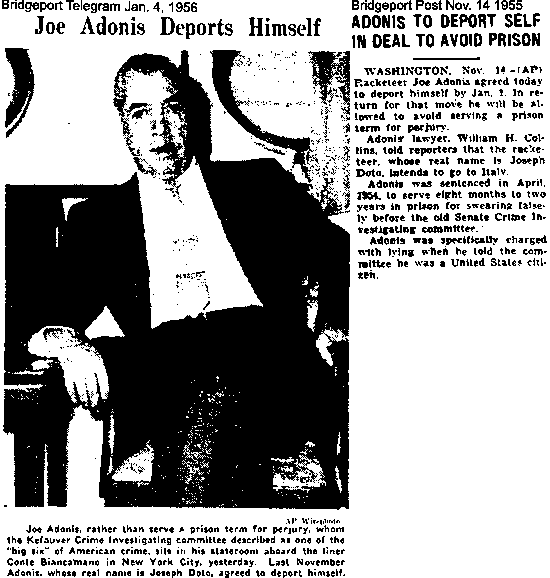
Adonis, who had long claimed to be an American native and who had settled in Fort Lee, NJ, in the mid-1940s (his Dearborn Road home was about a quarter mile from the Bluff Road home of Albert Anastasia), was shown to be an immigrant in the 1950s. Birth records indicating a 1901 birth in Passaic, New Jersey, were found to be fraudulent. Italian birth certificates, immigration records and early statements made by Adonis and his family members to authorities conflicted with statements Adonis made under oath before a New Jersey grand jury. Adonis was ordered to be deported in 1953. He fought that order in the courts. A voluntary deportation to Italy occurred in 1956 in the wake of a perjury charge stemming from the Kefauver Committee hearings.

One of the legendary fallings out between the American Mafiosi and the Kennedy Administration was allegedly over arrangements for the Mafia to support Kennedy's candidacy for President in return for Kennedy allowing Adonis back into the country. According to this tale, President John Kennedy was reportedly willing to welcome Adonis home, but Attorney General Robert Kennedy blocked the move.

The Italian government decided to inflict an exile within an exile upon Adonis on June 20, 1971. A Milan court demanded that he be restricted to the town of Ancona on Italy's Adriatic coast. Adonis died there of natural causes on Nov. 26, 1971. His remains were returned to the United States and buried Dec. 6 in Madonna Roman Catholic Cemetery in Fort Lee, NJ.


The Adonis funeral was relatively low-key. A cortege of fifteen automobiles, led by three cars of flowers, drove from Macagna's Funeral Home in Cliffside Park, New Jersey, to the funeral Mass at Epiphany Church. A private service was then held for Adonis's family - his wife, son and three daughters - and close friends at the chapel in Madonna Cemetery. The family and most attendees left before Adonis's casket was lowered into his grave. A number of reporters and photographers kept close watch on the event. There were no reports of known underworld figures in attendance.


Related Links:

Sources:

  • "Joe Adonis one of 8 cited in Dewey reply," Brooklyn Daily Eagle, Dec. 3, 1937, p. 1.
  • Investigation of Organized Crime in Interstate Commerce, Part 7, New York - New Jersey, Hearings before the Special Committee to Investigate Organized Crime in Interstate Commerce, U.S. Senate, 81st Congress 2nd Session, 82nd Congress 1st Session, Washington D.C.: U.S. Government Printing Office, 1951, p. 280-301.
  • Joseph Doto, Index of Births in New Jersey, 1901, A-H, certificate 37513.
  • Mary Doto, New York City Index to Death Certificates, certificate no. 15279, July 21, 1934.
  • Michael Doto, New York City Index to Death Certificates, certificate no. 9874, April 27, 1939.
  • Murray, Leo, "Offer birth certificates from Italy in Adonis case," Paterson NJ Morning Call, Jan. 15, 1954, p. 1.
  • New York State Census of 1915, Kings County, Brooklyn, Ward 10, Election District 11.
  • New York State Census of 1925, Kings County, Brooklyn, Assembly District 8, Election District 15. 
  • Passenger manifest of S.S. Citta di Milano, departed Naples on April 23, 1904, arrived New York on May 9, 1904.
  • Passenger manifest of S.S. Montserrat, departed Naples on June 23, 1909, arrived New York on July 11, 1909.
  • Plosia, Les, "Few turn out for Adonis burial," Passaic NJ Herald-News, Dec. 7, 1971, p. 12.
  • United States Census of 1920, New York State, Kings County, Brooklyn, Ward 14, Enumeration District 446.
  • United States Census of 1930, New York, Kings County, Brooklyn, Ward 10, Assembly District 8, Enumeration District 24-1079.
  • United States Census of 1940, New York, Kings County, Brooklyn, Assembly District 9, Enumeration District 24-1087.