Lombardo, Antonino (1891-1928)

Born Galati, Sicily, Nov. 23, 1891.

Killed Chicago, IL, Sept. 7, 1928.

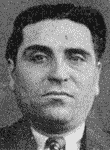
Antonino Lombardo

Lombardo, a trusted Capone adviser and perhaps his organization's consigliere, was one of the tools used by Capone in his effort to penetrate Chicago's Unione Siciliana.

In the chaos following Unione leader Mike Merlo's death in November 1924, Samuel Amatuna briefly held the presidency of the Sicilian underworld network in the Chicago area. Amatuna got in the way of some bullets five days after the first anniversary of Merlo's death, and the Unione leadership was once again vacant.

According to legend, Capone, who had taken over Johnny Torrio's operations in January of that year, used his influence to shove Lombardo into the president's chair. Reportedly many objected to the move but were too fearful of Capone's wrath to oppose it. The legend is probably inaccurate. Capone's authority within Chicago's Sicilian-Italian underworld was limited in 1925. However, it could be the case that Lombardo - a respected figure in the immigrant Sicilian community - took Capone under his wing.

Antonio Lombardo was born to Salvatore and Rosaria Lombardo on Nov. 23, 1891. Little is known for certain of his early life. It appears he entered the United States early in 1909. By the Prohibition Era, he was living in Cicero, Illinois, and running a successful wholesale grocery in Chicago.

Legend says that, by 1926, Lombardo was preparing the way for a direct takeover of the Chicago-area Unione Siciliana fraternal organization by Capone. Lombardo supposedly opened the membership of the group to non-Sicilian Italians, allowing the Neapolitan Capone to become a member. As a sign of the policy change, the organization changed its name to the Italo-American National Union. While the name change portion of this legend is accurate, the Unione fraternal organization had actually been open to non-Sicilian Italians for some time but remained closed to any who had criminal records. So, either the legend of Capone's takeover is incorrect or the name Unione Siciliana was applied at the time to more than the fraternal organization. If Unione Siciliana was a term used to refer to an underworld network in the Chicago area, it would explain Capone's long struggle to earn its recognition.

By 1927, Capone's meddling in the Unione and his aggressiveness in the Chicago rackets had forced the Aiello Brothers into an alliance with the North Side Gang against Capone. In January 1928, there were demands that Lombardo surrender the local Unione presidency to Joe Aiello. That did not happen.

The Sicilian underworld in Chicago took aim at Lombardo and blew him away in early September. He was shot in the head in front of 61 East Madison Street on Sept. 7, 1928. Lombardo's funeral was elaborate, in the gangland tradition. Mourners lined the streets, and floral decorations filled his home and spilled out onto the lawn. An enormous floral heart containing the words, "My Pal," was provided by Capone. Lombardo was buried in Mount Carmel Cemetery on Sept. 11.

After Lombardo, there followed a succession of short-lived presidents of the Chicago Unione, and the Unione itself began to diminish in importance as the Chicago Sicilian-Italian criminal societies consolidated.

Lombardo death certificate


Lolordo, Pasqualino (1885-1929)

Born Ribera, Sicily, June 28, 1887.

Died Chicago, IL, Jan. 8, 1929.


Lolordo was one of the unfortunate leaders of the Chicago Unione Siciliana of the late Prohibition Era. He stepped to the Unione presidency upon the death of Antonio Lombardo in September of 1928.

Lolordo's place of birth appears to have been Ribera, Sicily. The date of his birth was June 28, though the year is recorded differently in public records. A 1917 World War I draft registration shows his birth year as 1887. Lolordo's Cook County, Illinois, death certificate states that he was born in 1885. The later year seems the more reliable of the two. Lolordo entered the U.S. about 1907 and initially settled in New York City. He married Lena Mule. After serving time in a New York prison before Prohibition, he migrated westward to Chicago, where he became a successful merchant.

Police initially suspected Pasqualino's brother Joseph Lolordo - a Lombardo bodyguard - of performing the 1928 assassination of Lombardo. Newspapers noted that Joseph Lolordo and Al Capone had the same attorney at that time.

Pasqualino Lolordo's dreams of becoming a second Mike Merlo - and, in fact, his dreams of anything at all - stopped abruptly on Jan. 8, 1929. On that day, he was assassinated by visitors to his home. It is believed that the killing was ordered by the Aiello Mafia clan.

After Pasqualino's death, his wife Lena returned to New York City and lived with in-laws there.

Joseph "Hop Toad" Giunta, who had begun a Sicilian revolt within the Capone organization, bravely took over the Unione presidency. But he wouldn't survive to see the summer.


Licata, Nicola "Nick" (1897-1974)

Born Camporeale, Sicily, Feb. 20, 1897.

Died Santa Monica, CA, Oct, 19, 1974.


Nick Licata is remembered as the boss who presided over the dramatic decline of the Los Angeles crime family.

Licata was born in Camporeale, in the Sicilian province of Palermo. He entered the U.S. through New York on Dec. 7, 1913, settling first in Detroit. He later married there. He and his wife Josephine had two children in Highland Park, Michigan. He resettled in southern California in 1929.

First a grocer and then the owner of a Burbank cafe, Licata earned notice in the underworld through the summer 1951 murders of Kansas City Mafiosi Tony Brancato and Tony Trombino. Brancato and Trombino were moving into some of the Los Angeles rackets, apparently as part of a westward push by the Kansas City crime family. In mid-August, police rounded up Jimmy and Warren Fratianno, Sam London, and Sam Lazes, while they searched for missing Fratianno associates Charles Battaglia and Angelo Polizzi. Fratianno was considered the prime suspect in the killings, but Licata provided him with an alibi.

Licata became a front man for boss Jack Dragna during the later years of Dragna's reign. He served under Frank DeSimone for a decade after Dragna's death. After DeSimone passed in August 1967, Licata took control of a deeply divided crime family. Longtime California racketeer Joseph Dippolito served as underboss.


Law enforcement authorities had learned a great deal about the L.A. family by that time, and Licata was constantly hounded by police and federal agents. He was unable to consolidate his power. A branch of the criminal organization appears to have come under the control of Jack Dragna's son shortly after Licata ascended to the boss position.

Though he had earlier convinced Kansas City mafiosi to stay out of California, boss Licata also had to deal with incursions by the Cleveland mob family.

In July 1969, Licata was called before a grand jury to answer questions about the Jan. 10, 1969, slaying of Julius Anthony Petro of Cleveland. Known for committing bank robberies and suspected of murder in Cleveland, Petro was found shot to death in a parked car at the Los Angeles International Airport. Licata refused to testify and was ordered to prison for contempt of court. The following May, U.S. District Court Judge Jesse Curtis released Licata on $2,500 bail while he appealed the contempt order. Judge Curtis said he expected Licata would never answer questions on the Petro case.

With his family and his territory in disarray, Licata retained the title of boss - though probably not the power - until his death in fall of 1974. Licata died Oct. 19, 1974, at St. John's Hospital in Santa Monica.

A Requiem Mass was celebrated for Licata Oct. 23 at St. Peter's Roman Catholic Church in downtown Los Angeles. He was buried at Holy Cross Cemetery. About 150 people attended the services.

Related Links: