Showing posts with label Lupo. Show all posts

DelGaudio, Nicolo (?-1914)

Nicolo "Nick" DelGaudio and his brother Gaetano DelGaudio were influential members of the Manhattan Camorra during the 1910s. They apparently worked closely with Giosue Gallucci, the politically connected East Harlem crime boss, and with the remnants of the Morello-Lupo Mafia (Giuseppe Morello and Ignazio Lupo were locked up in Atlanta Federal Prison during the decade). About 1913, the old alliances broke down.

Nicolo resided at 2029 First Avenue in East Harlem. He owned a restaurant nearby at 2023 First Avenue. Authorities believed his restaurant was merely a front for illegal activities. In February 1913, he was suspected of involvement in an unsuccessful attempt on Gallucci's life that resulted in the death of Gallucci bodyguard Tony Capilongo. That spring, Nicolo left the country for a long trip to Italy. He returned in the fall of 1914.

On October 14, 1914, DelGaudio and his friend Tancredi Dellabado met at First Avenue and walked toward a garage where DelGaudio kept his automobile. As they passed a stable at 421 East 104th Street, a gunshot was heard. DelGaudio fell mortally wounded, and Dellabado ran off. Police later found a shotgun inside an upstairs front window over the stable. Along with it was a hat they traced to Francisco Ruggiero of 403 East 106th Street. Ruggiero was arrested.

Gaetano DelGaudio managed to remain alive for another two years. In the early morning hours of November 30, 1916, he was shot while working in his restaurant, 2031 First Avenue. He died a short time later in a hospital, after refusing to name his murderer.

Catania, Joseph "Grocer" (c1862-1902)

Born Sicily, c1862.

Killed Brooklyn, NY, July 22, 1902.


"Joe the Grocer" Catania of Brooklyn is remembered inaccurately as the father of younger Mafioso "Joe Baker." No documentary evidence proves the two Catanias were at all related.

"Joe the Grocer" Catania, a green grocer by day, was among the earlier Brooklyn members of the Lupo-Morello Mafia. Catania was involved in the Mafia's counterfeiting operations.

The popularly accepted story of his demise: Catania, 40, became drunk one night and began talking too much about the counterfeiting racket. He was eliminated as a Mafia disciplinary measure. Largely unaware of his link to Lupo's gang, police decided that Catania's murder was the result of an old-country feud, ended by imported killers.

Oft-repeated and erroneous legend says his corpse was discovered packed with sawdust inside a barrel at 73rd Street at the bay on July 23, 1902. That legend is the result of the confused memories of some 1900s New York journalists and the mixing of the Catania story with that of Benedetto Madonia (who was found in a barrel). A muddled 1909 news report actually referred to a murder victim named "Benedetto Catania."

News accounts of the discovery of Catania's body by four boys heading to the bay for an early evening swim do not mention a barrel. According to New York Times, New York Tribune, New York Evening World and Brooklyn Eagle articles, Catania was discovered within a potato sack lined with floor mats sewn into the shape of a large bag. His throat had been cut. His right thumb and forefinger were missing, authorities said, apparently the result of an earlier accident.

Police arrested Sicilian immigrant Vincenzo Troia for the killing of Catania, since the two men recently had quarreled over a debt. But Troia was let go when the old-country feud theory emerged.

Cascioferro, Vito (1862-1943)

Born Bisacquino, Sicily, 1862.

Died Pozzuoli, Italy, c1943.


Cascio Ferro was an influential Mafia leader on both sides of the Atlantic. It appears that much of the growth and cooperation of the early American Mafia was due to his conscious effort. A political radical, as a young man he embraced leftist causes, including the rise of labor and the anarchist philosophy.

Cascio Ferro was raised in the interior of western Sicily and became well known in the communities of Bisacquino, in Palermo province, and Burgio and Bivona, in Agrigento province (all south of Corleone). He spent several years in New York and New Orleans before returning home. His influence over Mafiosi in the New World added to his underworld prestige in Sicily. He kept in close touch with Mafiosi in both American cities through the 1900s and apparently worked with the transplanted criminals on a counterfeiting racket.

His 1901 voyage to New York was reportedly triggered by increased attention to his activities by the Italian police. When in New York, he reportedly stayed with members of the Morello-Lupo Mob. The group's leader, Giuseppe Morello, had been a top lieutenant in the Mafia of Corleone, Sicily, before fleeing to the U.S. in the early 1890s to escape prosecution for murders and forgery. During Cascio Ferro's visits, he is credited with helping American mobsters refine their practices for extorting protection money from businesses. According to legend, Cascio Ferro showed the gangs they could maximize profits by extorting sums that were not financially damaging to the businesses - a practice called "wetting the beak."

He is believed to have visited Sophia Knieland Bresci at her New Jersey home. She was the widow of Gaetano Bresci, the anarchist assassin who took the life of Italy's King Umberto I before apparently committing suicide in an Italian prison.

On May 21, 1902, Cascio Ferro was arrested along with several other members of a coin counterfeiting gang, in which Salvatore and Stella Frauto were prominent members. The other suspects were convicted and sent to prison, but Cascio Ferro escaped prosecution. Police considered him a suspect in the New York City "Barrel Murder" of Benedetto Madonia in 1903, but Cascio Ferro avoided arrest in that matter by traveling to New Orleans. By 1904, he had returned to Sicily.

He is thought to have organized and participated in the assassination of Lieutenant Joseph Petrosino of the New York Police during Petrosino's official visit to Sicily in 1909. Legend says Cascio Ferro excused himself from a dinner party at the home of a Sicilian government official, borrowed his host's vehicle and went to deliver the coup de grace shot to the head of Petrosino. Then, he returned to complete his friendly visit with the official. Though arrested in connection with the slaying of Petrosino, Cascio Ferro's distant alibi prevented authorities from prosecuting him.

Police arrested Cascio Ferro during a round up of underworld characters during the First World War, but again they could not make charges stick. The underworld leader continued to grow in strength and influence. He is said to have assembled a fleet of merchant vessels that were employed in the transport of stolen cattle from Sicily to the coast of North Africa and to have corrupted politicians and police officials to provide a protective screen for his various criminal endeavors.

The authorities believed early in 1925 that Cascio Ferro was responsible for ordering the murders of two uncooperative extortion targets, Francesco Falconieri and Gioacchino Lo Voi. The 63-year-old Cascio Ferro was charged with ordering the murders, and 40-year-old Vito Campegna of Prizzi was charged with carrying out the orders. Cascio Ferro managed to arrange a release on bail, and the murder charges were briefly forgotten.

With Benito Mussolini's Fascists taking power in Italy, Cascio Ferro faced his most determined and ruthless enemy. The Mussolini government late in 1925 sent Cesari Mori to Sicily to serve as prefect of Palermo, a police position with extraordinary authority. Cascio Ferro was again arrested on the duel murder charges in the spring of 1926. He was held for several years before being brought to trial in 1930 - just as the Castellammarese War was breaking out in the U.S. Mafia. He was convicted in July and sentenced to spend nine years in prison solitary confinement. The Fascist government may have wanted him behind bars as much for his leftist political leanings as for his prominence in the Mafia underworld, and appears to have had no plans ever to release him. His prison sentence took him first to Ucciardone and then to Portolongone before a transfer to Pozzuoli, where he would spend the rest of his life.

The date of his death is generally given as 1945, but author Arrigo Petacco ("Joe Petrosino," 1974) found evidence of Cascio Ferro's demise in summer of 1943. Petacco said the Mafia leader was left behind in his cell when other inmates of Pozzuoli prison were evacuated in advance of the Allied invasion. The author says Cascio Ferro died of thirst. Other sources claim he was killed as a result of Allied bombing.


Related Links:

Petrosino, Joseph (1860-1909) - New York PD

Born Padula, Italy, Aug. 30, 1860.

Killed Palermo, Sicily, March 12, 1909.


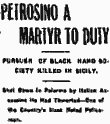
Lieutenant Joseph Petrosino achieved great success in the fight against Italian and Sicilian organized criminal groups in the United States. When he attempted to take the fight to the Mafia's home island, he was assassinated.

On a visit to Palermo in western Sicily, officially to gather information on the identities of Mafiosi who might have fled to the U.S., Petrosino was shot through the body, in the throat and in the head while he stood beside a garden in the Piazza Marina on March 12, 1909. He was 48.

His visit to Sicily was supposed to have been a secret. But many sources agree that Police Commissioner Bingham released fairly specific information about the trip through the New York Herald and other newspapers before Petrosino landed in Europe. Mafiosi in the U.S. were able to mobilize their Old World fellows to act against the lieutenant.

Many believe Vito Cascio Ferro, a Mafia leader on both sides of the Atlantic, organized and/or participated in the assassination. (An often retold and probably untrue story has Cascio Ferro excusing himself from a dinner party thrown by a local government official to do the deed. Cascio Ferro promptly returned to dinner afterward.) It is also known that several mafiosi traveled to Sicily just before the attack on Petrosino.

Petrosino joined the New York City police department in 1883, despite failing to meet the department's height requirement. Capt. "Clubber" Williams was his mentor. He rose through the ranks, reaching the detective sergeant level in 1895 under then-police commissioner (and later U.S. President) Theodore Roosevelt.

Petrosino would be considered brutal by today's standards. He did not hesitate to use threats and force to extract information from street thugs. While his tactics would be frowned upon by many today, they were accepted at the time (forensic science was in its infancy) and highly effective. Petrosino was placed in charge of the Italian Squad, a group of Italian and Sicilian officers whose job was to check organized criminal activity in ethnic neighborhoods.
Petrosino's greatest successes came against transplanted Neapolitan criminals - those belonging to the Camorra. He was less fortunate in dealing with the Sicilian Mafiosi, but may have been on the verge of acquiring some very effective tools in the form of documentary evidence from Italian police agencies.

Among Petrosino's more noteworthy adventures were: saving Angelo Carbone from execution by extracting a murder confession from another man; deporting Camorra leaders Tony Strolle and Enrico Alfano; and identifying both the victim and the perpetrators of the infamous barrel murder in 1903 (though the ring leaders, including Ignazio Lupo, Vito Cascio Ferro and Giuseppe Morello, managed to escape prosecution).

Many of Petrosino's cases were chronicled in a 1914 series of newspaper articles by A.R. Parkhurst under the title, "Perils of Petrosino." His career was also the subject of a number of pulp fiction volumes in the U.S. and Italy.

Related links:

D'Aquila, Salvatore "Toto" (1873-1928)

Born Palermo, Sicily, 1873

Killed New York, NY, Oct. 10, 1928.

Palermo-born D'Aquila ran a cheese importing business in New York when he wasn't occupied with the day-to-day business of one of the more successful Mafia organizations.

D'Aquila began his underworld career as a Bronx-based underling in the Mafia of American boss of bosses Giuseppe Morello. His personal criminal pursuits are not well known. He was arrested in 1906 as a confidence man and arrested again in 1909 on unknown charges. Both times, the charges were dropped.

D'Aquila moved to Brooklyn, where he likely became an important lieutenant under Morello brother-in-law Ignazio Lupo. When Morello and Lupo were jailed for counterfeiting in 1910, D'Aquila was selected as leader of the Lupo operation and as boss of bosses of the American Mafia.

D'Aquila meddled extensively in the business of other American crime families. He is believed to have inserted his own loyal followers as spies into other families.

Despite D'Aquila's vast strength, he did not succeed in uniting all of New York City's Mafiosi. He attempted to put down an insurrection in East Harlem through the assassinations of the Lomonte brothers. Italian colonies on Manhattan's Lower East Side also eluded his grasp.

The questionable loyalty of his underworld subjects in Manhattan apparently nagged at D'Aquila. When Morello and Lupo were released from federal prison around 1920, D'Aquila passed death sentences against his former superiors and ten of their closest allies in order to eliminate the potential rivals. One of those condemned by D'Aquila was his loyal henchman Umberto Valenti, then powerful enough to concern the boss of bosses.

Valenti reached an accord with D'Aquila by promising to eliminate Manhattan Mafia upstart Giuseppe Masseria, who had become the Morello faction's standard-bearer. Through guile and luck, Masseria survived Valenti attempts on his life and managed to kill D'Aquila's gunman in 1922.

The events of the early 1920s cost D'Aquila a key ally. Saverio "Sam" Pollaccia, a close friend of D'Aquila's who followed him from the Bronx to Brooklyn, abandoned D'Aquila and became a personal adviser to Masseria.

The boss of bosses' authority waned, particularly in New York, through the next few years. D'Aquila retreated back into the South Bronx about 1925-1926, moving into a home across the street from the entrance to the Bronx Zoo. D'Aquila was cornered and killed during a visit to a Manhattan doctor in 1928. Giuseppe Masseria became the new boss of bosses and retained Giuseppe Morello as his chief strategist.

While a number of D'Aquila loyalists sided with Brooklyn Castellammarese leader Salvatore Maranzano in the Castellammarese War of 1930-31, the old Brooklyn-Bronx D'Aquila unit was officially taken over by Masseria supporter Al Mineo and his right-hand man Steve Ferrigno.

After the deaths of Mineo and Ferrigno, the unit was run by Frank Scalise during the later Castellammarese War and was then turned over to Vincent Mangano in the 1931 underworld reorganization. It survives to this day as the Gambino Family.

Related Links: