Showing posts with label Unione Siciliana. Show all posts

Lombardo, Antonino (1891-1928)

Born Galati, Sicily, Nov. 23, 1891.

Killed Chicago, IL, Sept. 7, 1928.

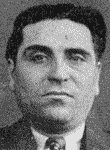
Antonino Lombardo

Lombardo, a trusted Capone adviser and perhaps his organization's consigliere, was one of the tools used by Capone in his effort to penetrate Chicago's Unione Siciliana.

In the chaos following Unione leader Mike Merlo's death in November 1924, Samuel Amatuna briefly held the presidency of the Sicilian underworld network in the Chicago area. Amatuna got in the way of some bullets five days after the first anniversary of Merlo's death, and the Unione leadership was once again vacant.

According to legend, Capone, who had taken over Johnny Torrio's operations in January of that year, used his influence to shove Lombardo into the president's chair. Reportedly many objected to the move but were too fearful of Capone's wrath to oppose it. The legend is probably inaccurate. Capone's authority within Chicago's Sicilian-Italian underworld was limited in 1925. However, it could be the case that Lombardo - a respected figure in the immigrant Sicilian community - took Capone under his wing.

Antonio Lombardo was born to Salvatore and Rosaria Lombardo on Nov. 23, 1891. Little is known for certain of his early life. It appears he entered the United States early in 1909. By the Prohibition Era, he was living in Cicero, Illinois, and running a successful wholesale grocery in Chicago.

Legend says that, by 1926, Lombardo was preparing the way for a direct takeover of the Chicago-area Unione Siciliana fraternal organization by Capone. Lombardo supposedly opened the membership of the group to non-Sicilian Italians, allowing the Neapolitan Capone to become a member. As a sign of the policy change, the organization changed its name to the Italo-American National Union. While the name change portion of this legend is accurate, the Unione fraternal organization had actually been open to non-Sicilian Italians for some time but remained closed to any who had criminal records. So, either the legend of Capone's takeover is incorrect or the name Unione Siciliana was applied at the time to more than the fraternal organization. If Unione Siciliana was a term used to refer to an underworld network in the Chicago area, it would explain Capone's long struggle to earn its recognition.

By 1927, Capone's meddling in the Unione and his aggressiveness in the Chicago rackets had forced the Aiello Brothers into an alliance with the North Side Gang against Capone. In January 1928, there were demands that Lombardo surrender the local Unione presidency to Joe Aiello. That did not happen.

The Sicilian underworld in Chicago took aim at Lombardo and blew him away in early September. He was shot in the head in front of 61 East Madison Street on Sept. 7, 1928. Lombardo's funeral was elaborate, in the gangland tradition. Mourners lined the streets, and floral decorations filled his home and spilled out onto the lawn. An enormous floral heart containing the words, "My Pal," was provided by Capone. Lombardo was buried in Mount Carmel Cemetery on Sept. 11.

After Lombardo, there followed a succession of short-lived presidents of the Chicago Unione, and the Unione itself began to diminish in importance as the Chicago Sicilian-Italian criminal societies consolidated.

Lombardo death certificate


Lolordo, Pasqualino (1885-1929)

Born Ribera, Sicily, June 28, 1887.

Died Chicago, IL, Jan. 8, 1929.


Lolordo was one of the unfortunate leaders of the Chicago Unione Siciliana of the late Prohibition Era. He stepped to the Unione presidency upon the death of Antonio Lombardo in September of 1928.

Lolordo's place of birth appears to have been Ribera, Sicily. The date of his birth was June 28, though the year is recorded differently in public records. A 1917 World War I draft registration shows his birth year as 1887. Lolordo's Cook County, Illinois, death certificate states that he was born in 1885. The later year seems the more reliable of the two. Lolordo entered the U.S. about 1907 and initially settled in New York City. He married Lena Mule. After serving time in a New York prison before Prohibition, he migrated westward to Chicago, where he became a successful merchant.

Police initially suspected Pasqualino's brother Joseph Lolordo - a Lombardo bodyguard - of performing the 1928 assassination of Lombardo. Newspapers noted that Joseph Lolordo and Al Capone had the same attorney at that time.

Pasqualino Lolordo's dreams of becoming a second Mike Merlo - and, in fact, his dreams of anything at all - stopped abruptly on Jan. 8, 1929. On that day, he was assassinated by visitors to his home. It is believed that the killing was ordered by the Aiello Mafia clan.

After Pasqualino's death, his wife Lena returned to New York City and lived with in-laws there.

Joseph "Hop Toad" Giunta, who had begun a Sicilian revolt within the Capone organization, bravely took over the Unione presidency. But he wouldn't survive to see the summer.


Guinta, Giuseppe (1887-1929)

Born 1887

Killed Cicero, IL, May 7, 1929.


"Hoptoad" Guinta briefly led the Chicago Unione Siciliana in 1929 and tried unsuccessfully to organize a revolt among Sicilians affiliated with Al Capone's Chicago gang.

Joe Guinta, resident of 1756 North Lockwood Avenue (he also used the home address of 1715 Adams Street), moved upward within the Unione Siciliana of Chicago as Unione bosses died or fell victim to assassination. Late in 1927, Guinta was arrested along with Unione boss Antonio Lombardo and Michael Butero. The men were all found to be carrying concealed weapons. Early the next year, the three were discharged, as Judge Joseph L. McCarthy determined that police were not justified in searching the men for weapons.

Lombardo took a conciliatory posture toward non-Sicilian gang boss Capone, and that likely cost him his life. He was shot to death in September 1928. Patsy Lolordo, brother of Lombardo's ineffective bodyguard, was Unione president briefly. Guinta took over the Unione presidency upon the murder of Pasqualino Lolordo, apparently by anti-Capone crime figures, in January 1929.

Unlike his predecessors, Guinta resisted Capone's attempts to dominate the Unione. Guinta drew John Scalisi and Albert Anselmi, believed at the time to be Capone enforcers, into a plot to eliminate their boss.

Capone learned of the conspiracy against him. According to legend, he invited the unsuspecting Guinta, Scalisi and Anselmi to a May 7, 1929, celebration at the Hawthorne Inn in Cicero. At the dinner, he had the three men suddenly bound and proceeded to beat them to death with a baseball bat. A few bullets were thrown in for good measure.

The three victims were discovered at Douglas Park in Hammond, Indiana. Scalisi's body had been tossed into a ditch. Guinta's and Anselmi's bodies were found in the rear of an abandoned automobile.

So ended Guinta's career and the Chicago rebellion. Guinta was buried in a $10,000 glass-covered bronze casket. The remains of Anselmi and Scalisi were shipped back to Sicily for burial.

The beating deaths of the three Mafiosi caused a great deal of concern among Capone's New York-area colleagues (many of whom were proudly Sicilian and strongly objected to Neapolitan Capone's abuses of their countrymen). Capone was called to a mid-May peace conference in Atlantic City, New Jersey.

Guinta was replaced as Unione boss by Capone's greatest Sicilian rival Joe Aiello.

Amatuna, Samuzzo (c1899-1925)

Born Sicily, c.1899.
Killed Chicago, Nov. 13, 1925.

Known as "Samoots" and "Sam," Amatuna reportedly briefly served as president of the Chicago Unione Siciliana organization. At the time - 1925 - Sicilian Mafiosi in Chicago were working to keep Alphonse Capone from gaining control of the local underworld.

Amatuna and several other key men of the Genna Mafia in Chicago apparently broke away and formed their own criminal organization. The organization possibly included Orazio Tropea, Albert Anselmi and John Scalisi.

Amatuna stepped into the Unione presidency after the murder of Angelo Genna on May 25, 1925.

Amatuna was shot and mortally wounded Nov. 10, 1925, in a barbershop near the intersection of West Roosevelt Road and Halsted Street. A few days later, as he attempted to marry his fiancee - Mike Merlo's sister-in-law Rosa Pecoraro - Amatuna lost consciousness and soon died.

Capone ally Antonio Lombardo became the next president of the influential Unione Siciliana.

Aiello, Joseph (1890-1930)

Born Bagheria, Sicily, Sept. 27, 1890.

Killed Chicago, IL, Oct. 23, 1930.

Aiello was the boss of the Sicilian Mafia in Prohibition-Era Chicago. While Alphonse Capone is widely regarded as Chicago's "Mafia" leader, Capone was not Sicilian and his involvement in Windy City organized crime was resisted by conservative Sicilian Mafiosi. As the recognized leader of the post-Genna Sicilian underworld in Chicago, Aiello controlled much of the criminal element in the city's Little Sicily, including its home liquor-making establishments, and was a thorn in Capone's side.

Aiello moved to Chicago after being involved for a time in the underworld of Utica, NY. He was a suspect in the 1917 shooting of East Utica resident Antonio Gagliano. In Chicago, he established a grocery business in partnership with Antonio Lombardo. Both men eventually served as leaders in the Chicago-based Unione Siciliana organization. Aiello was suspected of involvement in the January 1929 murder of Capone-backed Unione Siciliana leader Pasqualino Lolordo.

In the late 1920s, Aiello allied with Bugs Moran's North Side mob in Chicago in an attempt to destroy Capone. Giuseppe Masseria of New York, the U.S. Mafia "boss of bosses" of the period, attempted to mediate the growing conflict between Aiello and Capone around 1929 but only succeeded in offending Aiello (as well as his allies in Detroit, Buffalo and Brooklyn).

During the early Castellammarese War, Aiello supported Castellammarese forces against Masseria and spent some time hiding from his rivals in Buffalo. Aiello would have been on the winning side in the Castellamarese conflict, but he was killed by Capone's men on Oct. 23, 1930, near the corner of Kolmar and West End Avenues. He was hit by dozens of bullets fired from several locations as he tried to reach a waiting taxicab.

Joe Aiello had several brothers who also participated in bootlegging and other Mafia endeavors. The Aiellos were the heirs to the Genna organization of the early 1920s.

See also:

ELECTRONIC ARTS, INC. (Origin Store)