Born Ribera, Sicily, June 28, 1887.
Died Chicago, IL, Jan. 8, 1929.
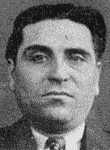
Lolordo was one of the unfortunate leaders of the Chicago Unione Siciliana of the late Prohibition Era. He stepped to the Unione presidency upon the death of Antonio Lombardo in September of 1928.
Lolordo's place of birth appears to have been Ribera, Sicily. The date of his birth was June 28, though the year is recorded differently in public records. A 1917 World War I draft registration shows his birth year as 1887. Lolordo's Cook County, Illinois, death certificate states that he was born in 1885. The later year seems the more reliable of the two. Lolordo entered the U.S. about 1907 and initially settled in New York City. He married Lena Mule. After serving time in a New York prison before Prohibition, he migrated westward to Chicago, where he became a successful merchant.
Police initially suspected Pasqualino's brother Joseph Lolordo - a Lombardo bodyguard - of performing the 1928 assassination of Lombardo. Newspapers noted that Joseph Lolordo and Al Capone had the same attorney at that time.
Pasqualino Lolordo's dreams of becoming a second Mike Merlo - and, in fact, his dreams of anything at all - stopped abruptly on Jan. 8, 1929. On that day, he was assassinated by visitors to his home. It is believed that the killing was ordered by the Aiello Mafia clan.
After Pasqualino's death, his wife Lena returned to New York City and lived with in-laws there.
Joseph "Hop Toad" Giunta, who had begun a Sicilian revolt within the Capone organization, bravely took over the Unione presidency. But he wouldn't survive to see the summer.
Showing posts with label Lolordo. Show all posts
Guinta, Giuseppe (1887-1929)
Born 1887
Killed Cicero, IL, May 7, 1929.
"Hoptoad" Guinta briefly led the Chicago Unione Siciliana in 1929 and tried unsuccessfully to organize a revolt among Sicilians affiliated with Al Capone's Chicago gang.
Joe Guinta, resident of 1756 North Lockwood Avenue (he also used the home address of 1715 Adams Street), moved upward within the Unione Siciliana of Chicago as Unione bosses died or fell victim to assassination. Late in 1927, Guinta was arrested along with Unione boss Antonio Lombardo and Michael Butero. The men were all found to be carrying concealed weapons. Early the next year, the three were discharged, as Judge Joseph L. McCarthy determined that police were not justified in searching the men for weapons.
Lombardo took a conciliatory posture toward non-Sicilian gang boss Capone, and that likely cost him his life. He was shot to death in September 1928. Patsy Lolordo, brother of Lombardo's ineffective bodyguard, was Unione president briefly. Guinta took over the Unione presidency upon the murder of Pasqualino Lolordo, apparently by anti-Capone crime figures, in January 1929.
Unlike his predecessors, Guinta resisted Capone's attempts to dominate the Unione. Guinta drew John Scalisi and Albert Anselmi, believed at the time to be Capone enforcers, into a plot to eliminate their boss.
Capone learned of the conspiracy against him. According to legend, he invited the unsuspecting Guinta, Scalisi and Anselmi to a May 7, 1929, celebration at the Hawthorne Inn in Cicero. At the dinner, he had the three men suddenly bound and proceeded to beat them to death with a baseball bat. A few bullets were thrown in for good measure.
The three victims were discovered at Douglas Park in Hammond, Indiana. Scalisi's body had been tossed into a ditch. Guinta's and Anselmi's bodies were found in the rear of an abandoned automobile.
So ended Guinta's career and the Chicago rebellion. Guinta was buried in a $10,000 glass-covered bronze casket. The remains of Anselmi and Scalisi were shipped back to Sicily for burial.
The beating deaths of the three Mafiosi caused a great deal of concern among Capone's New York-area colleagues (many of whom were proudly Sicilian and strongly objected to Neapolitan Capone's abuses of their countrymen). Capone was called to a mid-May peace conference in Atlantic City, New Jersey.
Guinta was replaced as Unione boss by Capone's greatest Sicilian rival Joe Aiello.
Killed Cicero, IL, May 7, 1929.
"Hoptoad" Guinta briefly led the Chicago Unione Siciliana in 1929 and tried unsuccessfully to organize a revolt among Sicilians affiliated with Al Capone's Chicago gang.
Joe Guinta, resident of 1756 North Lockwood Avenue (he also used the home address of 1715 Adams Street), moved upward within the Unione Siciliana of Chicago as Unione bosses died or fell victim to assassination. Late in 1927, Guinta was arrested along with Unione boss Antonio Lombardo and Michael Butero. The men were all found to be carrying concealed weapons. Early the next year, the three were discharged, as Judge Joseph L. McCarthy determined that police were not justified in searching the men for weapons.
Lombardo took a conciliatory posture toward non-Sicilian gang boss Capone, and that likely cost him his life. He was shot to death in September 1928. Patsy Lolordo, brother of Lombardo's ineffective bodyguard, was Unione president briefly. Guinta took over the Unione presidency upon the murder of Pasqualino Lolordo, apparently by anti-Capone crime figures, in January 1929.
Unlike his predecessors, Guinta resisted Capone's attempts to dominate the Unione. Guinta drew John Scalisi and Albert Anselmi, believed at the time to be Capone enforcers, into a plot to eliminate their boss.
Capone learned of the conspiracy against him. According to legend, he invited the unsuspecting Guinta, Scalisi and Anselmi to a May 7, 1929, celebration at the Hawthorne Inn in Cicero. At the dinner, he had the three men suddenly bound and proceeded to beat them to death with a baseball bat. A few bullets were thrown in for good measure.
The three victims were discovered at Douglas Park in Hammond, Indiana. Scalisi's body had been tossed into a ditch. Guinta's and Anselmi's bodies were found in the rear of an abandoned automobile.
So ended Guinta's career and the Chicago rebellion. Guinta was buried in a $10,000 glass-covered bronze casket. The remains of Anselmi and Scalisi were shipped back to Sicily for burial.
The beating deaths of the three Mafiosi caused a great deal of concern among Capone's New York-area colleagues (many of whom were proudly Sicilian and strongly objected to Neapolitan Capone's abuses of their countrymen). Capone was called to a mid-May peace conference in Atlantic City, New Jersey.
Guinta was replaced as Unione boss by Capone's greatest Sicilian rival Joe Aiello.
Subscribe to:
Posts (Atom)

